 Two Songs, Op.91, by Johannes Brahms
Transcribed for Clarinet by John W. Pratt (part originally for viola)
Clarinet Part, PDF $6.99
The two chamber music songs of Brahms' Zwei Gesänge, Op.91 were composed specifically for his dear friends, the violinist/violist Joseph Joachim and the mezzo-soprano Amalie Schneeweiss, who were married in 1863. The songs (for alto, viola, and piano) were written over 20 years apart, but Brahms published them together as Op.91 in 1884.
"Gestillte Sehnsucht", which appears first in the Op.91 pairing, was actually written second, in 1884. The song sets the text of the poem by Friedrich Rückert (1788-1866). "Gestillte Sehnsucht" is a nature poem, filled with images of forests at sunset, gentle breezes, and twittering birds. Rückert is famous not only for his exquisite poems themselves but also for the great inspiration his work provided to numerous prominent composers, in addition to Brahms. "Geistliches Wiegenlied" (Sacred Cradle Song) was first composed in 1863-1864, and later revised. The viola opens with the melody of the medieval Christmas carol "Joseph, lieber Joseph mein." The singer has her own variation of the melody, and enters after the first stanza of the viola's carol. The song is a beautiful cradle-rocking lullaby, in 6/8 time.
It is said that the viola was Brahms' favorite stringed instrument, and the composer gave the viola a major role in both of these songs, allowing it to open both pieces before the singer enters. Clarinetists have long coveted these viola parts, and various performances have provided clear evidence that a successful outcome can be achieved with the substitution of a clarinet for the viola in Op.91. So when a clarinetist friend of ours asked us to create a transcription for him, we gladly obliged. Our edition of the clarinet part adapts the first song, "Gestillte Sehnsucht", for clarinet in A, and the second, "Geistliches Wiegenlied", for clarinet in Bb. The original piano score and voice part are in the public domain, readily available as free PDF downloads from IMSLP.org.
Clarinet part, 4 pages; Total, 8 pages.
Preview
 Concerto in E-flat Major, K.447, by W. A. Mozart
Transcribed for Alto Flute (from horn and piano arrangement) by C.A.Vater
Alto Flute Part, PDF $5.99
Wolfgang Amadeus Mozart (1756-1791) wrote four horn concertos for his good friend Joseph Leutgeb (1732-1811). Leutgeb was a virtuoso horn player, who served as principal horn in Salzburg and thus became a colleague of Leopold Mozart, during the young Wolfgang's early years. Leutgeb appears to have remained a friend and inspiration for W. A. Mozart throughout the composer's life.
The Mozart horn concertos are delightful, joyous works. The third horn concerto, K.447, like two of the three others, was written in the key of E-flat major. It is thought to have been composed in 1787. The work is in typical concerto form, consisting of three movements—an Allegro, a Romanze, and another Allegro, which together have an average performance duration time of approximately 15 minutes.
K.447, Concerto for Horn in E-flat major for Horn and Orchestra, is scored for solo horn in E-flat, with two clarinets, two bassoons, and strings. Henri Kling (1842-1918), a horn player who was also a composer, conductor, and professor, arranged the concerto for horn and piano. His transcription was published by Breitkopf und Härtel, n.d. (ca. 1890). We used the Kling edition, now in the public domain and available as a free pdf download from imslp.org, to create a transcription of the horn part for alto flute. Our edition incorporates adjustments that account for differences in range and sonority between the alto flute and horn, while striving to maintain the style and character of the original composition.
We provide the alto flute part only; the piano score (horn and piano) by Henri Kling is freely available from imslp.org.
Alto Flute part, 5 pages; Total, 8 pages.
Preview
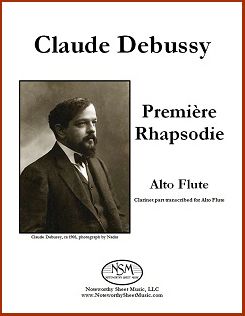 Première Rhapsodie, by Claude Debussy
Transcribed for Alto Flute by C.A.Vater, with a Foreword by P.H.Bloom
Alto Flute Part ― PDF $5.99
Since its introduction as a morceau de concours for the Paris Conservatoire in 1910, Debussy's Première Rhapsodie has been an essential piece of the clarinet repertoire.... Although most of the morceaux are, by definition, run-of-the mill exercises of virtuosity à la mode, a number have endured as works of significant musical merit. Debussy's Première Rhapsodie is one such piece. It's a vehicle for expressive interpretation and artistry, with charm, warmth, passion, and humor; a lasting treasure at the core of every clarinetist's collection of indispensable works.... But a transcription? Of a work by Debussy - the great colorist of instrumental sonority? From clarinet to alto-flute?... Each and every element, in fact, evokes the alto-flute!... Of course the piece sounds different on the two instruments. Although the sonic hues are different, the colors are just as vivid. The distinct sonorities of the alto-flute support the nuance, the affect, and the power of the work. (excerpted from Peter H. Bloom © 2012)
We provide our alto flute part only; appropriate parts for piano or orchestral accompaniment may be obtained as free pdf downloads from public domain resources, such as imslp.org.
Alto Flute part, 4 pages; Total, 10 pages.
Preview
 Sonata, Op.22, by Marion Bauer
Transcribed for Alto Flute by Peter H. Bloom (originally for viola)
Alto Flute Part, PDF $11.79
The following notes are excerpted, with permission, from the complete copyrighted foreword written by Peter H. Bloom for the Noteworthy Sheet Music edition of his transcription:
"The career of Marion Eugenie Bauer (1882-1955) as a composer, editor, writer, teacher, supportive colleague and mentor continues to assert a significant impact on the trajectory of American Music. It's mysterious that her legacy has been so rarely recalled and her music so infrequently performed in the six decades following her death. ... In 1906 she was the first of generations of American composers to study in Paris with the redoubtable Nadia Boulanger. ... We're fortunate that the composer crafted her own superb transcription of this sonata for clarinet and piano. In order to achieve the equivalent musical impact, her viola and clarinet versions differ in some places. The piano part, nevertheless, remains unchanged. Sometimes we've opted for the clarinet version, sometimes the viola version, and sometimes a conflation of the two. We have also made a few adaptive changes in tessitura, articulation, phrasing and dynamics to highlight the unique voice of the alto flute. Though execution may occasionally differ, the rhetorical and emotional shape of the work remains essentially the same."
P. H. Bloom, © January 7, 2014
We provide our alto flute transcription; the piano part is readily available as a free pdf download of the score from sources such as imslp.org/.
Alto Flute part, 9 pages of music; Total, 12 pages.
Preview
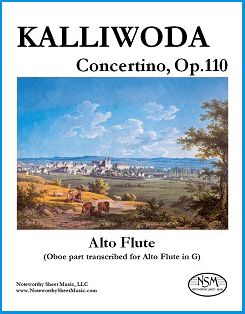 Concertino, Op.110, by J. W. Kalliwoda
Transcribed for Alto Flute by C.A.Vater
Alto Flute Part ― PDF $6.99
Johann Wenzel Kalliwoda (1801‒1866) was a Bohemian violinist, orchestra conductor, and prolific composer who wrote numerous compositions, including operas, symphonies, various works for violin and orchestra, piano pieces, and chamber music works. He was considered a significant composer in his day, especially for pieces written early in his career, and his music received the praise of Robert Schumann. Kalliwoda was immensely popular and a favorite of American concert-going audiences in the first half of the 19th century.
His Concertino, Op.110, for oboe and orchestra was first published by Schott in 1841. An arrangement of the work for oboe and piano is available on imslp.org, in addition to an orchestral score and parts for oboe, violins I and II, violas, cellos, and basses. Like many of Kalliwoda's earlier compositions, the Concertino is highly melodic and energetic. We created a transcription of the solo oboe part for alto flute that gives alto flutists an opportunity to experience first-hand the joy of playing this style of classical 19th century bravura work, for which the alto flute is well-suited. Perhaps it should be pointed out that Theodore Boehm, who developed the modern alto flute in G during the mid-1850's, intended that the alto become a new instrument in its own right, utilized in a variety of musical roles and characterized by a unique quality of sound. Indeed, we think Boehm likely would have approved of our creating new opportunities, such as this transcription of the Kalliwoda Concertino, to show off the alto flute's versatility and the alto flute performer's virtuosity.
We provide our alto flute part only; appropriate parts for piano or orchestral accompaniment may be obtained as free pdf downloads from public domain resources, such as imslp.org.
Alto Flute part, 7 pages; Total, 10 pages.
Preview
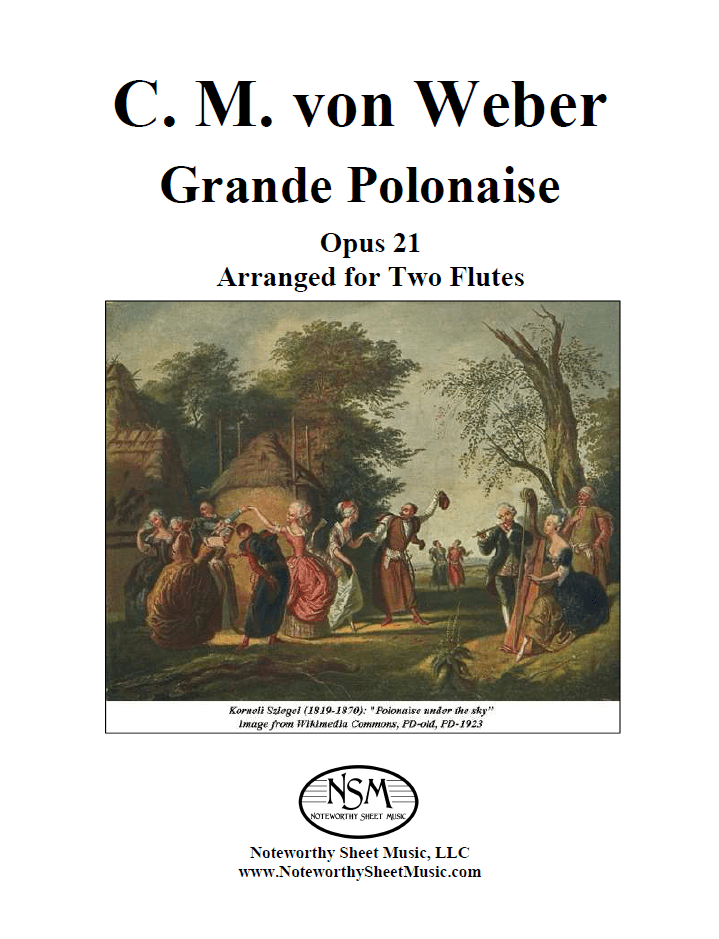 Grande Polonaise, Op.21, by Carl Maria von Weber
Anonymous Arrangement for Two Flutes
Gassett Collection - New Edition by C.A.Vater/Noteworthy Sheet Music
Flute 1 Part, Flute 2 Part, and Score, PDF $7.99
Carl Maria von Weber's Grande Polonaise, Op.21 was written originally for piano solo. The piece was composed in 1808 and first published in 1815. The Gassett Collection of 19th century flute music contains an edition of this piece arranged anonymously as a duet for two flutes, along with a flute duet version of Weber's Polacca Brillante in E major, Op.72, which we also offer. We re-notated the flute arrangement of the Grande Polonaise and offer this new edition, which includes a score at no extra charge, as well as the two flute parts.
For additional information about the Gassett Collection, please see see our article An Introduction to the Gassett Collection.
Flute 1 part, 4 pages; Flute 2 part, 4 pages; Fl1/Fl2 Score, 10 pages; Total, 24 pages.
Preview
 Fantaisie, Op.124, by Camille Saint-Saëns
Transcribed for Flute (originally for violin) by Peter H. Bloom
Flute Part, PDF $8.98
The following excerpt is taken from Peter H. Bloom's foreword to the edition:
"We flutists are always on the lookout for great repertoire to perform with harp, and the Fantaisie is a perfect gem to purloin from the violinists' repertoire. The expressively romantic melodies, lush impressionistic sonorities, athletic intervals, diversity of articulation, variety of dynamics, and evocative exoticism are ideal for the flute. The few problems of range are easily modified, customized, accommodated. As a duo, the work features both instruments in equally prominent and demanding roles. It's no surprise, then, that a number of flute transcriptions have been generated over the years. My goal, in this current work, is to provide fellow flutists with a significantly fresh approach to the Fantaisie.
Although a simplified adaptation of the Fantaisie is fairly straightforward, an arrangement that preserves the thrilling virtuosic intensity and rhetorical thrust of the work is another matter. An accurate presentation of Saint-Saëns's aural palette is essential to an authentic performance of the Fantaisie, and methods of achieving dynamic balance and tonal color often differ between flute and violin. The rhetorical nuances of articulation between the two instruments also require different approaches to achieve equivalent interpretations. The treatment of the violin pizzicato at measure 178, the elimination of articulation marks at measure 11, the inversions of double-stops/tremolos at measure 43-44 and 77-86, and the octave transposition from measure 184-194 exemplify these accommodations.
Violin double-stops present a conundrum. Technically impossible on the flute, double-stops are often reduced to a single line. The lower part is simply excised. But discarding the sonic complexity and virtuosic gesture of Saint-Saëns's parallel voicing dilutes the music and belies the composer's dramatic intentions. I've suggested double-stops be executed, on the flute, as tremolos. They're somewhat challenging but not impossible. Consider that the tremolo, as a virtuoso flute technique, was perhaps more popular during the composer's lifetime than in the late 20th and early 21st centuries.
Changes to the original violin part are made, here, with the intention of conserving the composer's ingenious creation. After a decade of study, experimentation, adjustment, and performance of this work, I've settled on a transcription for flute that conveys, with integrity, the musical spirit of the original orchestration."
P. H. Bloom, May 11, 2013 ©
 Click the icon to listen to a portion of the Saint-Saëns's Fantaisie performed by the duo "2", Peter H. Bloom on flute and Mary Jane Rupert on harp. Or watch part of a performance video on YouTube.
Fantaisie, Op.124 was written originally for violin and harp. We provide the Fantaisie flute part transcribed by P. H. Bloom; the harp part is available as a free PDF download from online libraries of public domain music, such as imslp.org.
Flute part, 7 pages; Total, 12 pages.
Preview
========================================================
We also offer a professionally-printed hard copy edition of Fantaisie, Op.124 by Saint-Saëns, transcribed for Flute for $14.99 plus a $5.95 shipping and handling fee to addresses in the USA. Use the Contact Us form to let us know which hard copy publication(s) you would like to purchase, along with your email contact information and USPS mailing address. We will then send you a PayPal invoice for the sale and, once we receive notice from PayPal that you have paid for the item(s), we will ship your music to the address provided.
 Concerto in D Major, K.412, by W. A. Mozart
Transcribed (from horn and piano arrangement) for Alto Flute by C.A.Vater
Alto Flute Part, PDF $3.99
Mozart's Concerto for Horn in D major for Horn and Orchestra is scored for solo horn in D, with two oboes, two bassoons, and strings. Henri Kling (1842-1918), horn player, composer, conductor, and professor, arranged the concerto for horn and piano. We used the Kling arrangement as the source from which to create a transcription of the horn part for alto flute. The piano scoreis in the public domain and available as a free pdf download from other sources such as imslp.org/.
The Concerto in D major, K.412 is a short work of approximately 8-10 min duration, consisting of only two movements - an Allegro and a Rondo Allegro. The movements are light and joyous, and pose no particular technical challenges to the alto flute player. The written range is quite limited, extending only from D5 to E6. Thus, this piece can be played by less advanced students as well as by more experienced alto flutists.
Alto Flute part, 4 pages of music; Total, 8 pages.
Preview
 Trois Grands Duos Brillants et Mélodiques pour Deux Flûtes Concertantes, by Jules Herman
New Editions by Noteworthy Sheet Music, with a Foreword by P. H. Bloom
Duo 1: Flute 1 Part, Flute 2 Part, and Mini-Score ― PDF $17.98
Duo 2: Flute 1 Part, Flute 2 Part, and Mini-Score ― PDF $21.75
Duo 3: Flute 1 Part, Flute 2 Part, and Mini-Score ― PDF $17.98
Jules Herman's Grands Duos Concertantes (Opus 86) are works of ingenuity, charm, brilliance, grace, and humor. Long overlooked, they are extraordinarily fine examples of concert-worthy duets of the late 19th century. Originally published by Choudens in Paris about 1885, the Grand Duos were dedicated to composer François-Auguste Gevaert (1828–1908), then director of the Royal Conservatory of Brussels. Flutists will find these works challenging and rewarding, teachers of advancing students will be amazed by their utility, and audiences will be enchanted. (excerpted from PHB's © foreword)
Note that these duets make for excellent sight-reading training... the music is interesting and demanding, and the parts are nicely balanced. All three duets have three movements each. Duo 1: Allegro moderato; Adagio sostenuto; and Rondo allegro. Duo 2: Moderato; Scherzando; and Polonaise. Duo 3: Allegretto vivace con brio; Air Varié, Andante; and Boléro, Moderato.
Duo 1: Fl 1 & Fl 2 Mini-Score, 12 pages 2-up; Flute 1 part, 12 pages; Flute 2 part, 12 pages; 40 pages total.
Preview Duo 1
Duo 2: Fl 1 & Fl 2 Mini-Score, 14 pages 2-up; Flute 1 part, 15 pages; Flute 2 part, 14 pages; 48 pages total.
Preview Duo 2
Duo 3 Fl 1 & Fl 2 Mini-Score, 11 pages 2-up; Flute 1 part, 12 pages; Flute 2 part, 12 pages; 40 pages total.
Preview Duo 3
 Sonata in G Major, K.301, by W. A. Mozart
Transcribed for Alto Flute (and Piano) by John W. Pratt
Alto Flute Part, PDF $4.99
This sunny sonata has two movements, an up-beat Allegro con spirito followed by an Allegro that is actually a sprightly minuet with a trio section in the minor, almost as near to a Beethoven scherzo as a Haydn minuet. The violin leads as often as the piano, including at the beginning and throughout the trio, but is largely spared Mozart's typical keyboard passage work. As with six other violin sonatas composed in 1778, the first of Mozart's maturity, the violin part rarely makes significant use of double stops and is in general very well suited to alto flute. In fact, K.301 was begun with flute in mind. We provide our transcribed alto flute part. The piano score is available in the public domain as a free pdf download from imslp.org/.
For additional information about the seven Mozart Mannheim sonatas and their alto flute transcriptions, please read the Mozart’s Mannheim Sonatas article written by Mr. Pratt; the article was originally published by Flute Focus and subsequently republished by NSM on our Resources – Reviews and Articles page.
Alto Flute part, 4 pages; Total, 6 pages.
Preview
