 4 Short Pieces, by Frank Bridge
Transcribed for Flute or Alto Flute (and Piano) by J.W.Pratt
Flute Part, Alto Part, PDF $8.99
The 4 Short Pieces by Frank Bridge were written for violin and piano, and first published in 1912. As noted in John Pratt's foreword to the edition, they "provide a fine and delightful introduction to an accessible post-romantic composer who should be better known." The pieces are Meditation, Spring Song, Lullaby, and Country Dance. Mr. Pratt has created transcriptions of the violin parts for both flute and alto flute, and we include both instrument versions in this edition. We think Nos. 1 and 3 sound particularly nice on the alto flute and No. 4 is a splendid romp on the C flute, but all four are effective on either instrument, so we prefer to let our flutists decide on which instrument they choose to play each piece. We provide only our flute and alto flute transcriptions; the piano score, including the original violin part, is available as a free pdf download at imslp.org.
Flute part, 5 pages; Alto Flute part, 5 pages; Total, 14 pages.
Preview
 Cradle Song, Gondoliera, Mélodie, and Elégie, by Frank Bridge
Transcribed for Flute or Alto Flute (and Piano) by J. W. Pratt
Flute Part, Alto Part, PDF $11.99
Like the 4 Short Pieces for Violin and Pianoforte published in transcription by Noteworthy Sheet Music previously, these additional four short pieces by Bridge "provide a fine and delightful introduction to an accessible post-romantic composer who should be better known." Published by Bridge between 1903 and 1911, the works included in our second edition are transcriptions of Cradle Song, written for violin or cello and piano, Gondoliera for violin and piano, and Mélodie and Elégie for cello and piano. Mr. Pratt has created transcriptions of all four pieces for both flute and alto flute, and we include both instrument versions in this combined edition. We think Cradle Song and Elégie are particularly beautiful on the alto flute, but all are effective on either instrument, so we prefer to let our flutists decide on which instrument they choose to play each piece. We provide our flute and alto flute parts only; the original piano scores work well with our transcriptions and are available, along with the violin and cello parts, as free pdf downloads at imslp.org—click the links to access the scores for Cradle Song, Gondoliera, Mélodie, and Elégie.
Flute part, 6 pages; Alto Flute part, 6 pages; Total, 14 pages.
Preview
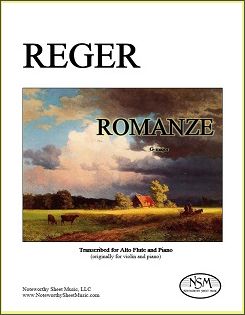 Romanze, by Max Reger
Transcribed for Alto Flute in G and Piano by C.A.Vater
Alto Flute Part and Piano Score, PDF $4.99
Reger's Romanze is a lovely, short piece in G major, consisting of a single movement, Andante con moto. Written in 1902 for violin (or cello) and piano, the work was published by Breitkopf und Härtel ca.1920 and is now in the public domain. Numerous arrangements and transcriptions of the Romanze, including those for C-flute, trumpet, cello, clarinet, viola, or alto saxophone and piano, and even one for oboe and accordion, attest to the piece's popularity. The Romanze works beautifully on alto flute, and Noteworthy Sheet Music's 2016 edition includes both our transcribed alto flute part and a re-notated piano score.
Cover image courtesy of Wikimedia Commons, PD-old: "Bavarian Landscape", by Albert Bierstadt (1830–1902).
Alto Flute Part, 1 page; Score 2 pages; Total, 6 pages.
Preview
 Auf dem Strom, Op.119, by Franz Schubert
Obbligato transcribed for A-Clarinet by C. A. Vater
Piano Score and Parts for Voice and A-Clarinet, PDF $9.50
The great Austrian composer Franz Peter Schubert (1797-1828) was a master at creating extremely beautiful, melodic, emotional lieder. His song Auf dem Strom (On the River) provided a musical setting for the text of the eponymous poem written by the German poet and music critic Ludwig Rellstab. The lyrics tell the story of a sad parting, of the yearning and loneliness that sets in as the narrator bids farewell to a loved one on shore, while his river journey carries him away towards the sea. The premier performance of Auf dem Strom took place in Schubert’s 1828 public concert, during which the obbligato part was played by Josef Lewy on horn, the instrument for which the obbligato was written and which undoubtedly can provide an appropriately mournful, sentimental character to the piece. However, an alternate obbligato version for cello was also published. Now, with all respect, we provide an A-clarinet version of the obbligato, in expectation that clarinetists will appreciate this addition to the voice/clarinet/piano repertoire. We believe that a well-played clarinet can aptly contribute a suitably complex, dolorous essence and tone that will adequately do justice to this highly romantic lied by Schubert. Schubert himself created one of his most wonderful and popular works, Der Hirt auf dem Felsen, for clarinet obbligato, and we hope he would welcome our adaptation of Auf dem Strom for A-clarinet.
Score, 19 pages; Voice part, 4 pages; A-Clarinet part, 4 pages; Total, 32 pages.
Preview
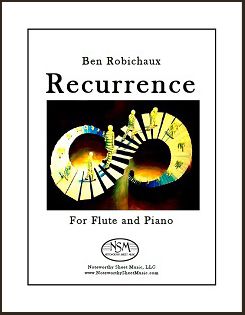 Recurrence, by Ben Robichaux
Contemporary Composition for Flute and Piano
Flute Part and Piano Score, PDF $12.99
NSM welcomed composer Ben Robichaux as a new contributor to our catalog in early June, 2017, when we published his piece Recurrence for flute and piano. For details of Mr. Robichaux's background, interests, and other works, please click the link to access the Composers section of the NSM website.
Recurrence was written for the composer's friend Michael Lyons. As outlined in the program notes, the "duet is framed in a traditional rondo form: ABACA. The returns of the A theme are never literal returns and repeated materials among the differing sections are never identical repetitions. These returns of A are the inspiration for the title, and the re-occurrence of the A material is a study on the lengths that a theme can be stretched and still be recognizable. The returns undergo extensive development. The B and C sections are meant to be extreme contrasts to the A sections as a means of cleansing the aural palate in order to erase the listener's memory of the theme. Despite the great lengths taken to blur the primary theme, its recognizability is undeniable. The closing section is a reflection on the basic differences among the three occurrences of the main theme. This final section is a summation of the processes that have previously been blurred by the contrasting sections of the piece. Ultimately the form portrays a futile fight that concludes with a peaceful resignation to the inevitable."
 The premiere of Recurrence took place in July, 2017, with Kenneth Cox (flute) and Bronwyn Schuman (piano). The performance was recorded by audio engineer Charles Hagaman; a sample can be heard by clicking the mp3 icon.
The cover artwork for our publication was created by Scoop Brancisco, used with permission.
Piano score, 10 pages; Flute part, 3 pages; Total, 15 pages.
Preview
 Auf dem Strom, Op.119, by Franz Schubert
Obbligato transcribed for Bass Flute by C. A. Vater
Piano Score and Parts for Voice and Bass Flute, PDF $9.50
The great Austrian composer Franz Peter Schubert (1797-1828) was a master at creating extremely beautiful, melodic, emotional lieder. His song Auf dem Strom (On the River) provided a musical setting for the text of the eponymous poem written by the German poet and music critic Ludwig Rellstab. The lyrics tell the story of a sad parting, of the yearning and loneliness that sets in as the narrator bids farewell to a loved one on shore, while his river journey carries him away towards the sea. The premier performance of Auf dem Strom took place in Schubert's 1828 public concert, during which the obbligato part was played by Josef Lewy on horn, the instrument for which the obbligato was written and which undoubtedly can provide an appropriately mournful, sentimental character to the piece. However, an alternate obbligato version for cello was also published. Now, with all respect, and at the suggestion of our flutist colleague Peter H. Bloom, we offer a bass flute version of the obbligato. Most of the transposed horn part falls nicely within the sweet range of the bass flute, and very few adaptations were required. Though clearly having different sonic qualities than a horn, the bass flute lends a forlorn, haunting, earthy tone that can well do justice to this Schubert song. After giving the bass flute obbligato a try, Mr. Bloom commented: "Fabulous! // The tone-color of the bass flute for this number is gorgeous."
Piano score, 19 pages; Bass Flute part, 4 pages; Total, 32 pages.
Preview
 Lento - Bereavement, by Moritz Hauptmann
Transcribed for Alto Flute and Piano by C. A. Vater
Piano Score and Alto Flute Part, PDF $3.99
Hauptmann's 3 Violin Duos, Op.16 were first published in 1832. The Lento (Bereavement) from Op.16 later was arranged for violin and piano by the renowned violinist, violist, and composer Heinrich Wilhelm Ernst. It is this arrangement by Henri Ernst, published in 1880, that served as the basis for NSM’s transcription of the piece for alto flute and piano. The mournful simplicity of the Lento is perfectly captured and beautifully rendered by the alto flute.
Alto Flute part, 1 page; Piano Score, 2 pages; Total, 6 pages.
Preview
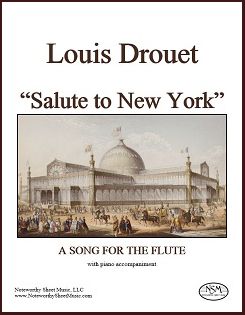 Salute to New York, A Song for the Flute, by Louis Drouet
Edited and with a Foreword by P. H. Bloom
Piano Score and Flute Part, PDF $5.99
We have posted Peter H. Bloom's fascinating and highly informative © foreword to this edition, in its entirety, elsewhere on our website, under Resources - Reviews & Articles, so please visit that page for additional historical details regarding the composer, Salute to New York, the New York Crystal Palace, and Hall & Son's flutes, beyond the short excerpts and paraphrases included here.
Louis-Francois-Philippe Drouet (1792-1873) is one of the most highly esteemed flute virtuosi in history. Innumerable contemporary press accounts of his concert triumphs throughout Europe attest to his technical brilliance and exquisite musicianship. He was a prolific and accomplished composer, author, flute theoretician, and pedagogue. His many etudes are still prescribed as tools for flute mastery. His Method of Flute Playing (1830) and 72 Studies on Style and Taste (1855) provide us with useful information concerning instrumental technique and performance practice in the mid-nineteenth century.
The exquisite Salute to New York, A Song for the Flute was performed by Mr. Drouet at the Crystal Palace in New York, on the occasion of its grand reopening under the new management of showman P. T. Barnum in 1854. Our renotated edition of the piece was edited by flutist Peter H. Bloom, who also has enhanced the original piano score with the addition of chord changes in order to broaden the scope of potential players.
Score, 4 pages; Flute part, 2 pages; Total, 14 pages.
Preview
 Chanson de Matin, Op.15, No.2, by Edward Elgar
Transcribed for Flute and Piano by C.A.Vater
Flute Part and Piano Score, PDF $6.99
Edward Elgar composed his Chanson de Matin for violin and piano c.1889-1890. The two companion pieces, Chanson de Matin (No. 2) and Chanson de Nuit (No. 1), together constitute his Op.15, and both pieces were later arranged for small orchestra by the composer. Chanson de Matin was received with great enthusiasm, and its initial and lasting popularity can be attributed largely to its strong melodic appeal. Enduring public affection for the piece has spawned the creation of numerous arrangements and transcriptions, including renditions for cello and piano, viola and piano, flute and guitar, piano solo, organ solo, and string quartet. Noteworthy Sheet Music offers two of our own transcriptions of the lovely Chanson de Matin, one for alto flute and piano and one for concert flute and piano.
Flute part, 2 pages; Piano Score, 4 pages; Total, 12 pages.
Preview
 Three Romances, Op.22, by Clara Schumann
Transcribed for Alto Flute or Flute (and Piano) by C.A.Vater
Alto Flute Part and alternative Flute Part, PDF $8.99
Clara Schumann’s Drei Romanzen für Pianoforte und Violine, Op. 22, were written in 1853 and dedicated to the Schumanns’ great friend, the famous Hungarian violin virtuoso Joseph Joachim, with whom Clara performed the Three Romances when they concertized together on tours across Europe. The Romances are lovely, short pieces; melodic and expressive, they epitomize the Romantic era and represent true chamber music in the sense that both instruments are featured comparably, rather than the piano having a merely accompaniment role. They are nicely adaptable to wind instruments, and are particularly lovely when played on alto flute. Our transcription required few modifications to bring the original violin part completely in range for alto flute and provides flute-friendly, musically-appropriate alternatives to the occasional violin double-stop. Some flutists may wish to mix and match the three movements, preferring to play one or two of the Romances on alto flute and the third on concert flute, or vice versa; so, to that end, we have included in this edition a complete alternative part adapted for C-flute. We do not provide a re-notated copy of the score, however, since high-quality PDFs of the piano and violin score are freely available in the public domain, and are easy to use along with our flute transcriptions of the violin line. To download one such PDF of the score, please visit the imslp website.
Alto Flute part, 5 pages; Flute part, 5 pages; Total 14 pages.
Preview
