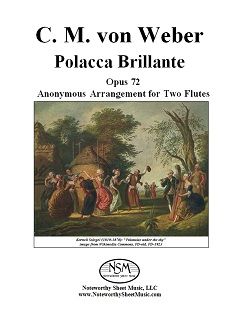
 Polacca Brillante, Op.72, by Carl Maria von Weber
Anonymous Arrangement for Two Flutes
Gassett Collection - New Edition by C.A.Vater/Noteworthy Sheet Music
Flute 1 Part, Flute 2 Part, and Score, PDF $7.99
Carl Maria von Weber (1786-1826) was a German piano virtuoso and prolific composer who made major, influential contributions to many kinds of music and is widely credited with being a founder of the Romantic school. Weber's rousing Polacca Brillante in E major, Op.72 (alternatively known as L'Hilarité or Grande Polonaise brillante) was written originally for piano solo. It was composed and first published in 1819, and was later transcribed by Liszt for piano and orchestra.
We came across an anonymous arrangement of this piece, a duet for two flutes, among the print copies included in the Gassett Collection. The duet is great fun for flutists, so we created a renotated edition of the arrangement, with the goal of modernizing the format and correcting some likely inaccuracies. Our new edition includes a score at no extra charge as well as the two flute parts.
For additional information about the Gassett Collection, please see see our article An Introduction to the Gassett Collection.
Fl1/Fl2 Score, 8 pages; Flute 1 part, 4 pages; Flute 2 part, 4 pages; Total, 22 pages.
Preview
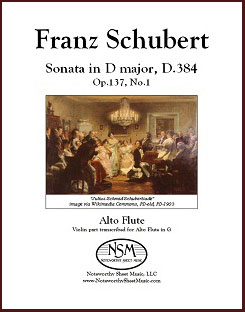 Sonatas, Op.137, by F. Schubert
Transcribed for Alto Flute and Piano by C. A. Vater & J. W. Pratt
No.1, Sonata in D major, D.384, Alto Flute Part, PDF $5.99
No.2, Sonata in A minor, D.385, Alto Flute Part, PDF $7.99
No.3, Sonata in G minor, D.408, Alto Flute Part, PDF $5.99
Franz Schubert (1797-1828) wrote his three violin sonatas Opus 137 when he was barely 19. They were published posthumously as 'Sonatinas', perhaps for marketing reasons, but they are full-scale sonatas in traditional classical style and format, the first having three movements and the others four. These plus the violin sonata in A of the next year constitute fully half of Schubert's known works for piano and solo instrument.
Schubert's Op.137 sonatas are truly delightful, and we have adapted the violin parts for alto flute. Where appropriate, changes have been introduced to better accommodate the range, sonority, and general characteristics of the alto flute. Such modifications include occasional octave adjustments, dynamic changes, and suitable flute-friendly alternatives to the violin's doublestops. We provide our transcribed alto flute parts; the piano scores are readily available in the public domain as free pdf downloads from imslp.org/.
No.1, Sonata in D major: Alto Flute part, 6 pages; Total, 8 pages. PDF $5.99
Preview
No.2, Sonata in A minor: Alto Flute part, 8 pages; Total, 10 pages. PDF $7.99PreviewNo.3, Sonata in G minor: Alto Flute part, 6 pages; Total, 8 pages. PDF $5.99Preview
 Three Melodies That Descend, Op.474, Nos.96-98 by John D. McDonald
Contemporary Composition for Solo Flute, $2.99
John McDonald is Professor of Music at Tufts University, where he served as Director of Graduate Music Studies from 2000 to 2010 and Department Chair from 2000 to 2003. He was named the 2007 MTNA—Shepherd Distinguished Composer of the Year by the Music Teachers National Association, and received the 2009 Lillian and Joseph Leibner Award for Distinguished Teaching and Advising from Tufts University. In 2010, he received the Waring Prize from Western Reserve Academy, the highest award given to alumni of that school. His recordings appear on the Albany, Archetype, Boston, Bridge, Capstone, Neuma, New Ariel, and New World labels, and he has concertized widely as composer, pianist, and collaborative performer. New releases include pianist Andrew Rangell's performance of McDonald's Meditation Before A Sonata: Dew Cloth, Dream Drapery, on Bridge Records.
McDonald's Three Melodies That Descend, Op.474, Nos.96-98 were written for composer and flutist Joshua Hahn after his graduation from Tufts University in May 2011. They work on the principle that what starts high must come down, and they are also a foil to the Eleven Melodies That Go Up In Different Ways (Op. 474, Nos. 30-40).
Flute part, 2 pages; Total, 4 pages.
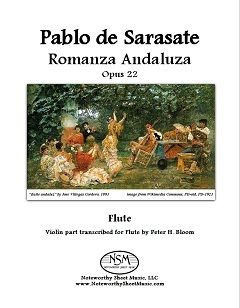 Romanza Andaluza, by Pablo de Sarasate
Transcribed for Flute (originally for violin) by Peter H. Bloom
Flute Part, PDF $6.66
'Pablo Sarasate was one of those rare violin virtuosos whose compositions, while designed to display instrumental athleticism, also expressed elegance, economy, imagination, a suave sensuality, and musical integrity. His music befits the sort of technique that, although acrobatic, is captivating rather than assaultive; evocative rather than provocative. It's with this spirit—to amuse, amaze, and engage the audience while providing a satisfying challenge to the performer—that I've adapted his Romanza Andaluza for flute.
Sarasate frequently used the musical material of folk songs and dances from his native Spain as a framework for his pieces. With the melody prescribed, the harmonies implied, and the style both familiar and exotic, he would paraphrase, embellish, and interpret as if to say "with the violin, we can do this..." Inspired by his source material, his methods, and his style, I propose that: With the flute, then, we can do this...' ― Peter H. Bloom, June 23, 2012 ©
Romanza Andaluza, Op.22 was written originally for violin and piano. Editions of the piano score (click to access) are available as free PDF downloads from online libraries of public domain music, such as imslp.org. We provide the Flute part - click below to preview p1.
Flute part, 4 pages; Total, 6 pages.
Preview
 Sonata in C Major, K.303, by W. A. Mozart
Transcribed for Alto Flute (and Piano) by John W. Pratt
Alto Flute Part, PDF $4.99
Both movements of Mozart's Sonata in C Major, K.303 are quite different from others of his 'Mannheim' set. The unusual first movement is in sonata form mixing retro and novel features—the whole first subject and transition to the dominant are adagio and considerably varied in the recapitulation, and there is no development. The second movement is an old-style minuet (without trio), ending with a pedal point terminating in a tremble. Our transcription for alto flute shifts the violin part to a different octave in three short segments and we have substituted musically appropriate alternatives for the double stops. We provide our transcription of the violin part for Alto Flute in G; the piano scoreis available in the public domain as a free pdf download from imslp.org/.
Alto Flute part, 5 pages; Total, 8 pages.
Preview
 Three Four-Note Flute Duets, Op.448b, by John D. McDonald
Contemporary Composition for Two Flutes, PDF $2.99
"Composed for Ethel Farny and her flute students at the Rivers Music School, these short duets sprout initially from the first flute/violin duet of Several Strands, Op. 448a. This Grazioso is indeed made from only four pitches. Similarly, Murmurando confines itself to a four-note knot until its final dyad. The third duet, Con Eleganza, stretches the four-note concept a bit more. Each instrument has its own four-pitch pattern, and a coda leaves the four-note idea behind all together, concluding the set with six slower, somewhat more chromatic bars that could very well lead to future music of more emotional complexity. Perhaps there will be more duets to come." ― John McDonald, November 2009
John McDonald is a member of The Mockingbird Trio, directs the Tufts Composers Concert Series, and serves on the boards of several performance organizations in New England. He has recently fulfilled commissions from The Chamber Orchestra of Boston, pianist David Holzman, The Firebird Ensemble (for an Apple Hill Center for Chamber Music Residency, with support from a Meet the Composer MetLife Creative Connections Award), and the ANA Trio (Fredonia University; soprano, cello, and piano), among others. Recent performances by McDonald at the Goethe Institut of Boston, at Tufts, and at many other venues have been highly acclaimed.
Score for Two Flutes, 2 pages; Total, 4 pages.
 Sonata in A Major, K.305, by W. A. Mozart
Transcribed for Alto Flute and Piano by John W. Pratt
Alto Flute Part, PDF $3.99
Mozart's Sonata in A Major, K.305 is perhaps the most completely extroverted of the Mannheim sonatas. Like K.302, it opens with four emphatically tonic bars, followed by a gentle, linear four-bar theme, all immediately repeated. The second movement of K.305 is the only movement of the Mannheim sonatas in theme-and-variations form. It is far from routine. The theme has an unusual variety of rhythms and accompaniment figurations; the 32nd-note variation is the very first, not a later one; the minor variation is at the prevailing tempo, not slow; and a brief but telling piano cadenza interrupts the antepenultimate variation's peroration. (excerpted from JWP's foreword to the edition)
We provide the transcribed alto flute part—the piano scoreis available in the public domain as a free pdf download from imslp.org/.
Alto Flute part, 4 pages; Total, 6 pages.
Preview
 Sonata in E-flat Major, K.302, by W. A. Mozart
Transcribed for Alto Flute (and Piano) by John W. Pratt
Alto Flute Part, PDF $4.99
Mozart's Sonata in E-flat Major, K.302 has two movements, an Allegro and a rondo Andante grazioso. This ebullient sonata opens with a striking call to attention, much used later, which descends on the tonic triad but alternates half and quarter notes in 3/4 time, thus avoiding both square rhythm and repeated root positions on every down beat. The theme which follows is contrastingly gentle. The second movement offers a firmly forward-moving theme whose immediate repeat and final returns are variously and charmingly re-orchestrated. (excerpted from JWP's foreword to the edition)
We provide our transcription of the violin part for alto flute; the piano score is available in the public domain as a free pdf download from imslp.org/.
For additional information about the seven Mozart Mannheim sonatas and their alto flute transcriptions, please read the Mozart’s Mannheim Sonatas article written by Mr. Pratt; the article was originally published by Flute Focus and subsequently republished by NSM on our Resources – Reviews and Articles page.
Alto Flute part, 5 pages; Total, 8 pages.
Preview
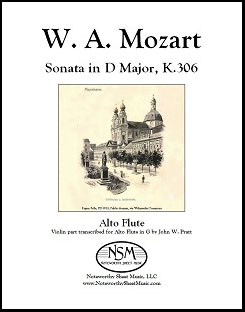 Sonata in D Major, K.306, by W. A. Mozart
Transcribed for Alto Flute and Piano by John W. Pratt
Alto Flute Part, PDF $9.99
Mozart's Sonata in D Major, K.306 is by far the longest and showiest of the 'Mannheim' sonatas, with three large-scale movements, some quasi orchestral textures, much doubling, and brilliant passage work. The first movement's development expands four transitional bars of the exposition into a far-reaching harmonic excursion. The recapitulation begins with the second subject and returns to the first so late it amounts to a coda, the only instance of 'mirror' sonata-form in the Mannheim set. In contrast, the second movement, Andante cantabile, has a structurally orthodox sonata form, compressing and ornamenting the themes in the recapitulation, as befits the tempo. The finale is an elaborate rondo alternating between allegretto in 2/4 and allegro in 6/8. (excerpted from JWP's foreword to the edition)
We provide our transcribed alto flute part; the piano scoreis available in the public domain as a free pdf download from imslp.org/.
Alto Flute part, 10 pages; Total, 12 pages.
Preview
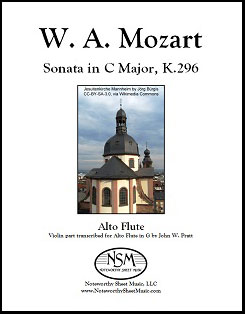 Sonata in C Major, K.296, by W. A. Mozart
Transcribed for Alto Flute and Piano by John W. Pratt
Alto Flute Part, PDF $6.99
Mozart composed K.296 in 1778 under the same creative impulse as the other Mannheim violin sonatas, K.301‒306, but published it later, in 1781, with five other three-movement sonatas. He dedicated it to his Mannheim landlord's 15-year old daughter, Therese-Pierron Serrarius, who perhaps inspired the turns lightening the opening fanfares, quick trills in the first theme, and contrasting textures and sparkling interplay between the instruments in the first movement. The second movement is a beautiful arietta with wonderful opportunities for the alto flute to both present and accompany the melody. In the concluding Rondo, in sonata-rondo form, the instruments repeatedly swap the theme and much of the episodic material. ―J. W. Pratt
We provide our transcription of the violin part for alto flute; the piano score is available in the public domain as a free pdf download from imslp.org/.
For additional information about the seven Mozart Mannheim sonatas and their alto flute transcriptions, please read the Mozart’s Mannheim Sonatas article written by Mr. Pratt; the article was originally published by Flute Focus and subsequently republished by NSM on our Resources – Reviews and Articles page.
Alto Flute part, 7 pages; Total, 10 pages.
Preview
