 Elegy, Op.44, by Alexander Glazunov
Transcribed for Flute or Alto Flute (and Piano) by John W. Pratt
Parts for Flute and Alto Flute, PDF $5.99
Alexander Konstantinovich Glazunov (1865-1936) was a major composer in the late Russian romantic tradition. His Elegy, Op.44, was written for viola and piano in 1893. The viola melody is readily adaptable for other instruments, since it is without double stops, and has been transcribed here by John W. Pratt for either flute or alto flute. The piece is about 6 minutes long, elegiac but not lugubrious. It consists of a lovely melody in 9/8 time, enhanced by a simple but warm piano accompaniment. The NSM edition includes a flute part and an alternative alto flute part, but does not include one for piano, since a suitable score is freely available at IMSLP.org.
Flute part, 2 pages; Alto Flute part, 2 pages; Total, 8 pages.
Preview
 Greetings to Hungary, Op.407, by Wilhelm Popp
Flute and Piano
Flute Part and Piano Score, PDF $0.00
Wilhelm Albrecht Otto Popp (1828-1903) was an esteemed German composer, flutist, and pianist. He received his flute training from Caspar Kummer and Louis Drouet, and served as court pianist and flutist at the Ducal Saxon Court Theater in Coburg-Gotha. In 1867 he moved to Hamburg and became first flute of the Hamburg Philharmonic Orchestra. Popp composed some 600 works, many of which were written for flute and piano; most of his compositions were published in his lifetime and were well-known to musicians of his day.
Wilhelm Popp’s Gruß an Ungarn (Greetings to Hungary) was first published for flute and orchestra in 1890, and an edition for flute and piano was published in 1899. NSM re-notated the flute and piano version, changing only the formatting and adding bar numbers and a new cover page. With a decidedly Hungarian sentiment, this piece is great fun to play and provides an enjoyable, exciting listen for audiences as well.
Click for a free download of our re-typeset edition of Popp’s Gruß an Ungarn.
Piano score, 8 pages; Flute part, 5 pages; Total 16 pages.
 Zwei Charakterstücke, by Karl Eduard Goepfart
transcribed for Alto Flute and Piano by C. A. Vater
Alto Flute part and Piano score, PDF $8.99
Karl Eduard Goepfart (1859-1942) was a German pianist, composer and conductor. His Zwei Charakterstücke, Op. 27(Two Character Pieces) were written for oboe and piano and first published in Leipzig in 1888. The two contrasting pieces are the very charming Mässig schnell, gehend and Mässig langsam (in ruhiger Bewegung)with its playful, energetic Lebhaft section. We prepared a transcription of this under-appreciated work for alto flute, complete with piano score. The pieces work well on alto flute, providing the accompanying pianist is sensitive to the alto flute’s lower sound power and projection capability, especially in the low register, compared to that of the oboe.
Piano Score, 8 pages; Alto Flute part, 3 pages; Total, 16 pages.
Preview
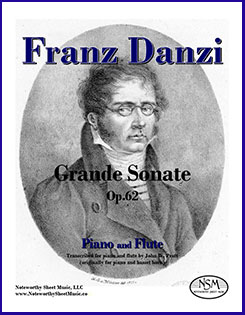 Grande Sonate, Op.62, by Franz Danzi
transcribed for Piano and Flute by John W. Pratt
Piano score and Flute part, PDF $14.99
excerpted from John Pratt’s foreword to the edition: 'Franz Danzi (1763-1826) was an active musician, cellist, and teacher in Mannheim, Munich, Stuttgart, and Karlsruhe. A prolific composer, especially of music for the stage and chamber music from keyboard solos to sextets, he revered Mozart and mentored Weber. His wind quintets are notable. His Grande Sonate, Opus 62, for piano and basset horn, was published about 1823, along with an alternative cello part which sometimes differs from the basset horn part in other ways than octave transposition. // The sound of the basset horn varies widely, depending on its construction, who is playing, what is being played, and who is describing it. George Bernard Shaw said, ''The devil himself could not make a basset horn sparkle.'' Burnet Tuthill, in Cobbett's Cyclopedic Survey of Chamber Music (1929), wrote of its "soft mellow timbre of rich beauty.” E.T.A. Hoffmann likened its sound to the scent of red carnations (see Georgina Dobré, The Basset Horn,who says, pace Shaw, “Sparkle it certainly can!”). That tent is broad enough to cover the characteristics of both the flute and the clarinet comfortably, and Danzi’s Grande Sonate alternates sparkle and mellow rich beauty in large measure.' Since we at NSM have grown quite fond of this piece, we decided to transcribe it for both flute and clarinet, so we and our friends could enjoy playing it. We offer here the flute edition, with a version for clarinet to follow in the coming weeks.
Piano score, 28 pages; Flute part, 7 pages; Total 40 pages.
Preview
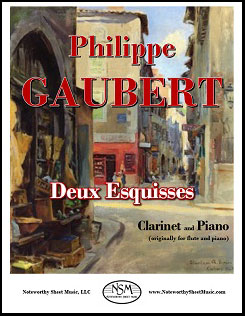 Deux Esquisses, by Philippe Gaubert
transcribed for Clarinet and Piano by C. A. Vater
Clarinet part and Piano score, PDF $9.99
Philippe Gaubert was a prominent French flutist, composer, and conductor who held a professorship at the Paris Conservatory and principal conducting positions at the Paris Opéra and the Orchestre de la Société des Concerts du Conservatoire. We’ve created a transcription of his Deux Esquisses (Two Sketches) for B♭ clarinet, complete with piano score. These pieces were written for flute and piano but are nicely adaptable for other winds. They were originally published by Heugel & Cie, in 1915 (No.1) and 1914 (No.2), and are now in the public domain. No.1, Soir sur la Plaine (Evening on the Plain), opens intriguingly with the solo instrument playing alone, repeating a single note. This motif sets the lovely, mysteriously forlorn tone of Soir sur la Plaine, and returns multiple times later in the piece. No.2, the second sketch, is Orientale, which, as its name suggests, evokes an atmosphere seemingly strange and foreign, Eastern.
Piano Score, 10 pages; Clarinet part, 4 pages; Total, 20 pages.
Preview
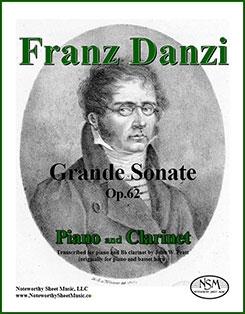 Grande Sonate, by Franz Danzi
transcribed for Piano and Clarinet by John W. Pratt
Piano score and B♭ Clarinet part, PDF $14.99
Danzi’s Grande Sonate, Opus 62, written for piano and basset horn, was published around 1823, along with an alternative part for cello. Please see additional information about this piece in the article describing our re-notated basset horn edition. The Grande Sonate comprises four movements and provides both sparkle and mellow rich beauty. It is nicely adaptable to other winds, particularly the clarinet. Certain passages in the final movement of the original work seem to invite elaboration or improvisation by the solo instrument, and arranger John Pratt offers suggestions for possible additions or alternatives for the clarinet, making it even more fun to play.
Piano Score, 28 pages; B♭ Clarinet Part, 7 pages; Total, 40 pages.
Preview
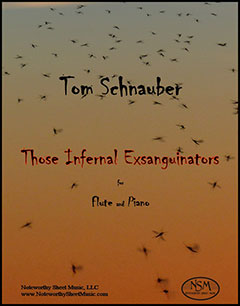 Those Infernal Exsanguinators, by Tom Schnauber
Flute part and Piano score, PDF $17.97
Summer in Minnesota. The sun is setting, the broad sky is clear, and the cool light of dusk promises a welcome respite from the day’s heat and humidity. You step out into the stillness and stand, gazing at the orange-red horizon, thankful for the dimming light and approaching night. And then they come. Those insidious little creatures, those vile insects that define and destroy the season: the mosquitoes. Only some at first, few enough to make you think that if you swat them away, you can still enjoy the evening air. But then more come, and more, and even more. They whine, you moan, they sting, you slap, they swarm, you flail. Soon, your body a mass of swelling welts, you realize that the twilight peace you had hoped for when you left your house is a sham, an impossible illusion shattered by the piercing terror of those infernal exsanguinators. Angry and itching, you run back inside and slam the door shut. —Tom Schnauber
In October, 2020, we at NSM were delighted to welcome Tom Schnauber as one of our contributing contemporary composers; click the link to read about this acclaimed composer's career and his many exciting projects.
Those Infernal Exsanguinators is a compelling piece; to discover this for yourself, please visit Tom Schnauber's soundcloud page and listen to arecording of the work beautifully performed by Tamara Thweatt, flute, and Hey-Seon Choi, piano.
Piano Score, 18 pages; Flute part, 7 pages; Total, 28 pages.
Preview
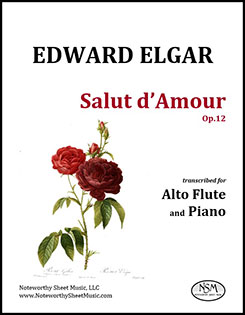 Salut d’Amour, Op. 12, by Edward Elgar
Transcribed for Alto Flute and Piano by C. A. Vater
Piano Score and Part for Alto Flute, PDF $6.99
The English composer Edward Elgar held many positions throughout his career, including those of organist at St. George’s Roman Catholic Church in Worcester, conductor of the Worcester Philharmonic, Professor of Music at the University of Birmingham, and conductor of the London Symphony Orchestra. He achieved considerable prominence as a result of his many successful orchestral, vocal, and chamber music compositions. Elgar composed this piece in 1888, as an engagement gift to his beloved future wife. Though first written for piano solo, arrangements were created shortly thereafter by the composer himself for violin and piano, and for orchestra. Originally titled “Liebesgruss” (Love’s Greeting), but later changed to Salut d’Amour, the piece is now one of Elgar’s most widely recognized works, and its immense popularity has led to arrangements for a wide variety of other instruments. We provide here a transcription of Salut d’Amour for alto flute and piano, which has been adapted from the editions published by Schott for violin and piano, oboe and piano, or orchestra and which are now in the public domain.
Score, 4 pages; Alto Flute part, 2 pages; Total, 10 pages.
Preview
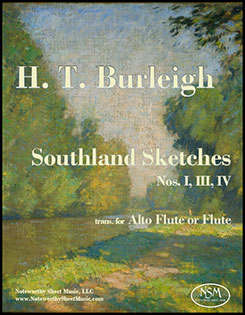 Southland Sketches, Nos. I, III, IV, by H. T. Burleigh
Transcribed for Alto Flute or Flute (and piano) by C. A. Vater
Alto Flute part and Flute part, PDF $9.96
Harry Thacker Burleigh was an acclaimed African-American singer, music editor, and composer whose adaptations of African-American spirituals became famous. His Southland Sketches, which were composed for violin and piano and published by G. Ricordi in 1916, are a fine example of Burleigh’s quintessential American style. The original composition included 4 movements. Our edition excludes the second movement, but adapts three of the original four miniatures for either alto flute or flute. We provide only the transcribed alto flute and flute parts, as they have been designed to work well with the piano part in the original score for violin and piano which is available as a good quality, free pdf download from imslp.org. Performers may choose to play all three of these pieces on either flute or alto flute, or switch instruments between sketches, depending on personal preference.
Alto Flute part, 6 pages; alternate Flute part, 6 pages; Total,18 pages. (pdf of piano accompaniment is freely available at imslp.org)
Preview
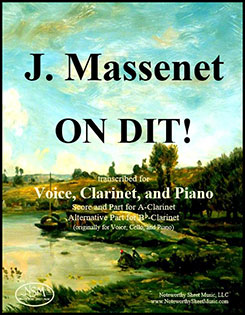 On Dit!, by Jules Massenet
Transcribed for Clarinet, Voice and Piano by C. A. Vater
Score for Clarinet, Voice and Piano; Alternative Parts for A-Clarinet and B-flat-Clarinet, PDF $8.99
Massenet’s composition On dit! is a musical setting of the eponymous poem by Jean Roux in which the poet ponders how the word “love” is commonly and inevitably associated with the sweetness and delights of spring. In addition to the vocal line and piano accompaniment, Massenet provided On dit! with a prominent part for cello. The cello line can be readily adapted for clarinet, creating a lovely and suitable new version of the piece for clarinet, voice, and piano. Our Noteworthy Sheet Music edition includes a score in concert pitch, as well as individual parts for either A-clarinet or B-flat-clarinet transcribed from the original cello part. Clarinetists in possession of both A and B-flat instruments may develop a personal preference for playing this piece on one instrument over the other, based on tone quality, complementarity with a particular singer’s sound, etc.
Score, 5 pages; A-Clarinet Part, 2 pages; B-flat-Clarinet Part, 2 pages; Total, 16 pages.
Preview
