Two versions, for "Low voice (in Db)" or "High voice (in Eb)", with Alto Flute Obbligato (transcribed) and Piano. Alternative parts for Alto Flute Solo and Bb Clarinet Obbligato. Program Notes by Peter H. Bloom.
Piano Scores, Voice Parts, Alto Flute Obbligato Parts, and alternative Alto Flute Solo Parts and Clarinet Obbligato Parts; PDF $8.99
Noteworthy Sheet Music was thrilled to publish our edition of Amy Marcy Cheney Beach's song Ecstasy in 2017, in celebration of the 150th anniversary of the composer's birth. The idea to make Ecstasy available to a broader combination of players and singers came from flutist Peter H. Bloom, who proposed that the piece would be an excellent vehicle with which instructors might inform students (early and advanced alike) about interpretation of the highly romantic late 19th century idiom. To that end, we have packaged together in a single edition Mrs. H. H. A. Beach's two versions of Ecstasy, for "low voice (in Db)" and "high voice (in Eb)", with each version including transcriptions of the obbligato (originally for violin) for either alto flute in G or clarinet in Bb, and an alternative solo part in the form of an alto flute transcription of the voice line. Thus, multiple performance variations are possible, including high or low voice and piano with either alto flute or clarinet obbligato, or fully instrumental versions for alto flute and piano, or two alto flutes and piano, or alto flute, clarinet, and piano.
Scores, 8 pages (4 pages each version); Voice parts, 2 pages (1 page each version); Alto Flute Obbligatos, 2 pages (1 page each version); Clarinet Obbligatos, 2 pages (1 page each version); Alto Flute solo parts, 2 pages (1 page each version); Total, 20 pages.
Contemporary Composition for 2 Flutes, 2 Clarinets, Bass Clarinet, and 9 Percussion Instruments
Score and Parts, PDF $14.25
Walter Finlayson (1919-2000) was an American composer, musician, educator, and music innovator, with nearly twenty original compositions and some forty arrangements to his credit. While serving in the navy, he played saxophone and clarinet in the US Naval Reserve dance band, seated next to the great Artie Shaw. Finlayson's ASCAP output includes music for band, dance band, orchestra, voice, and chorus. His compositions and arrangements have been published by Boosey & Hawkes, EB Marks, Boston Music, and Mercury Music, and performed by major college marching band programs. One of his best-known compositions is I Had a Premonition, which was written for voice and piano, but which was later arranged for the Jimmie Lunceford Orchestra, one of the preeminent bands of the swing era. A recording of the tune can be heard on The Jimmie Lunceford Collection: 1930-47 compact disc released in 2014 on the Fabulous label, and on YouTube.
Noteworthy Sheet Music's chief editorial consultant Peter H. Bloom received Finlayson's previously-unpublished score for Moon Shadows from the composer's daughter, and we were impressed with its quality and sophistication. For a piece written in the late 1930's or early 1940's, as Gale Finlayson recollects (the score is not dated), Moon Shadows seems remarkably ahead of its time. The work is scored for two flutes, two clarinets, bass clarinet, bells, vibraphone, xylophone, finger cymbals, maracas, bongos, roll cymbals, temple blocks, and tympani. We notated our modern edition of the piece as faithfully as possible based on the hand-written Finlayson score; our edition of Moon Shadows includes both score and parts. We at NSM are pleased to aid in the re-discovery of some of Walter Finlayson's works; for additional information about this interesting composer, please visit the Our Composers page under About Us.
Score, 19 pages; Parts for Flute-1, Flute-2, Clarinet-1, Clarinet-2, Bass Clarinet, Bells, Vibraphone, Xylophone, Finger Cymbals and Maracas, Bongos and Roll Cymbals, Temple Blocks, and Tympani, 1 page each; Total, 34 pages.
for Piano and Basset Horn; re-notated, edited, and with occasional ossia elaborations suggested by John W. Pratt
Piano Score and Basset Horn Part, PDF $13.99
Franz Danzi (1763-1826) was an active musician, cellist, and teacher in Mannheim, Munich, Stuttgart, and Karlsruhe. A prolific composer, especially of music for the stage and chamber music from keyboard solos to sextets, he revered Mozart and mentored Weber. His wind quintets are notable. His Grande Sonate, Opus 62, for piano and basset horn, was published about 1823, along with an alternative cello part which sometimes differs from the basset horn part in other ways than octave transposition. // The original publication of Danzi’s Opus 62 is available at imslp.org., but there is no full score and the parts are hard to play from, or sometimes even to read at all, lack measure numbers, have a few errors, and differ in the number of measures in the last two movements. We have therefore prepared a full score including the basset horn in concert pitch, to facilitate checking the fit of the basset horn and piano lines and our transcriptions for other instruments against the original. — excerpted from John Pratt’s foreword to the edition
Piano Score, 28 pages; Basset Horn part, 7 pages; Total 40 pages.
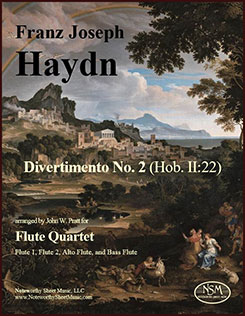
Divertimento No. 2 (Hob. II:22; Op.2, No.5) by Franz Joseph Haydn
Arranged for Flute Quartet by John W. Pratt (originally for string quartet plus 2 horns)
Score and Parts for Flute 1, Flute 2, Alto Flute, and Bass Flute, PDF $10.97
This is the second of Haydn’s two divertimenti, Hob. II:21 and II:22, that John Pratt has arranged for flute quartet, scored for two C-flutes, alto flute, and bass flute. Both divertimenti were written originally for string quartet plus two horns, but were later adapted by others as quartet-only versions identified as Opus 2, No.3 and No.5. Please see the text excerpted from Mr. Pratt’s preface to his arrangement of Haydn’s Divertimento No.1 (Op.2, No.3) for additional information that applies to both these works. There are 5 movements in Op.2, No.5: I-Presto, II-Minuet, III-Largo, IV-Minuet, and V-Finale Presto. Listen to this computer-generated audio clip from the second movement Minuet to get a sense of how the quartet sounds with flutes in lieu of strings.
“Haydn (1732-1809) is credited with developing the classical forms of both the string quartet and the symphony, starting from the loose structures and permissive instrumentation of Baroque instrumental music. … His first string quartets are his Opus 1 Nos. 1-4 and 6, and Opus 2 Nos. 1-6, thus eleven. Opus 1 No. 5 is somewhat later, added to make a set of 6, apparently a perfect number in music publication as well as in mathematics. Opus 2 Nos. 3 and 5 are quartet arrangements of two divertimentos including also two horns and listed in the Hoboken catalogue as II:21 and 22 … The spirit and spiritedness of the two divertimentos suit them to flute quartet, as does the distribution of activity. In addition, a flute quartet combines the unified timbre of a string quartet with the wind sound of the horns, while the early string quartets do not exploit the string sound per se. Transposition up a step puts the cello and viola parts of Hob. II:21 mostly within the bass and alto flute ranges and makes the violin parts if anything more comfortable for C flutes.”
There are 5 movements in total: I-Allegro molto, II-Minuet, III-Adagio, IV-Minuet, and V-Finale Allegro. To get some sense of how the Op. 2 No. 3 quartet works with flutes in lieu of strings, listen to this computer-generated audio clip of the first movement—realizing it will of course sound considerably better played in-person on real instruments.
Transcribed for Solo Flute accompanied by Flute Choir, by John W. Pratt (originally for flute and strings)
Score and Parts for Solo Flute, Flutes 1 and 2, Alto Flute, and Bass Flute/Contrabass Flute, PDF $7.99
Haydn wrote his Symphony No.24 in 1764. Its second movement is a beautiful Adagio for flute solo accompanied by strings. The string parts are simple, with no double stops or extreme high notes, so they can be played comfortably by corresponding members of the flute family, except for a few low notes. This transcription for flute choir is therefore straightforward except that the alto flute sometimes plays violin notes that C-flutes cannot play or can use support playing, and similarly the bass flute plays some viola notes instead of or in addition to the alto flute playing them. Notes taken from the cello in its lowest octave have been raised an octave for bass flute, but there are fewer than one might expect. Perhaps one reason is that Haydn expected a (string) bass to be doubling the cello an octave lower, playing from the same part. If a contrabass flute is available, it can double the bass flute similarly, serving even more to enrich the sound. —adapted from JWP’s preface to the edition
Listen to a computer-generated audio sample.
Score, 5 pages; Parts for Solo Flute, 2 pages; Flutes 1 and 2, 2 pages; Alto Flute, 1 page; Bass Flute/Contrabass Flute, 1 page; Total 19 pages.
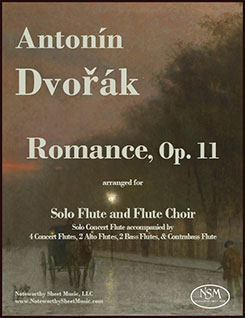
Arranged for Solo Flute and Flute Choir by C. A. Vater (originally for solo violin and orchestra)
Score and Parts for Solo Concert Flute, 4 Concert Flutes, 2 Alto Flutes, 2 Bass Flutes, and 1 Contrabass Flute, PDF $21.97
Czech composer Antonín Dvořák based his Romance, Opus 11 on the slow movement of his String Quartet in F minor, composed in 1873, re-working that Andante con moto quasi allegretto to create two versions of the Romance, one for solo violin and orchestra (B.39) and another for solo violin and piano (B.38). The Romance is one of Dvořák’s most magnificent melodic works, teaming with romance, lyricism, and emotional intensity. I created a solo flute version of this piece for my personal use, and I so enjoyed playing it that I shared it with a flutist friend / NSM editorial consultant, who suggested that the Romance might be nicely adaptable for flute choir. I took on that challenge and created this arrangement, scored for flute solo with the accompaniment of four concert flutes, two alto flutes, two bass flutes, and one contrabass flute. A few changes have been incorporated in the solo part, bringing the violin’s lowest notes into concert flute range and providing appropriate alternatives to the occasional double stops. Likewise, the various string and wind parts created by Dvořák for his orchestral arrangement (available on IMSLP.org) have been modified in places to suit members of the flute family. Of course, any work played by a flute choir will sound very different than when played by an orchestra, but in arranging this piece for flute choir, every effort has been made to maintain the spirit, character, balance, and flow of Dvořák’s exquisite Romance.
The parts in our edition have been formatted for convenient page turns when the complete PDF is printed 2-sided in its entirety. If a more compact version of the score is desired, however, please select a “2 pages per sheet” printer option for the score and print the score pages separately from the parts.
Score, 60 pages; Solo Flute part, 4 pages of music; Flutes 1-4 parts, each 3 pages of music; Alto Flute 1 part, 4 pages of music; Alto Flute 2 part, 3 pages of music; Contrabass Flute part, 3 pages of music; Total, 104 pages.
Transcribed for Alto Flute and Piano by C. A. Vater
Piano Score and Part for Alto Flute, PDF $5.49
In 1888, Elgar composed Salut d’Amour, now one of his most-recognized pieces, as an engagement gift for his beloved fiancée. Later he wrote Mot d'Amour (Love's Word) for violin and piano as a companion piece to Salut d’Amour. Mot d'Amour, which was initially given the German title Liebesahnung, was published in 1889 by Osborn & Tuckwood in the edition 2 Pieces for Violin & Piano that included this piece and a second one, less well-suited to alto flute, called Bizarrerie. Mot d’Amour is similar to Salut d’Amour in being light, charming, and highly romantic. Although Mot d’Amour never attained the level of popularity achieved by the earlier work, it is considered by some to be the finer composition (https://www.elgar.org/3salut.htm). Both Salut d’Amourand Mot d'Amoursound especially rich and mellow when performed on alto flute, and both pieces are now available from Noteworthy Sheet Music as transcriptions for alto flute and piano, adapted from the composer’s violin and piano editions now in the public domain and available on imslp.org.
Score and Parts for Flute 1, Flute 2, Alto Flute, and Bass Flute, PDF $21.25
Among J. S. Bach's big organ works, the Toccata, Adagio, and Fugue, BWV 564 is atypical in ways that make it especially adaptable to transcription for winds, as we noted when transcribing it for woodwind quartet. The middle movement Adagio has an elaborate and gorgeous melody which lies comfortably for flute and can benefit greatly from the shaded, nuanced dynamics and articulations that a solo flutist can provide. The four-part Fugue is unusual, too—light and lighthearted, happily adaptable to woodwinds. The Adagio and Fugue are particularly well-suited to a flute quartet and these (but not the Toccata) are included in John Pratt’s arrangement of the piece for two flutes, alto flute and bass flute. Note that the score is presented with the alto flute line in concert pitch and the bass flute line shown in bass clef so as to easily see the range of all the flutes' notes; in the parts, of course, the alto flute is transposed and the bass flute is in treble clef.
Contemporary Composition for Solo Flutist, playing flute, alto flute, and piccolo, PDF $9.00
—adapted from excerpts of program notes written by the composer, Timothy J. Bowlby:
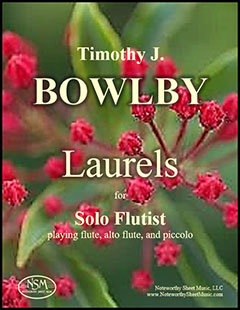
Laurels, for solo flutist playing flute, alto flute, and piccolo, was written in 2018 for two of the composer’s flutist colleagues, Laurel Tempas and Peter H. Bloom. The piece is cast in a three-section form. The flute is featured exclusively in the initially march-like A section of the work. A “lyrical alto flute passage”, requested by Mr. Bloom, starts the middle or B section and the piccolo concludes it; the overall affect is one of contemplation and reflection in nature. The concluding A’ portion is begun by the piccolo and ends with a return to the flute and the march-like material that started the piece.
Laurels was premiered by Peter H. Bloom in June, 2019. A recording of a performance from 9/23/2023 can be accessed on YouTube:
The lovely cover image used for our Laurels edition is courtesy of wikiwand.com, Kalmia latifolia, the mountain laurel, calico bush, or spoonwood, image of flower buds. Attribution-ShareAlike 1.0 Generic (CC BY-SA 1.0). The image has been cropped, enlarged and sharpened.

 Ecstasy, Op.19 No.2, by Mrs. H. H. A. Beach
 Moon Shadows, by Walter A. Finlayson
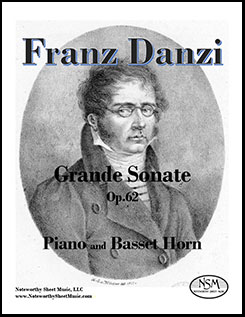 Grande Sonate, Op.62, by Franz Danzi
 Divertimento No. 2 (Hob. II:22; Op.2, No.5) by Franz Joseph Haydn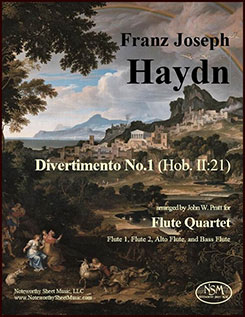
 Romance, Op. 11 by Antonín Dvořák
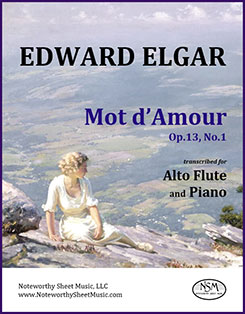 Mot d’Amour, Op.13, No.1, by Edward Elgar
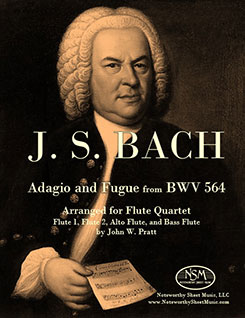 Adagio and Fugue from BWV 564, by J. S. Bach