In 1833, Felix Mendelssohn (1809-1847) wrote two Concert Pieces for Clarinet, Basset Horn, and Piano, op. 113 and op. 114, as show-pieces for the famous clarinetist Heinrich Bärmann (1784-1847) to play with his up-and-coming son Karl (1811-1885) on the basset horn. // These works are very suitable for transcription, even aside from the rarity of the basset horn today. We provide, as well as the original clarinet part, transcriptions of it for flute and oboe. Transcriptions of the basset horn part are provided for bassoon, clarinet, and English horn. These primo and secondo parts can be mixed and matched at will. // Since a good quality PDF of the original piano score with excellent page turns is freely available in the public domain at IMSLP.org, we have not provided a score here; our transcribed primo and secondo wind parts can readily be used with the original score.
Each wind part is 4 pages of music; 6 pages total.
Primo parts for Flute, Clarinet in B-flat (note that the original primo clarinet part is freely available on IMSLP.org), or Oboe.
Score and Parts for Flute, Oboe, Bb Clarinet, F Horn, and Bassoon; PDF $5.99
Wilt heden nu treden, nowadays more commonly known as We Gather Together, is a Christian hymn of Dutch origin composed by Adrianus Valerius and first published in 1626 (imslp.org); it was later harmonized by Eduard Kremser (en.wikipedia.org). In the United States, We Gather Together is the most popular song traditionally associated with the Thanksgiving holiday. John Pratt has created an arrangement of We Gather Together for woodwind quintet that lends new excitement and interesting harmonies to this old favorite. In his family, the tradition goes back as far as John Pratt (b. 1931) can remember, and when it fell to him to play all three stanzas at his family's annual gathering, he got interested in livening it up. The opportunistic half-step modulations introduced to help amateur voices warm up also brighten successive stanzas for winds. Our Noteworthy Sheet Music edition includes a score in concert pitch, as well as parts for flute, oboe, Bb clarinet, horn in F, and bassoon.
transposed to B-flat major and arranged for Woodwind Quartet by John W. Pratt
Score and Parts for Flute, Oboe, B-flat Clarinet, and Bassoon; PDF $20.97
As noted in the arranger’s forward to the edition, the later piano trios of Franz Joseph Haydn (1732-1809) are superb music, but because they were written for excellent pianists and weak string players, they are dominated by the piano part. This imbalance among the parts actually makes the trios highly amenable to and effective in arrangement for woodwind quartet. Written after Haydn’s first visit to London, the Piano Trio in A major, Hob. XV:18, was first published in 1794. The first of its three movements, a flowing Allegro moderato, is unified by ingenious use of the three-note motif opening its cantabile main theme. The lovely middle Andante, in ABA form and 6/8 meter, features some luxurious ornamentation and proceeds attacca to the spirited and humorous Allegro finale. The resources of a woodwind quartet are well suited to the musical ideas of this trio, and the arrangement adapts Haydn’s piano, violin, and cello lines wonderfully to the range and sonority of the instruments used: flute, oboe, B-flat clarinet, and bassoon. This adaptation is facilitated by transposition from Haydn’s original key of A major to B-flat major. We provide parts plus a score in concert pitch.
Click to listen to computer-generated audio samples from the score; audio clips from movements I (m44.4 - m64.3), II (m0 - m4.5 & m49.6 - m54.5), and III (m36.2.2 - m48) are separated by brief pauses.
Score and Parts for Flute, Oboe, B♭-Clarinet, and Bassoon; plus, an alternative A-Clarinet part; PDF $16.97
Short summary adapted by NSM from John W. Pratt’s foreword to the edition:The trios Hob. XV: 24-26 were, in Robbins Landon’s account (Haydn, Indiana, 1976), probably the last works Haydn delivered to his publishers before he left England in 1795. They were written for strong amateur pianists and weak string players, and although the string parts are essential for their effects on sonority, they are not terribly interesting. Such a scenario lends itself beautifully to arrangement of these piano trios for wind quartet.
Haydn labeled the finale of Hob. XV: 25 "in the Gypsies' style", and the trio became an enormous favorite. In the key of G, it opens with a particularly lovely slow movement having alternating minor and major variations. The third variation is in the relative minor (e), anticipating the key, E major, of the even slower, but subtle and melodically rich, second movement. This retardation heightens the effect of the famous finale.
We have provided alternative parts for clarinet in B-flat and in clarinet in A. Some players may wish to use the A-clarinet only in the second movement, for the sake of the friendlier key signature and perhaps also for sound, depending on the instrument.
Click to listen to computer-generated audio samples from the score; audio clips from movements I (m42-48, m72-78), II (m57-63), and III (168-190) are separated by brief pauses.
Score in concert pitch, 17 pages; Flute part, 6 pages; Oboe part, 4 pages; B♭-Clarinet part, 6 pages; Bassoon part, 4 pages; alternative part for A-Clarinet, 6 pages; Total, 56 pages.
A Little Grand Wedding March Waltz, by Tom Schnauber
Score for Piccolo and Trombone, PDF $4.99
This piece was written for the wedding of two good friends of mine from graduate school. One was a trombonist and the other a piccolo specialist. It was conceived in the lovely tradition of Hausmusik: short, simple, fun, and meant for two people to play with each other or for friends. Also, though the score indicates trombone and piccolo, it should be equally satisfying with a cello or bassoon on the lower part and a standard flute on the upper. Or even contrabassoon and piccolo . . . whatever you have available. —Tom Schnauber
Variationen über ein Thema von Robert Schumann, Op.23, by Johannes Brahms
Arranged for Piano, Flute, Oboe, Clarinet, and Bassoon by John W. Pratt
Piano Score and Wind Parts, PDF $16.99
- adapted from John W. Pratt’s foreword to the edition: Brahms’s Variations on a Theme by Robert Schumann, Op.23, were written in tribute to his friend, for piano four hands. Yet how often have you heard this exquisite masterpiece, in any form? Arranging it as a quintet for piano and winds allows realization of its implicit orchestral effects and incorporation of contrasting and beautiful woodwind sonorities while preserving its many special piano sonorities and its personal, chamber music qualities and will, hopefully, encourage performance. The variations range from delicately decorative (Var. I) to spectral (IV) to warmly Brahmsian (many) to bravura (IX) and even perhaps witty (V and VII). The final variation (X) is an amazing valedictory, a funeral march which becomes combined with the theme and is suffused throughout with sadness, solemnity, resignation, and reaffirmation, by turns and even simultaneously. Especially apt contributions by the woodwinds in this arrangement include, to mention just two, the appreciative chuckles accompanying the rollicking theme of Var. V and the chorale effect at the end of Var. X. At the same time, the arrangement allows the piano to fulfill its usual roles in chamber ensembles and to contribute some special colorings of its own, including the multi-octave filigree of Var. I, the layout of the accompaniments in the first part of Var. III and last part of Var. V, the bass rumbles of Var. IV and Var. X, and the two-hand octaves in Var. VI and Var. IX.
Listen to a computer-generated audio clip of the Theme; of course, real live instruments will sound even better:
The Preview below is a page of the score from Var. VI. Note that the score is presented in concert pitch.
For Children, by Béla Bartók piano pieces based on Hungarian and Slovakian folksongs
Selected pieces arranged as woodwind duos, trios, or quartets by John W. Pratt and presented in multiple editions, organized by instrumentation and nationality.
Béla Bartók was not only a major composer in a post-Romantic extended tonal style, but he was also a superb pianist with a precise technique, a scholarly explorer of folk music, and a serious pedagog. Folk melodies and harmonies strongly influenced his music, both indirectly and often directly, including many of his orchestral and chamber works, as well as solo piano pieces ranging in difficulty from easy to virtuosic. His For Children (Gyermekeknek,1908-1909, Sz. 42) was written for solo piano, and the original Books 1 and 2 contained 42 pieces after Hungarian folksongs and 43 pieces after Slovakian folksongs, respectively. Besides the usual purposes of music written for children, Bartók sought to broaden their musical experience with, for instance, modal and other scales, and harmonies outside the traditional western canon. For Children is by no means pablum; though the notes may be easy to play, these pieces have a lot else to offer. They were written when Bartók’s folksong research was well under way and his notational efforts at their peak. Students, teachers, and every-day players can make as much of them as they like... as simple tunes for beginners content to learn basic notes and rhythms, or as more advanced studies on articulation, musicality, etc. —extracted from the preface by JWP
John Pratt has arranged selected pieces from the For Children books as various duos, trios, and quartets for wind instruments. As presented originally by Bartók, many of the folksongs are entirely or mostly in two voices, like Bach’s two-part inventions in style if not structure or harmony, and thus convenient for wind duo and no more childish for Bartók than Bach. Many others are also adaptable to duos of flute or oboe and clarinet or bassoon, mostly by spreading the left-hand chords in time. Still others of the For Children pieces are more suitable for a wind trio of flute (or oboe), B-flat clarinet, and bassoon, or a quartet of flute, oboe, B-flat clarinet, and bassoon. To compare the specific songs included in our editions with the complete set arranged for piano available in Bartók’s publications, visit the For Children listing on imslp.org.
All of the NSM editions described below are available as downloadable PDFs. We provide scores, but not separate parts, as all players can easily play off copies of the scores, which are organized for convenient page turns when the PDFs are printed two-sided in their entirety. Click the Preview button to view a page of the score from each edition. To order, in the table at the bottom of this webpage, check the box for the edition you would like to purchase, click Add to Cart, then click Checkout.
► Bartók - For Children, Book 1 - selected pieces arr. as Duets for Flute (or Oboe) and Clarinet This edition includes 25 pieces from Book 1 arranged as duets; all of them can be played by B-flat clarinet and either flute or oboe, but for six of the pieces we also include alternative versions with octave changes that are better suited to oboe. The pieces included are Nos. 1-15, 22-26, 29, 31, 21, 40, and 42. Click to listen to computer-generated audio samples from the score; audio clips of #11 "Me and the Rain" with flute and clarinet and #32 "Wedding Day and Night" with oboe and clarinet are separated by a brief pause.
► Bartók - For Children, Book 1 - selected pieces arr. as Duets for Oboe (or Flute) and Bassoon
Our oboe (or flute) and bassoon edition includes the same 25 pieces from Book 1 as our flute and clarinet edition described above, except here they are arranged and optimized as duets for oboe and bassoon, with alternative versions better suited for flute and bassoon provided for two of the folksongs.
► Bartók - For Children, Book 2 - selected pieces arr. as Duetsfor Flute (or Oboe) and Clarinet
Our Book 2 edition of arrangements for flute (or oboe) and clarinet duo includes 23 pieces: Nos. 1-6, 8, 10-13, 16-20, 22, 25, 26, 29, 31, 35, and 36. All of these pieces can be played by B-flat clarinet and either flute or oboe, but we also include alternative versions that are more suitable for oboe for three of the pieces.
► Bartók - For Children, Book 2 - selected pieces arranged as Duetsfor Oboe (or Flute) and Bassoon
The oboe (or flute) and bassoon edition includes the same 23 pieces from Book 2 described above for flute and clarinet, here arranged and optimized as duets for oboe and bassoon, with an alternative version better suited for flute for one of the pieces.
► Bartók - For Children, Book 1 - selected pieces arranged as Triosfor Flute (or Oboe), Clarinet, and Bassoon
In this trio edition, we present 20 songs from Book 1, including 14 that are also available as duo arrangements in the editions listed above and 6 that are only offered in our trio edition. The pieces are Nos. 1-9, 11, 13-15, 19, 20, 30, 35, 39, 41, and 42. The trios are arranged for flute or oboe, B-flat clarinet, and bassoon. Click to listen to a computer-generated audio sample from #39 "Insect Wedding".
► Bartók - For Children, Book 2 - selected pieces arranged as Trios for Flute (or Oboe), Clarinet, and Bassoon
Here Mr. Pratt offers eighteen of Bartók’s Book 2 Slovakian folksongs in arrangements for a woodwind trio of flute or oboe, B-flat clarinet, and bassoon; the pieces included are Nos. 2, 3, 7, 9, 11-14, 16, 17, 21, 25, 26, 28, 29, 32, 33, and 42. Ten of these songs are also included in our duo arrangement publications.
► Bartók - For Children, Book 1 - selected pieces arranged for Wind Quartet (Flute, Oboe, Clarinet, and Bassoon)
This edition includes eleven of Bartók’s Hungarian folksongs in arrangements for a woodwind quartet of flute, oboe, B-flat clarinet, and bassoon. Two of these songs, Nos. 19 and 20, are also included in our trio arrangement publication, but none are replicated in the duo arrangement editions; the quartet publication includes Book 1 Nos. 16-21, 27, 28, and 36-38.
► Bartók - For Children, Book 2 - selected pieces arranged for Wind Quartet (Flute, Oboe, Clarinet, and Bassoon)
This edition presents seventeen of Bartók’s Book 2 Slovakian folksongs in arrangements for woodwind quartet (flute, oboe, B-flat clarinet, and bassoon). Four of these songs, Nos. 11, 14, 25 and 28, are also included in our trio arrangement publication, and several are included in the duo arrangement editions. The Book 2 songs arranged here as quartets are Nos. 5, 8, 11, 14, 15, 18, 23- 25, 27, 28, 30, 31, 34, 37, 38, and 43. Click to listen to a computer-generated audio sample that consists of ~32” of song #5 Bird in Flight (Theme & part of Var.1, through m34), followed immediately by #18 Former Flame in its entirety.
Contemporary Composition for Flute (doubling piccolo & bass flute) and Harp
Score and Flute Part, PDF $15.25
Play of Light, for flute and harp, was written for the duo "2" (Peter H. Bloom and Mary Jane Rupert). The piece is built around spaciousness, transparency, multi-hued shadings and playful chases. The incorporation of bass flute and piccolo further enhances the inherently rich color possibilities of the flute/harp combination—the three flute instruments in succession form a sort of "super-flute" in the work's final section.
Drawing on his jazz and improvisation background, composer Richard Nelson in this composition leads the players into a substantial section that they complete through improvisation. While they follow signposts on intensity, energy and pitch content that he provides, this practice nonetheless creates an element of intrigue and unpredictability that the composer values highly. It also assures that each performance of the piece will have a strongly individual profile.
The Duo "2" artists have released a studio recording ofPlay of Light, available free of charge; please click the link to listen to the audio file on the composer's SoundCloud site.
Peter H. Bloom gave a lecture on “Effective Writing for Flutes and the Contemporary Flutist” at the 2018 Snow Pond Composers Workshop. In his presentation, Mr. Bloom discussed various topics using four contemporary works published by Noteworthy Sheet Music, including Play of Light, as examples. We later published a free text version of this excellent presentation on our website, in the Reviews and Articles section, including some of the audio clips and supplemental written materials that Mr. Bloom used as demonstrations.
========================================================== We also offer a print version of Play of Light by Richard Nelson, for those who prefer to purchase the work as a professionally-printed hard copy. Due to prohibitively high international shipping rates, we ship print editions only to addresses in the USA. The cost of the hard copy edition of Play of Light is $25.93, plus a $5.95 shipping and handling fee. Please use the Contact Us form to let us know which print publication(s) you would like to purchase, along with your email contact information and USPS mailing address. We will then send you a PayPal invoice for the sale and, once we receive notice from PayPal that you have paid for the item(s), we will ship your music to the address provided for delivery in 7-10 business days.
Waldesgruss and Frühlingsblumen, Op.26, by C. Reinecke
Facsimile Edition plus Transcriptions for Flute & Alto Flute by C.A.Vater
Score for Violin, Voice, & Piano, Violin Part, Flute & Alto Flute Parts, PDF $9.98
Carl Reinecke (1824-1910) was a renowned German pianist, composer, conductor, and teacher of composition. He composed numerous works, and for over 35 years was a leader of the music scene in Leipzig. Reinecke's Op.26 includes two songs for voice with accompaniment of violin and piano: No.1, Waldesgruss (The Forest's Greeting); and No.2, Frühlingsblumen (Spring Flowers). The vocal range of Reinecke's Op.26 lieder extends from C4 to A5, and thus is well-suited for either soprano or mezzo-soprano.
Our edition contains an "enhanced" facsimile of the original score and violin part, plus new transcriptions of the violin part for either alto flute or flute. Thus, the two songs may be performed utilizing the accompaniment of violin, alto flute, or flute, along with the voice and piano. Alternatively, these pieces work very well as an instrumental arrangement with the voice part played on flute, accompanied by alto flute and piano.
“Among the big Bach organ fugues, BWV 532 is unusually well suited to woodwind quartet. Written during Bach's early, carefree Weimar period (only four children to support), it is high-spirited and can even be read as witty. It benefits from having a separate sonority for each voice, especially when the countersubject interjects a perky comment in the subject's empty space. It has rapid passage work throughout, almost suggesting Mendelssohn—but his chamber music, not his organ music! It makes almost no significant use of the sheer power of the mighty “king of instruments”; the way the voices are brought in and deployed in itself provides the excitement and variations in volume. Woodwinds have ample piano and forte capabilities for the purpose. The Prelude is also readily adapted to woodwind quartet, consisting mainly of a straightforward four-part Alla breve.The Prelude’s brief introductory and concluding material includes pedal scales and other flourishes that are no less effective for being easy to play on winds. // The arrangement here preserves Bach's four voices almost exactly.” — from J. W. Pratt’s foreword to the edition
Click to listen to computer-generated audio samples from the score; audio clips from the Prelude (m4-22) and the Fugue (m14-27), are separated by a brief pause.

 Concert Piece No.2, Op.114, by Felix Mendelssohn
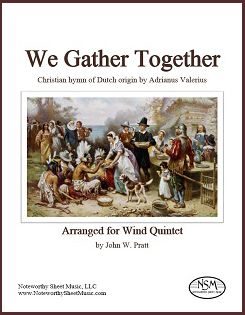 We Gather Together, by Adrianus Valerius
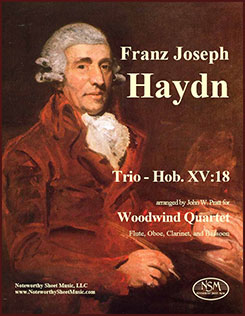 Trio, Hob. XV:18, by Franz Joseph Haydn
 Trio, Hob. XV:25 ‘Gypsy’, by Franz Joseph Haydn
 A Little Grand Wedding March Waltz, by Tom Schnauber
 Variationen über ein Thema von Robert Schumann, Op.23, by Johannes Brahms
 This edition includes 25 pieces from Book 1 arranged as duets; all of them can be played by B-flat clarinet and either flute or oboe, but for six of the pieces we also include alternative versions with octave changes that are better suited to oboe. The pieces included are Nos. 1-15, 22-26, 29, 31, 21, 40, and 42. Click to listen to computer-generated audio samples from the score; audio clips of #11 "Me and the Rain" with flute and clarinet and #32 "Wedding Day and Night" with oboe and clarinet are separated by a brief pause.
 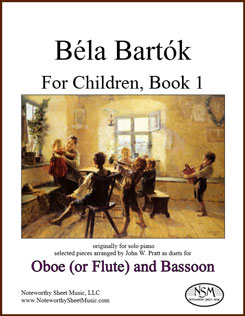 Our oboe (or flute) and bassoon edition includes the same 25 pieces from Book 1 as our flute and clarinet edition described above, except here they are arranged and optimized as duets for oboe and bassoon, with alternative versions better suited for flute and bassoon provided for two of the folksongs.
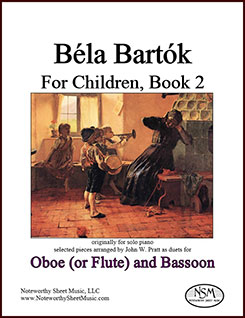 The oboe (or flute) and bassoon edition includes the same 23 pieces from Book 2 described above for flute and clarinet, here arranged and optimized as duets for oboe and bassoon, with an alternative version better suited for flute for one of the pieces.
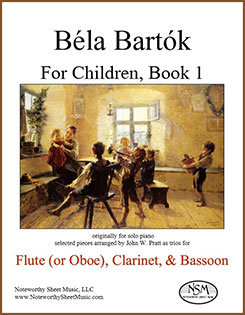 In this trio edition, we present 20 songs from Book 1, including 14 that are also available as duo arrangements in the editions listed above and 6 that are only offered in our trio edition. The pieces are Nos. 1-9, 11, 13-15, 19, 20, 30, 35, 39, 41, and 42. The trios are arranged for flute or oboe, B-flat clarinet, and bassoon. Click to listen to a computer-generated audio sample from #39 "Insect Wedding".
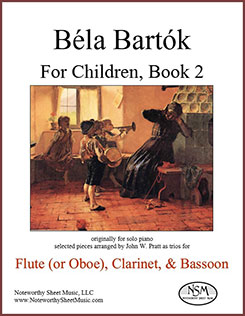 Here Mr. Pratt offers eighteen of Bartók’s Book 2 Slovakian folksongs in arrangements for a woodwind trio of flute or oboe, B-flat clarinet, and bassoon; the pieces included are Nos. 2, 3, 7, 9, 11-14, 16, 17, 21, 25, 26, 28, 29, 32, 33, and 42. Ten of these songs are also included in our duo arrangement publications.
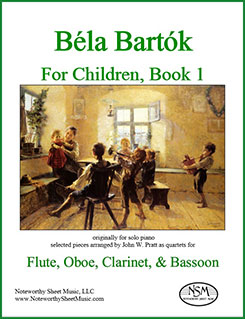 This edition includes eleven of Bartók’s Hungarian folksongs in arrangements for a woodwind quartet of flute, oboe, B-flat clarinet, and bassoon. Two of these songs, Nos. 19 and 20, are also included in our trio arrangement publication, but none are replicated in the duo arrangement editions; the quartet publication includes Book 1 Nos. 16-21, 27, 28, and 36-38.
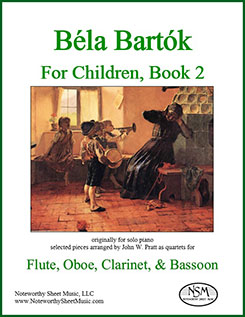 This edition presents seventeen of Bartók’s Book 2 Slovakian folksongs in arrangements for woodwind quartet (flute, oboe, B-flat clarinet, and bassoon). Four of these songs, Nos. 11, 14, 25 and 28, are also included in our trio arrangement publication, and several are included in the duo arrangement editions. The Book 2 songs arranged here as quartets are Nos. 5, 8, 11, 14, 15, 18, 23- 25, 27, 28, 30, 31, 34, 37, 38, and 43. Click to listen to a computer-generated audio sample that consists of ~32” of song #5 Bird in Flight (Theme & part of Var.1, through m34), followed immediately by #18 Former Flame in its entirety.
 Play of Light, by Richard Nelson
 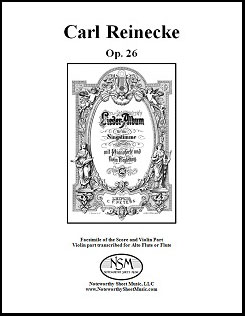 Waldesgruss and Frühlingsblumen, Op.26, by C. Reinecke
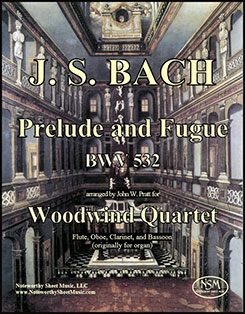 Prelude and Fugue, BWV 532, by J. S. Bach