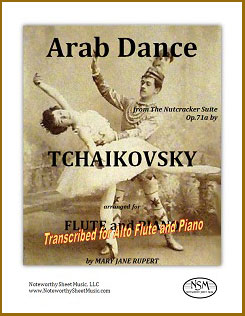
 Arab Dance, by P. Tchaikovsky
Arranged for Flute and Harp or Piano by Mary Jane Rupert
Transcribed for Alto Flute by C.A.Vater
Alto Flute Part and Harp or Piano Score, PDF $7.99
Mary Jane Rupert's arrangement of The Nutcracker for flute and harp or piano includes all of the pieces from the original Suite, Op. 71a, except the Overture. Dr. Rupert stayed as close as possible to the original orchestration, in terms of key, harmony, register, and color. Originally published in 1988, the arrangement was re-edited by Dr. Rupert in 2013 for publication as separate flute/piano and flute/harp editions by Noteworthy Sheet Music. After creating the new flute editions, Noteworthy Sheet Music's editors realized that one of the pieces of the suite in particular, Arab Dance, would work beautifully on alto flute. We created an alto flute transcription of the flute part, both for ourselves and for our alto flutist friends.
We offer separate versions of the score for piano or harp, although in the case of the Arab Dance the harp-specific notation is minimal compared to some of the other pieces contained in the complete edition of The Nutcracker arranged for flute and harp.
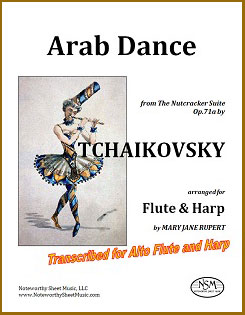 Alto Flute & Harp Edition: Harp score, 6 pages; Alto Flute part, 1 page; Total, 10 pages. $7.99Preview
Alto Flute & Piano Edition: Piano score, 6 pages; Alto Flute part, 1 page; Total, 10 pages. $7.99
Preview
 Old Folks at Home and Oh! Susanna, by Stephen Foster
Arranged with Flute and Cello ad lib by John W. Pratt
Flute Parts, Cello Parts, Voice Parts, and Piano Scores ― PDF $7.99
The following excerpts are taken from John W. Pratt's foreword to the edition:
When a Golden Oldie comes to mind, Doo-dah! Doo-dah!Comic, sad, or any kind, Oh! Doo-dah-day!Jeanie, Swanee, Kentucky, Joe, Doo-dah! Doo-dah!Beautiful, dreamy, fast, or slow, Oh! Doo-dah-day!I'll bet I know who wrote it, he wrote them night and day,Stephen Foster wrote it, he'll never go away.
Stephen Foster was born in Lawrenceville, Pa., on July 4, 1826...He wrote over 200 songs, including 135 parlor songs, 28 minstrel songs, and 21 hymns and Sunday school songs. A remarkable number are memorable, as the ditty above will attest to anyone with anything like my background. One wonders why. The harmonies and rhythms are basic, as are the forms and rhyme schemes (see above), the music is repetitious, and the vocal range rarely goes outside an octave (a great benefit for community singing). Yet the fit is so natural and the pacing so well judged that the songs are ideally effective and diabolically catchy. Foster is perhaps, though on a different plane, the Mozart of his field...
For a pianist playing several stanzas at a sing-along, Foster's songs do become a little dull. But their very simplicity, repetitiousness, and familiarity abet variation as, again on a different plane, chorales serve Bach chorale preludes. Like chorale preludes, the piano parts here always incorporate the melody, so they can be played solo or to accompany amateur singers. It struck me that they could be enhanced by optional flute parts. After writing them, I discovered that, according to his brother Morrison, Foster himself "delighted in playing accompaniments on the flute...As the song went on he would improvise...the most beautiful variations upon its musical theme." If Foster's improvisations were like the one his brother published, however, they just varied the melody itself in the manner of the period. My game is more ambitious, as you will easily see. I added optional cello parts, mostly for color, as in the Haydn trios but superficially more interesting for the cellist. (Again we are on a different plane, of course.)
"Oh! Susanna," one of the best-known American songs by anybody, is Foster's "Erlkönig." (Speak of different planes!) With its nonsensical lyrics and polka beat, it is clearly comical, and I treated it accordingly. It was written in Cincinnati, possibly for a social club, first performed at an ice cream saloon in Pittsburgh in 1847, and published in 1848. When no American song had sold over 5,000 copies, it sold over 100,000. It earned Foster only $100, but its popularity led to a publisher's offer, convincing him to become a professional songwriter, America's first.
"Old Folks at Home" established Foster as a truly American composer. It was written in 1851 for a blackface troupe whose leader paid Foster about $15 to be credited for it. When almost finished, Foster asked his brother for "a good name of two syllables for a Southern river." He rejected Yazoo and Pedee, but was delighted with Swanee, a shortening of Suwanee, a small river in Florida which his brother found in an atlas. Though about a slave's nostalgia for home, I find its theme universal and melancholy and I resisted the temptation to jazz it up. Please try, at least, a slowish tempo.
― John W. Pratt, May 27, 2013 ©
Flute parts, 2 pages; Cello parts, 2 pages; Voice parts, 2 pages; Scores, 7 pages; Total, 18 pages.
Preview
 In die Ferne, Op.98, No.1, by J. W. Kalliwoda
Facsimile Edition plus Transcription of Violin part for Flute by C.A.Vater
Score for Violin, Voice, & Piano, Violin Part, Flute Part, PDF $5.99
Johann Wenzel Kalliwoda (1801‒1866) was a Bohemian violinist, conductor, and composer who spent much of his career in Donaueschingen, where he served as the conductor of the court orchestra for Prince Karl Egon II of Fürstenberg. Kalliwoda composed numerous works, including operas, symphonies, pieces for piano, violin and orchestra, and chamber music.
Kalliwoda's song In die Ferne (Far Away) was published in a nineteenth century collection of lieder, along with several songs by Hauptmann and Reinecke. The vocal range of In die Ferne extends from E4 to G#5, and thus is well-suited for either soprano or mezzo-soprano. Our edition contains "enhanced" facsimiles of the original score (violin, voice, and piano) and violin part, plus a transcription of the violin part for flute created using a modern music notation program. Therefore, In die Ferne may be performed using the accompaniment of either violin or flute, along with the voice and piano.
Score, 6 pages; Violin and Flute parts, 1 page each; Total, 12 pages.
Preview
===============
U.S. customers may purchase professionally-printed hard copies of In die Fernefor $10.18 plus a $5.95 shipping and handling fee. Please use the Contact Us form to let us know which print edition(s) you would like to purchase, along with your contact information and your USPO mailing address.
 Prelude and Fugue, WTC Book I, No.22, by J. S. Bach
Transcribed for String Quintet by John W. Pratt, PDF $16.00
Though written for keyboard, this Prelude and Fugue from Book I of Bach's Well-Tempered Clavier is wonderfully adaptable to an instrumental quintet. The Prelude, with its serene harmonic pacing, reveals an almost Schubertian sublime beauty, and the magical counterpoint of the five-part fugue emerges crystal-clear. The challenge for the players, as well as the pleasure, lies in ensemble achievements, not technical difficulties in individual parts.
Score, 6 pages; Parts, 2 pages each, for Violin I, Violin 2, Viola 1, Viola 2, and Cello
with an alternate part for Cello in place of Viola 2; Total, 20 pages.
Preview
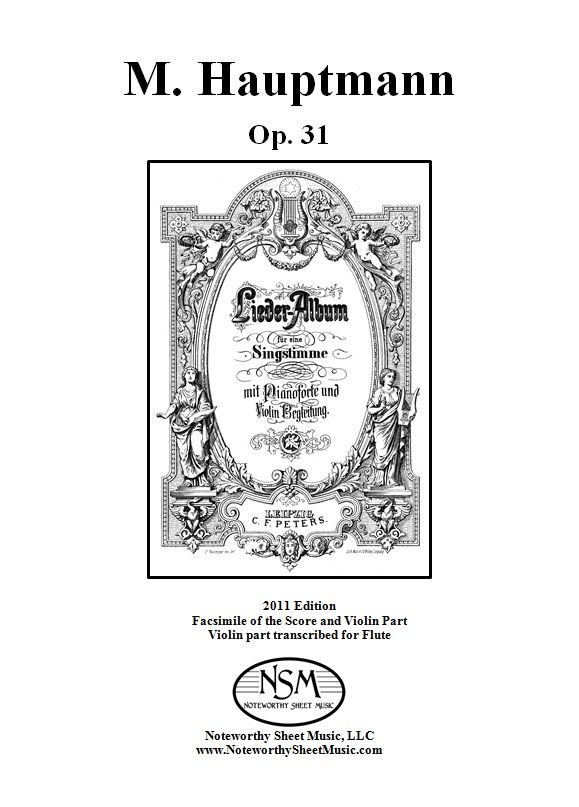 Meerfahrt, Nachtgesang, and Der Fischer, Op.31, by M. Hauptmann
Facsimile Edition plus a Transcription of the violin part for Flute by C.A.Vater
Score for Violin, Voice, & Piano, Violin Part, and Flute Part, PDF $18.75
Moritz Hauptmann (1792-1868) was a renowned music theorist, pedagogue, violinist, and composer. In 1842, at Mendelssohn's recommendation, he was appointed cantor at the Thomasschule and professor of composition at the newly founded Leipzig Conservatory. Hauptmann published a major scholarly work on music theory in 1853, "Die Natur der Harmonik und Metrik" (The Nature of Harmony and Meter), as well as some 60 compositions.
Hauptmann's Op.31 comprises three lovely songs scored for voice with accompaniment of violin and piano: No.1, Meerfahrt (Sea Voyage); No.2, Nachtgesang (Night Song); and No.3, Der Fischer (The Fisherman). The vocal range extends from B3 to G5, and thus is well-suited for mezzo-soprano. These pieces were published by C. F. Peters as part of a larger volume, now in the public domain, entitled "Lieder-Album für eine Singstimme mit Pianoforte und Violin Begleitung". Our edition contains an "enhanced" facsimile of the original, plus a new transcription of the violin part for flute created using a modern music notation program. The three songs may be performed with comparable gratification utilizing the accompaniment of either violin or flute, along with the voice and piano.
Score, 15 pages; Violin part, 5 pages; Flute part, 5 pages; Total, 29 pages.
Preview
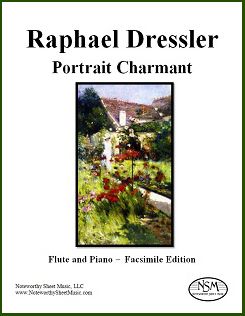 Portrait Charmant, by Raphael Dressler
Gassett Collection - Facsimile Edition by C.A.Vater/Noteworthy Sheet Music
Part for Flute or Violin and Piano Score, PDF $3.00
Raphael Dressler (1784-1835) was a well-known Austrian flutist and composer. He wrote more than 100 compositions for flute and published a popular flute method book, New and Complete Instructions for the Flute. His career included a position as first flutist in the Kärntnerthor Theater orchestra in Vienna and many years as a teacher and performer in London. Dressler's Portrait Charmant is the fifth of his Douze Thèmes Favoris pour Pianoforte et Flûte (ou Violon). The piece is a short work, simple yet indeed charming, and playable by flutists (or violinists) and pianists of many skill levels. A favorite of ours, Portrait Charmant can also be played effectively as a solo work for flute or violin alone.
For additional information about the Gassett Collection, please see see our article An Introduction to the Gassett Collection.
Piano score, 3 pages; Flute or Violin part, 1 page; Total, 8 pages.
Preview
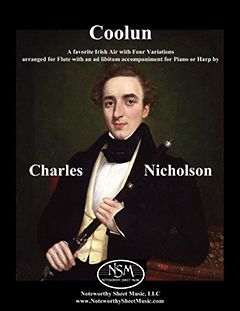 Coolun, A favorite Irish Air with Four Variations, by C. Nicholson
Gassett Collection - Facsimile Edition by C.A.Vater/Noteworthy Sheet Music
Piano Score and Flute Part, PDF $9.99
Charles Nicholson (1795-1837) was a masterful, hugely popular, and highly influential English flutist and teacher, famous for his individual style and powerful tone. Among Nicholson's compositions are 13 fantasies and 15 airs with variations, including Coolun. A favorite Irish Air with Four Variations arranged for the Flute with an ad libitum Accompaniment for the Piano Forte, or Harp. The "Coulin" or "Coolan" was described in an 1833 letter to the editor of the Dublin Penny Journal (www.libraryireland.com) as "an air, that once heard even in the earliest infancy, can never be forgotten—a melody which breathes the most touching tenderness and exquisite sensibility, and the memory of which, enables the Irish to hear Scotland's 'O, Nanny wilt thou gang with me,'—or her 'Banks and Braes,' without envious repinings."
Nicholson's consummate rendition of Coolun is highly effective when played either as a solo for flute alone or by flute with accompaniment of piano, lever harp, or pedal harp. The Gassett Collection print from which our facsimile was created consists of a score for piano forte and flute, without a separate flute part. The flute part included in our edition was created from the score using a modern music notation software program.
Noteworthy Sheet Music's publication of Coolun was favorably reviewed by Katherine Borst Jones in the January, 2014 issue of Flute Talk magazine. You can read the review, reproduced on our website for your convenience, or at Flute Talk (subscribers).
For additional information about the Gassett Collection, please see see our article An Introduction to the Gassett Collection.
Piano score, 6 pages; Flute part, 5 pages; Total, 15 pages.
Preview
==============================================================================
To order our print edition of Coolun, A Favorite Irish Air arranged for Flute and Piano or Harp for $16.98 plus a $5.95 shipping and handling fee to addresses in the USA. Use the Contact Us form to let us know which hard copy publication(s) you would like to purchase, along with your email contact information and USPS mailing address. We will then send you a PayPal invoice for the sale and, once we receive notice from PayPal that you have paid for the item(s), we will ship your music to the address provided.
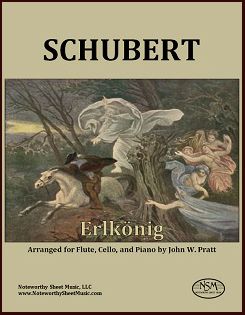 Erlkönig, Franz Schubert
Arranged for Flute, Cello, and Piano by John W. Pratt
Piano Score and Parts for Flute and Cello; PDF $11.99
Franz Schubert (1797-1828), inspired by reading Goethe's poem, wrote his song "Erlkönig" in a few hours in 1815. The song was an immediate hit, and continues to be popular to the present day. Numerous transcriptions have been prepared, but surprisingly none that we found for flute, cello, and piano. John Pratt has created such a trio arrangement, listed here, and also a duet version of the piece with Schubert's solo part adopted without change but with a less punishing alternative to Schubert's piano accompaniment.
Excerpted from Mr. Pratt's © preface:
"In the trio arrangement, the flute provides a natural voice for the child and for the mysterious Erlking, whose words are in the child's head. The cello makes a natural father. The narration is mostly given to the cello also, but the flute takes over when the child is mentioned in bars MM 24-30, and joins the cello when the ride is ending in anguish and distress (MM 139-145). The piano is treated as a member of a trio rather than an accompaniment to a voice singing words. The presence of the cello helps free the piano from the constant pounding and allows it to employ a wider range of expressive sonorities than Schubert's, befitting the absence of words. One might view the result as a kind of tone poem."
Piano score, 8 pages; Flute part, 2 pages; Cello part, 2 pages; Total, 20 pages.Preview
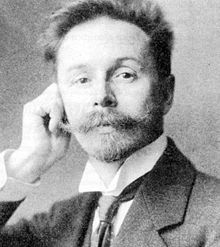 Romance, by Alexander Scriabin
Transcribed for Clarinet or Flute or Alto Flute (and Piano) by J. W. Pratt
Parts, PDF $0.00
Alexander Scriabin (1872-1915), the mystic Russian composer with music to match, wrote nine mind-bending orchestral works and myriad mostly miniature piano pieces. He began as a "Russian Chopin" and ended planning a week-long "Mysterium" to be performed in the Himalayas using "an orchestra, a large mixed choir, an instrument with visual effects, dancers, a procession, incense, and... mists and lights" (Wikipedia).
The Romance of 1890, his only chamber work except one variation for string quartet, is nearer the Chopin end of that spectrum, though the piano part adds harmonic and rhythmic complexities not evident from the solo part alone.
—John W. Pratt, Jan. 19, 2016
Please click on the links to download your free PDFs:
Transcription for clarinet required no changes of pitch. Scriabin - Romance - Clarinet
The transcription for flute is raised an octave, except the last five measures. Scriabin - Romance - Flute
The transcription for alto flute raises MM21-24 and MM36-48 an octave. Scriabin - Romance - Alto Flute
The piano score is freely available on IMSLP.org.
Scriabin image courtesy of Wikimedia.org, PD-old.
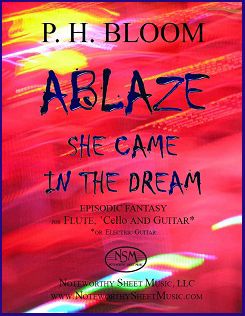 Ablaze She Came in the Dream, by Peter H. Bloom
Contemporary Composition for Flute, Cello, and Guitar (or Electric Guitar)
Flute, Cello, & Guitar Parts, and Score, PDF $22.97
Ablaze She Came in the Dream by flutist Peter H. Bloom was scored in its original version for flute, viola, and guitar. This intriguing piece comprises eleven brief episodes, which may be repeated any number of times. It is intended to serve as an interpretive vehicle for the performers and thus should be executed freely and expressively. Ablaze received its premier performance in November, 2014, in Boston as part of the Church of the Advent Library Concert Series and featured Mr. Bloom on flute, Frank Grimes on viola, and Anastasiya Dumma on electric guitar.
In the spring of 2016, NSM received a request for a cello version of Ablaze; we complied by creating, in collaboration with the composer, an adaptation for flute, cello, and guitar. Ablaze is not only an exciting piece to hear, it's fun to play as well. Both the viola and cello editions are suitable for adventurous, advanced players. Those wishing to purchase one of our Ablaze editions and then order an additional alternative viola or cello part for a small charge should use the Contact Us form to let us know; we'll make arrangements to accommodate your request.
Score, 23 pages; Flute Part, 11 pages; Guitar Part, 12 pages; Cello Part, 12 pages; Total, 66 pages.
Preview
