Arranged for Cello (or Viola or Alto Flute) and Piano by John W. Pratt
Piano Score and Parts for Cello/Voice, Viola, and Alto Flute; PDF $11.99
Franz Schubert (1797-1828), inspired by reading Goethe's poem, wrote his song "Erlkönig" in a few hours in 1815. The song was an immediate hit, and continues to be popular to the present day. John Pratt has created a trio arrangement for flute, cello, and piano (click for more information), and also the duo version offered here with Schubert's solo voice part transposed for cello (or viola or alto flute), and with a less arduous alternative to Schubert's piano accompaniment.
Contemporary Composition for Tenor or Soprano, with Flute (doubling Piccolo), Clarinet in B-flat, Bassoon, and Horn in F
Score and Parts, PDF $13.99
Peter H. Bloom is a Boston-based flutist, whose original compositions and arrangements are published by Noteworthy Sheet Music. From the Drawer was written for Tenor or Soprano, with Flute (doubling Piccolo), Clarinet, Bassoon, and Horn, and provides a musical setting for the intensely emotional poem by Constantine Cavafy.
"Constantine Cavafy’s 1923 poem, From the Drawer, captures the acerbic condition of longing, the impossibly private nature of affection, and the occultation of time. Its poignancy is universal; transcending gender, age, era, place, and even translation. Rather than rely on one particular translation of Cavafy’s text, I’ve drawn on a number of versions to arrive at a paraphrase that both informs and is shaped by the musical score.
The musical setting is a sonic image of the intensely emotional response to a flood of memory that informs the poet’s narrative: now pensive, now anxious, now wistful, now joyous, now fraught, now resigned, and ever mercurial." P. H. Bloom, September 19, 2015
Our sheet music edition of From the Drawer was featured on the New Products page of the Summer 2016 edition of "The Flutist Quarterly", journal of The National Flute Association.
We also offer a professionally-printed hard copy edition of From the Drawer for $23.78 plus a $5.95 shipping and handling fee. Due to prohibitively high international shipping rates, we ship print editions only to addresses in the USA. Please use the Contact Us form to let us know which hard copy publication(s) you would like to purchase, along with your email contact information and USPS mailing address. We will then send you a PayPal invoice for the sale and, once we receive notice from PayPal that you have paid for the item(s), we will ship your music to the address provided.
Arranged for Brass Ensemble by John W. Pratt Quartet version: Score and Parts for C-Trumpet-1, C-Trumpet-2, F Horn, and Trombone; Quintet version: Score and Parts for C-Trumpet-1, C-Trumpet-2, F Horn, Trombone, and Tuba;
Edition includes both Quartet and Quintet versions; PDF $7.99
Wilt heden nu treden, nowadays more commonly known as We Gather Together, is a Christian hymn of Dutch origin composed by Adrianus Valerius and first published in 1626 (imslp.org); it was later harmonized by Eduard Kremser (en.wikipedia.org). In the United States, We Gather Together is the most popular song traditionally associated with the Thanksgiving holiday. The Thanksgiving tradition in the Pratt household goes back as far as John Pratt (b. 1931) can remember, and when it fell to him to play all three stanzas at his family's annual gathering, he got interested in livening it up. He has now created an arrangement of We Gather Together for brass ensemble that lends new excitement and interesting harmonies to this old favorite. The opportunistic half-step modulations introduced to help amateur voices warm up also brighten successive stanzas for brass. The Noteworthy Sheet Music edition includes two variations of this brass arrangement, for quartet or quintet. Some of the parts (in addition to tuba) differ in the quartet and quintet arrangements, and we are including both complete sets of scores and parts in this single publication. Note that for these publications, the parts should be printed one-sided since they are only one page each and we have not inserted blank filler pages.
Click to listen to an mp3 of a computer-generated rendition of the brass quartet arrangement; your live performances will of course be more realistic and appealing.
Brass Quartet: Score, 3 pages; Parts for C-Trumpet-1, C-Trumpet-2, F-Horn, and Trombone, 1 page each. Brass Quintet: Score, 3 pages; Parts for C-Trumpet-1, C-Trumpet-2, F-Horn, Trombone, and Tuba, 1 page each. Total, 18 pages.
Arranged as Woodwind Duets by John W. Pratt (originally for keyboard)
Even the earliest of Franz Joseph Haydn’s keyboard sonatas have great rhythmic variety and vitality, and are delightful when played with verve. They are mostly in two voices, and even where not, their early classical harmonies are easily conveyed by two instruments. They incorporate few pianistic effects and lie comfortably within range for flute or oboe and bassoon or clarinet, and thus make natural woodwind duets of lively, interesting music. All these editions include a score and parts. Those wishing to consult the keyboard editions of the Haydn sonatas, from which Mr. Pratt created his arrangements, can find them at imslp.org. (Adapted from J. W. Pratt’s preface to the edition.)
Cover image “Decorations of the Sala Terrena, Eszterházy Palace in Fertőd, Hungary“ by Monyesz, Creative Commons Attribution-Share Alike 3.0 Unported license.
►Early Haydn Sonatas arranged by John W. Pratt as Duets for Flute and Bassoon, Vol. 1, Nos. 1-7
This edition includes seven of Haydn's early keyboard sonatas arranged as duets for flute and bassoon. John Pratt's creation of these duets was inspired by a desire to offer two of his music colleagues some new music to enjoy, as they had exhausted their available flute and bassoon duo repertoire. These duets work nicely for winds and are fun to play. For a sense of how they sound when played by flute and bassoon, click below to listen to a computer-generated audio excerpt: the first 45” of the recording come from the Andante of Sonata 5 (Hob. XVI:11), followed by 25” of the Sonata 6 (Hob. XVI:10) Presto. Alternatively, the flute part can be played on oboe, making these sonata arrangements nicely amenable to oboe and bassoon duos as well.
►Early Haydn Sonatas arranged by John W. Pratt as Duets for Flute and B-flatClarinet, Vol. 1, Nos. 1-7
Please see the description above for Volume 1 of Haydn’s early keyboard sonatas arranged as duets for flute and bassoon. Our flute and clarinet edition of Vol. 1 contains the same seven sonatas, here arranged for flute (or oboe) and B-flat clarinet. Click to listen to a computer-generated audio clip of two excerpts: the first 27” of the recording come from the Andante of Sonata 1 (Hob. XVI:8), followed by 26” of the Scherzo from Sonata 3 (Hob. XVI:9).
Colonel Bogey March by Kenneth J. Alford (Frederick J. Ricketts)
Arranged for Flute/Piccolo, Cello or Bassoon, and Piano by John W. Pratt (originally for military band)
Score and Parts for Flute/Piccolo and Cello, PDF $13.99
The Colonel Bogey March was composed in 1914 by the British Army bandmaster Frederick J. Ricketts, who published under the pseudonym Kenneth J. Alford. Having since appeared in a variety of famous films and TV shows, the tune will surely be familiar to most. As originally written for military band, the piece is best performed outdoors or in a very large hall. John Pratt has created an arrangement for an ensemble suitable to smaller spaces... a trio of flute/piccolo, cello or bassoon, and piano can cover the musical essentials just fine and provide desirable tonal variety to boot. (Please note that bassoonists use the cello part, playing the upper note where the cello has an occasional double stop.) For amusement, while also allowing time for the flutist to switch between flute and piccolo, Pratt has inserted a few short “what’s-that-tune?” passages, making for an especially entertaining adaptation of Ricketts’ composition.
Score, 14 pages; Flute/Piccolo part, 3 pages; Cello part (Bassoon uses cello part, playing upper note of double stops), 3 pages; Total, 24 pages.
Sinfonia Concertante, K.364, by Wolfgang Amadeus Mozart
Transcribed for Flute, Clarinet, and Piano by John W. Pratt (originally for Violin, Viola, and Orchestra)
Piano Score, Flute & Clarinet Parts, PDF $17.99
Excerpted from the Foreword by J. W. Pratt: "The idea that every piece, especially a major one, can be satisfactorily transcribed for whatever instruments one would like is one I firmly reject. However, a trio arrangement of this Sinfonia Concertante for flute, clarinet, and piano can, I believe, capture and present in a new light many of the wonders of this great work, even the wonders of its sonorities..... In the arrangement here, the flute and clarinet almost always play either a solo part or an orchestral part with only octave changes..... For the piano, on the other hand, straightforward orchestral reduction is often ineffective and unsatisfying, and that would certainly be true here, even with the flute and clarinet taking some wind parts. I have attempted instead to find natural piano "orchestrations" as alternatives to Mozart's orchestral layouts, especially where the full orchestra is playing..... Such effects, often heightened on returns, are better suited to the piano's capabilities and its role as a member of a trio than a straightforward reduction would be..... The music available for flute, clarinet, and piano includes surprisingly few major works. The purpose of our arrangement is to add a significant piece to this repertoire and to enable players and listeners to enjoy Mozart's magnificent Sinfonia Concertante in a new way."
Original Compositions for 2 Flutes, 2 Oboes, or 2 Clarinets, $0.00 (free!)
Elizabeth Vercoe's Duos for woodwinds are available as free downloads from the composer's own website at http://www.elizabethvercoe.com/. Dr. Vercoe kindly offered to allow Noteworthy Sheet Music, LLC to make these duets available from our website as well.
The Duos, in versions for two flutes, two oboes, or two clarinets, are "fun and quite easy. They are suitable for intermediate students."
Photo of Elizabeth Vercoe courtesy of Caroline Alden.
Just click on the links below to download the Duos at no charge; each PDF includes all 5 short duets:
Contemporary Composition for Flute, Viola, and Guitar (or Electric Guitar)
Flute, Viola, & Guitar Parts and Score, PDF $22.97
Flutist Peter H. Bloom is no stranger to Noteworthy Sheet Music or to our customers, as he has contributed several popular arrangements and transcriptions to our catalog and he also serves as an editorial consultant for NSM.
Now we are very pleased to offer this newly published (2014) and highly intriguing original composition by Mr. Bloom entitled Ablaze She Came in the Dream. The piece comprises eleven brief episodes written for the unusual trio combination of flute, viola, and guitar (or electric guitar). Ablaze is intended to serve as an interpretive vehicle for the performers and thus should be executed freely and expressively. The work is suitable for advanced players.
Click to access a recording of the premier performance of Ablaze which took place on November 21, 2014 in Boston, MA, as part of the Church of the Advent Library Concert Series. The performance features Peter H. Bloom on flute, Frank Grimes on viola, and Anastasiya Dumma on electric guitar.
==================================== We also offer a professionally-printed hard copy edition of Ablaze She Came in the Dream for $45.88 plus a $5.95 shipping and handling fee. Due to prohibitively high international shipping rates, we ship print editions only to addresses in the USA. Please use the Contact Us form to let us know which hard copy publication(s) you would like to purchase, along with your email contact information and USPS mailing address. We will then send you a PayPal invoice for the sale and, once we receive notice from PayPal that you have paid for the item(s), we will ship your music to the address provided for delivery in 7-10 business days.
Amy Marcy Cheney was born in Henniker, New Hampshire in 1867 and began composing music at the age of four. Initially home-schooled as a pianist, she continued her music studies in Boston and made her professional debut as a pianist at age 16. She later became a soloist with the Boston Symphony Orchestra. At 18, she married the prominent Boston physician Dr. Henry Harris Aubrey Beach and began using "Mrs. H. H. A. Beach" as her professional name. She continued to perform occasionally as a pianist, but for many years she focused her musical skills primarily on composing. After her husband's death in 1910, Mrs. Beach resumed her performing career, beginning with a three year tour of Europe, while also continuing to write music. Her works were received with great acclaim, and Amy Beach became one of America's leading composers and the first American woman composer to achieve widespread recognition in the United States and abroad. During her lifetime, she wrote more than 150 numbered works, spanning a variety of genres that included piano pieces, chamber music, orchestral works, sacred choral music, and a great many songs.
Amy Beach's 3 Compositions for Violin and Piano, Op.40, were first published in 1898. Written in the romantic style, the three pieces are (1) the beautiful but sombre La Captive, (2) a lovely, lyrical Berceuse, and (3) a lively but still tender Mazurka. In addition to alto flute transcriptions of all three pieces, we include in our edition a version of the Mazurka transcribed for flute and piano (score and part), for those wishing to give this option a try as well.

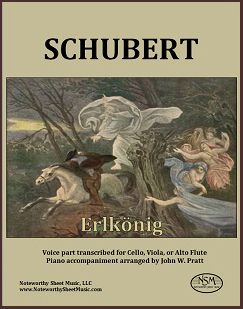 Erlkönig, by Franz Schubert
 From the Drawer, by Peter H. Bloom
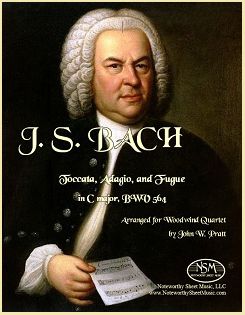 Toccata, Adagio, and Fugue in C major, BWV 564, by J. S. Bach
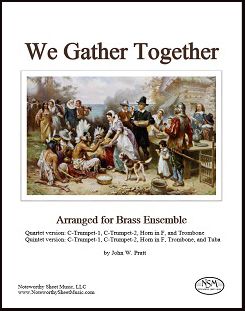 We Gather Together, by Adrianus Valerius
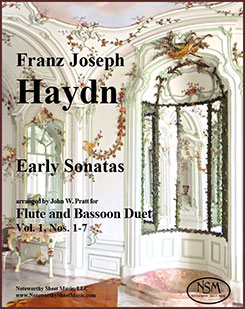 Early Sonatas, by Franz Joseph Haydn
 This edition includes seven of Haydn's early keyboard sonatas arranged as duets for flute and bassoon. John Pratt's creation of these duets was inspired by a desire to offer two of his music colleagues some new music to enjoy, as they had exhausted their available flute and bassoon duo repertoire. These duets work nicely for winds and are fun to play. For a sense of how they sound when played by flute and bassoon, click below to listen to a computer-generated audio excerpt: the first 45” of the recording come from the Andante of Sonata 5 (Hob. XVI:11), followed by 25” of the Sonata 6 (Hob. XVI:10) Presto. Alternatively, the flute part can be played on oboe, making these sonata arrangements nicely amenable to oboe and bassoon duos as well.
 ►Early Haydn Sonatas arranged by John W. Pratt as Duets for Flute and B-flatClarinet, Vol. 1, Nos. 1-7
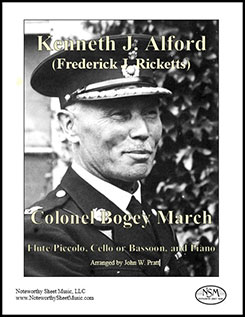 Colonel Bogey March by Kenneth J. Alford (Frederick J. Ricketts)
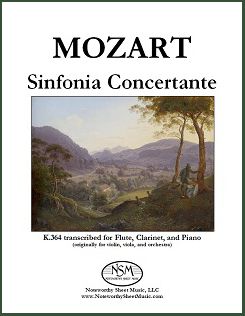 Sinfonia Concertante, K.364, by Wolfgang Amadeus Mozart
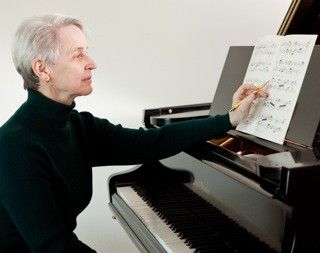 Woodwind Duos, by Elizabeth Vercoe
 Ablaze She Came in the Dream, by Peter H. Bloom
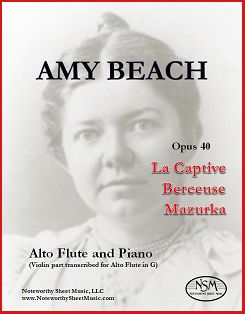 3 Compositions, Op.40, by Amy Beach