 Symphony 13, by Franz Joseph Haydn
Arranged for Multiple Flutes by John W. Pratt
Score and Parts for Flutes 1-4, Alto Flute, Bass Flute; PDF $23.95
This arrangement of Haydn’s Symphony No.13 is for a flute ensemble of any size including at least one bass, one alto, and two concert flutes. Third and fourth concert flute parts are also provided, and all parts can be doubled at will. If a contrabass flute is available, it can double the bass flute, serving to deepen and enrich the sound. The second movement is a beautiful Adagio cantabile, originally for solo cello accompanied by strings, which transcribes nicely for alto flute accompanied by the rest of the flute family. The trio of the symphony’s third movement has a delightful solo flute part with only string accompaniment. A large flute ensemble would be about the size of Haydn’s core orchestra at the time this symphony was composed; in our arrangement, Haydn’s original key has been raised a minor third to better suit the natural range of a flute ensemble.
Score, 17 pages; separate parts for Flute 1, Flute 2, Flute 3, and Flute 4, 6 pages each; Alto Flute part, 7 pages; Bass Flute part, 6 pages; Total, 68 pages.
Preview
 Quartet, Op.1, No.1, by Franz Joseph Haydn
Arranged for Flute Quartet by John W. Pratt (originally for strings)
Score and Parts for Flute 1, Flute 2, Alto Flute, and Bass Flute, PDF $15.99
The earliest quartets of Franz Joseph Haydn are not precursors of the later works wherein he developed the form and style of the classical string quartet, but rather divertimenti written for four friends when he was about 25. Most of these early works have five movements: fast, minuet/trio, slow, minuet/trio, fast; and their slow movements feature beautiful, elaborate, gently accompanied melodies.
The divertimento style and instrumental character of these early pieces does not evoke strings specifically or necessarily, and thus arrangement for other instruments is natural and might expand enjoyment of these wonderful first significant Haydn works to other players and audiences. In John Pratt’s arrangement of Haydn’s Op.1, No.1 (Hob.III:1), most of the range issues for flutes were solved by transposition up a step, a few more by exchanging the two inner voices in places or by octave transpositions. This lovely, effective arrangement is for a flute quartet consisting of two concert flutes, alto flute, and bass flute; the edition is available exclusively from Noteworthy Sheet Music.
Score, 19 pages; Parts for Flute 1, Flute 2, Alto Flute and Bass Flute, 5 pages each; Total, 46 pages.
Preview
 Quintet, K.516 by Wolfgang Amadeus Mozart
Arranged for Flute Quintet by John W. Pratt (originally for strings)
Score and Parts for Flute 1, Flute 2, Alto Flute 1, Alto Flute 2, and Bass Flute, PDF $23.50
Wolfgang Amadeus Mozart (1756-1791) wrote six quintets for 2 violins, 2 violas, and cello. Two of these, K.515 in C major and K.516 in G minor, are generally regarded as high points in Mozart’s, and indeed all, chamber music. Adaptation of K.516 to flute quintet is apropos, as its textural possibilities apply also to a flute quintet, and its musical and emotional content are well worth viewing through the prism of five flutes. In John Pratt’s arrangement, the work has been transposed up a step to better adapt to a flute ensemble. Our edition includes a score as well as parts for two concert flutes, two alto flutes, and bass flute.
Score, 30 pages; Flute 1, 14 pages; Flute 2, 13 pages; Alto Flute 1, 14 pages; Alto Flute 2, 13 pages; and Bass Flute, 11 pages of music; Total, 106 pages.
Preview
 Quintet, K.515, by Wolfgang Amadeus Mozart
Arranged for Flute Quintet by John W. Pratt (originally for strings)
Score and Parts for Flute 1, Flute 2, Alto Flute 1, Alto Flute 2, and Bass Flute, PDF $26.50
Wolfgang Amadeus Mozart wrote six quintets for 2 violins, 2 violas, and cello. Two of these, K.515 in C major and K.516 in G minor, are generally regarded as high points in Mozart’s, and indeed all, chamber music. Performances of K.515 are infrequent, far less than such great music deserves, since there is not enough repertoire to support permanent string quintets and string quartets have an abundance of great music to play without needing to find an additional violist. Adaptation to flute quintet is thus particularly apropos, as its textural possibilities apply also to a flute quintet, and its musical and emotional content are well worth viewing through the prism of five flutes. Our edition includes a score as well as parts for two concert flutes, two alto flutes, and bass flute. (adapted from jwp’s foreword to the edition)
Score, 37 pages; Flute 1, 16 pages of music; Flute 2, 14 pages of music; Alto Flute 1, 16 pages of music; Alto Flute 2, 14 pages of music; and Bass Flute, 14 pages of music; Total, 124 pages.
Preview
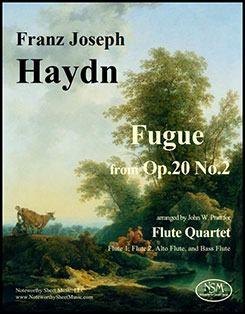 Fugue from Op.20 No.2, by Franz Joseph Haydn
Arranged for Flute Quartet by John W. Pratt (originally for strings)
Score and Parts for Flute 1, Flute 2, Alto Flute, and Bass Flute, PDF $14.99
Haydn's development of the string quartet, of which he was the father no less than of the symphony, reached maturity with his "Sun" quartets Op.20. The finales of three of the Op.20 quartets are fugues, and are regarded as highly important because they set the standard for contrapuntal texture in quartets. They are as lively and fun as any other Haydn finale, and all four instruments share the action. Transposed up a fourth, the finale of Op.20 No.2 suits the range of a flute quartet with some adaptation, mostly for the bass flute. It is a blast to play. —JWP
Score, 12 pages; Flute 1 part, 3 pages; Flute 2 part, 3 pages; Alto Flute part, 3 page; Bass Flute part, 2 pages; Total,30 pages.
Preview
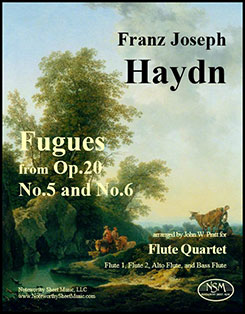 Fugues from Op.20 No.5 and No.6 by Franz Joseph Haydn
Arranged for Flute Quartet by John W. Pratt (originally for strings)
Scores and Parts for Flute 1, Flute 2, Alto Flute, and Bass Flute, PDF $21.75
Haydn’s quartets through Op.20 made him the father of the string quartet no less than of the symphony. Three of the finales of the Op.20 quartets are exuberant fugues with multiple subjects (Haydn “soggetti”)... four subjects in No.2, two in No.5, and three in No.6. John Pratt has arranged these lively fugues for flute quartet; this edition includes two of the fugues, those from Op.20 No.5 and No.6, while the Op.20 No.2 fugue has been published separately. A group of four flutes is well suited to the kittens-on-the-keys feel of Haydn’s Op.20 fugues, and they are a blast to play. For the arrangements in this publication, the No.5 fugue has been transposed up a major third and the No.6 fugue up a minor third to bring them into better range for flutes.
Scores, 20 pages; Flute 1 parts, 4 pages; Flute 2 parts, 4 pages; Alto Flute parts, 4 pages; Bass Flute parts, 4 pages; Total,46 pages.
Preview
Berceuse, Op.16, by Gabriel Fauré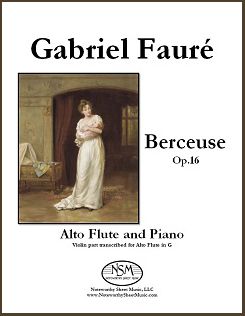
Transcribed for Alto Flute and Piano by C.A.Vater
Piano Score and Alto Flute Part, PDF $6.99
Gabriel Fauré composed his Berceuse(Op. 16) for violin (or cello) and piano in 1878-1879, and it was first published by J. Hamelle, Paris. To this day, the Berceuse remains one of Fauré's most beloved and popular works. The piece is simple but beautiful, short, with a quiet sweet melody that appeals to both performers and audiences alike. It is no wonder that over the years the Berceuse has been transcribed for many other instruments; arrangements have been created for solo piano, viola, flute, alto saxophone, flute and harp, and string quartet, in addition to the composer's own arrangement for violin and orchestra.
Now, in response to an excellent suggestion we received from one of our customers, we add our own version of the Fauré Berceuse, a transcription for alto flute and piano. Perhaps we are biased, but we think the alto flute is a wonderful instrument choice for this lullaby. The piece is suitable for players of all levels.
Alto Flute part, 2 pages; Piano Score, 5 pages; Total, 12 pages.
Preview
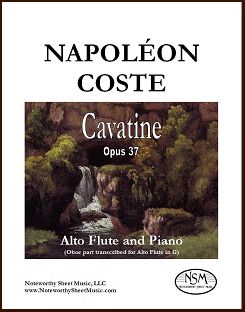 Cavatine, Op.37, by Napoléon Coste
Transcribed for Alto Flute and Piano by C.A.Vater
Piano Score and Alto Flute Part, PDF $8.25
Napoléon Coste (1805-1883) was born in a small village in the Départment of the Doubs, France. He began to play guitar at the age of 6, studying with his mother who was an accomplished guitar performer. Napoléon himself began teaching and performing on guitar as a teenager. At age 24 he moved to Paris, where he studied under Fernando Sor, the renowned Spanish classical guitarist and composer. Coste quickly established himself as a virtuoso and is widely acknowledged as the dominant French guitarist of his era.
Coste became famous not only as a guitar soloist, but also as a major composer of some 60 works, most of which were written for guitar. His Op.37 "Cavatine" is a short, single-movement piece composed for piano and oboe (or violin or flute). The work is lovely, melodic but lively in places; it falls nicely within the range of the alto flute and sounds appealing and completely natural on that instrument. The Noteworthy Sheet Music edition includes a score for piano and alto flute, in addition to the transcribed alto flute part.
Alto Flute part, 3 pages; Piano Score, 8 pages; Total, 16 pages.
Preview
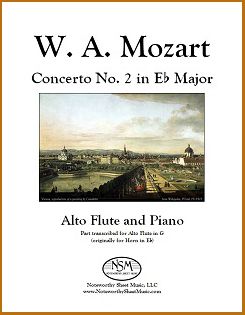 Concerto No.2 in E-flat major, K.417, by W. A. Mozart
Transcribed for Alto Flute (from horn and piano arrangement) by C.A.Vater
Piano Score and Alto Flute Part, PDF $9.99
Mozart wrote his Concerto No. 2 in E-flat major for Horn and Orchestra for his good friend, the virtuoso horn soloist Joseph Leutgeb (c.1745-1811), who became first horn in the orchestra of the Salzburg archbishop in 1770. The concerto was completed in 1783. Its movements are light, joyous, and teeming with melody: a wide-ranging opening allegro, a slow middle movement, and a final rondo. The second movement Andante is particularly lyrical and beautiful, whereas the concluding Rondo is quite comic with an obvious hunting theme.
The concerto was arranged for horn and piano by Henri Kling (1842-1918), horn player, composer, conductor, and professor. We used the Kling arrangement, which was published ca.1890 and is now in the public domain, as the basis of our transcription of the concerto for alto flute and piano. We introduced only minor changes to the solo horn line to adapt it for alto flute, and those alterations were made with sensitivity and the intention of preserving Mozart's inspired creation to the fullest extent possible.
Alto Flute part, 4 pages; Piano Score, 16 pages; Total, 22 pages.
Preview
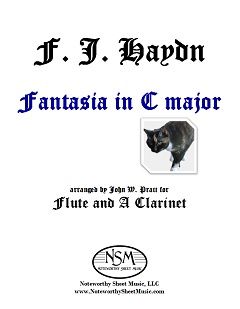 Fantasia in C major, by F. J. Haydn
Arranged as a Duet for Flute and Clarinet by John W. Pratt
Flute Part, A Clarinet Part, and Mini-Score ― PDF $12.99
Fantasia in C major (Op.58; Hob. XVII:4) was written by Haydn in 1789 for the pianoforte. Based on a folk song about a farmer's wife chasing her cat, one can easily imagine in the music kittenish scampering, stealthy approaches, unexpected pounces, and mad chases with abrupt changes of direction. The style and playfulness of the piece lend themselves well to flute and clarinet. The transcription is able to capture the feel Haydn intended, with new coloring, while at the same time affording flutists and clarinetists the joy of experiencing the work first-hand. (adapted from JWP's foreword to the edition)
Flute part, 6 pages; Clarinet in A part, 6 pages; Mini-score in concert pitch, 6 pages; Total, 24 pages.
Preview
