Brahms ― Sonata, Op.120 No.2 ― Alto Flute
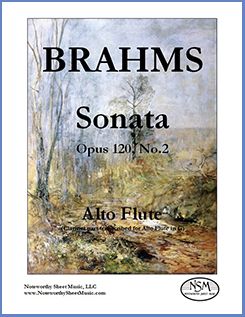
Brahms Op120 No2 Afl nsmSonata, Op.120 No.2, by Johannes Brahms

Transcribed for Alto Flute by J.W.Pratt

Alto Flute Part, PDF $8.99

This is the second of Brahms' two clarinet sonatas, transcribed for alto flute by John Pratt.  Although written originally for clarinet, Brahms himself created two more versions of his Op.120 sonatas, for violin and viola. Mr. Pratt, who transcribed these works for alto flute so expertly, writes in his foreword: "If Brahms was happy with versions for clarinet, viola, and violin, surely he would have welcomed arrangements for alto flute, especially since it is the mellow rather than the clarion aspect of the clarinet that he called on. In making our arrangements for alto flute, the violin versions have been particularly helpful, since the violin has the same lower range as the alto flute, but they required modification for several reasons. One, of course, is that the alto flute cannot play as loudly at the bottom of its range as the violin can. Another is that Brahms gave the violin double stops even though the clarinet is limited to a single voice." Our editions of the two Op.120 sonatas include only the alto flute parts, as Brahms' piano scores are freely available in the public domain. Here is a link to the listing of Op.120 No.2 on IMSLP.org, where the clarinet, viola, and violin versions with piano scores may be found. Our alto flute arrangements are based on the usual piano parts that accompany the clarinet as the solo instrument.

Alto Flute part, 8 pages; Total, 12 pages.

Preview
$8.99

alto flute, duet, duets: alto flute and piano

Brahms ― Sonata, Op.120 No.1 ― Alto Flute

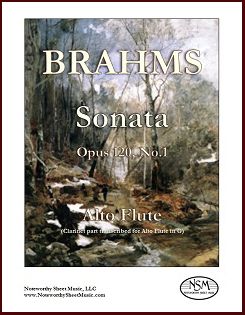
Brahms-Sonata-Op120-1 Afl nsmSonata, Op.120 No.1, by Johannes Brahms

Transcribed for Alto Flute by J.W.Pratt

Alto Flute Part, PDF $8.99

Although written originally for clarinet, Brahms himself created two more versions of his Op.120 sonatas, for violin and viola. John W. Pratt, who transcribed these works for alto flute so expertly, writes in his foreword: "If Brahms was happy with versions for clarinet, viola, and violin, surely he would have welcomed arrangements for alto flute, especially since it is the mellow rather than the clarion aspect of the clarinet that he called on. In making our arrangements for alto flute, the violin versions have been particularly helpful, since the violin has the same lower range as the alto flute, but they required modification for several reasons. One, of course, is that the alto flute cannot play as loudly at the bottom of its range as the violin can. Another is that Brahms gave the violin double stops even though the clarinet is limited to a single voice." Our editions of the two Op.120 sonatas include only the alto flute parts, as Brahms' piano scores are freely available in the public domain. Here is a link to the listing of Op.120 No.1 on IMSLP.org, where the clarinet, viola, and violin versions with piano scores may be found. Our alto flute arrangements are based on the usual piano parts that accompany the clarinet as the solo instrument. The entire transcription of Op.120 No.1 works remarkably well, but the breathtakingly beautiful slow movement played on alto flute will steal your heart away.

Alto Flute part, 9 pages; Total 14 pages.

Preview
$8.99

alto flute, duet, duets: alto flute and piano

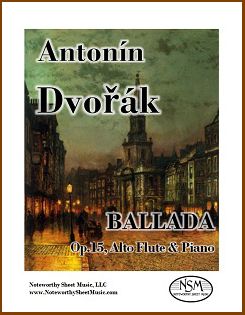
Dvořák - Ballada - Alto Flute & Piano

Dvorak-Ballada-Op15 AflPf nsmBallada, Op. 15, by Antonín Dvořák

Transcribed for Alto Flute and Piano by C.A.Vater

Alto Flute Part and Piano Score, PDF $7.99

The Czech composer Antonín Leopold Dvořák (1841-1904) first visited England in 1884, at the invitation of the Philharmonic Society of London. He conducted several of his works there and and was commissioned to compose a new symphony for the Philharmonic Society, his Symphony No. 7 in D minor, Op.70, which he conducted in London on April 22, 1885. Dvořák, who was well-received in England for his longer works, including cantatas and oratorios, was asked by London publishers to write shorter compositions as well. The Ballada, composed by Dvořák in late 1884 shortly after he completed his Symphony No. 7, was written specifically for publication in the Christmas edition of the London Magazine of Music. It is a short work of approximately six minutes duration for violin and piano. Written in the key of D minor, the Ballad's outer sections are solemn and melancholy while the contrasting central Allegro agitato is fervid and intense. The piece works nicely on alto flute, and our transcription required few adaptations from the original violin part.

[Sources for Dvořák biographical information: Baker's Biographical Dictionary of Musicians (Eighth Edition, Revised by Nicolas Slonimsky) and the internet website http://www.antonin-dvorak.cz/en/ballad.]

Score, 8 pages; Alto Flute part, 3 pages; Total, 14 pages.

Preview
$7.99

alto flute, piano, duet, duets: alto flute and piano

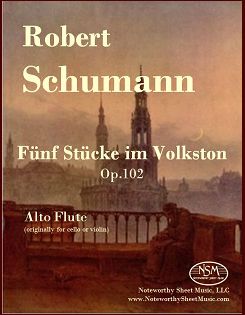
Schumann - Five Pieces in Folk Style - Alto Flute

Schumann Funf-Stucke-Op102 nsmFünf Stücke im Volkston, Op.102, by Robert Schumann
Transcribed for Alto Flute (and Piano) by John W. Pratt

Alto Flute Part, PDF $6.99

Excerpted from the foreword by John W. Pratt:
"Robert Schumann (1810-1856) wrote Fünf Stücke im Volkston (Five Pieces in Folk Style), Opus 102, for violoncello and piano on April 13-15, 1849.  //   Fünf Stücke im Volkston was premiered on Schumann's 40th birthday, June 8, 1850 by his wife, Clara, and their friend Andreas Grabau, the dedicatee, a cellist in the Leipzig Gewandhaus Orchestra. Clara thought the pieces beguiling, fresh, original, and under-appreciated. They have been viewed as precursors of his cello concerto, composed in October, 1850, and first performed after his death in honor of his 50th birthday.  // Just as folk songs may appropriately be sung by a great variety of voices, it is perhaps appropriate that songs without words in folk style may be played by a great variety of solo instruments and piano. In any event, Schumann's Fünf Stücke im Volkston have been arranged for oboe, viola, clarinet, alto saxophone, horn, bass clarinet, bassoon, trombone, and baritone saxophone, at least. The pieces are this popular for good reason, being varied and appealing, and we are pleased to add alto flute to this list. Though often programmed by professionals, they call for folk-like playing, not virtuosity, and are entirely suitable for ordinary folk."

We provide our transcribed alto flute part only; the piano score is in the public domain and available without charge from imslp.org.

Alto Flute part, 6 pages; Total, 10 pages.

Preview
$6.99

alto flute, duet, duets: alto flute and piano

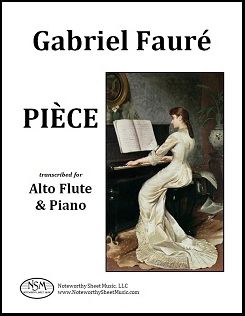
Fauré - Pièce - Alto Flute & Piano

faure piece nsmPièce (Vocalise-Étude), by Gabriel Fauré

Transcribed for Alto Flute and Piano by C.A.Vater

Alto Flute Part and Piano Score, PDF $4.99

Vocalises are songs without words written to provide technical challenges for singers; they are designed to develop flexibility and control, and thus often serve as vocal warm-up exercises.  Gabriel Fauré composed his Vocalise-Étude in 1906, and it was published by Leduc the following year.  The original piece, in the key of E minor and marked Adagio molto tranquillo, includes a piano accompaniment and incorporates various difficulties for the vocal soloist, including wide intervals, unexpected harmonies, and demanding rhythms.

Fauré's Vocalise-Étude has long been recognized as a particularly lovely and poignant piece of music, not merely a vocal exercise but a musical work of intrinsic beauty.  Under its alternative name Pièce, the Vocalise-Étude has been transcribed for various orchestral instruments, including bassoon and piano, flute and piano, and oboe and harp.  We at Noteworthy Sheet Music think the alto flute, with its rich, mellow tone, is the perfect instrument for this moving and somewhat melancholy Fauré melody.  Our transcription for alto flute and piano is based on the version of the Vocalise-Étude for medium voice, in the key of D minor, published by Alphonse Leduc in 1907 and now in the public domain.

Alto Flute part, 1 page; Piano Score, 3 pages; Total, 8 pages.

Preview
$4.99

alto flute, piano, duet, duets: alto flute and piano