D’Indy - Choral Varié, Op.55, trans. Alto Flute
DIndy ChoralVarie Afl nsmChoral Varié, Op.55, by Vincent d’Indy

Solo part transcribed for Alto Flute by C. A. Vater (originally for saxophone or viola)

Part for Alto Flute, PDF $5.99

D’Indy composed his Choral Varié pour Saxophone solo (ou Alto) et Orchestre, Op.55 in 1903.  The composer also created an orchestral reduction arrangement, published by Durand, Paris, 1903, for alto saxophone (or viola) and piano; it is this edition that we used as the basis for our transcription of the solo part for alto flute.  The Choral Varié piece is appealing and distinctive, solemn and tender.  It adapts nicely to the alto flute, highlighting the beautiful, intimate quality of that instrument’s low-register tones.  Our publication provides only our transcribed alto flute part; the piano part, published as the composer’s score in concert pitch for solo and piano, is freely available as a PDF download from imslp.org.

Alto Flute part, 3 pages of music; Total, 6 pages. 

Preview  
$5.99
 

alto flute, duet, duets: alto flute and piano

Schumann, Clara – Sechs Lieder - trans. for Alto Flute (and piano)

Clara Op13 Afl nsmSechs Lieder, by Clara Schumann

Transcribed for Alto Flute by C. A. Vater

Part for Alto Flute (in lieu of voice); PDF $5.99

In her Sechs Lieder, Op. 13, Clara Schumann set to music six German poems—two written by Heinrich Heine (Ich stand in dunklen Träumen and Sie liebten sich beide), three by Emanuel Geibel (Liebeszauber, Der Mond kommt still gegangen, and Die stille Lotosblume) and one by Friedrich Rückert (Ich hab’ in deinem Auge).  Many of Clara Schumann’s songs were composed as gifts for her beloved husband Robert; they are romantic, melodic and highly expressive, and the Sechs Lieder of Op. 13 appropriately convey the broad array of intense emotions portrayed in the poetry that inspired them.  These songs, which are absolutely charming, are nicely adaptable for a solo instrument in lieu of voice.  They have been transcribed previously for violin or cello, and likely other instruments as well, but are particularly lovely when played on either alto flute or clarinet, instruments for which the voice line falls completely in range. Our Noteworthy Sheet Music editions of Op. 13 for alto flute or clarinet do not include re-notated versions of the score, since a high-quality PDF of the original piano and voice score is available free of charge in the public domain, and that piano accompaniment works perfectly well with our instrumental transcriptions of the voice line.  The score we used when creating our parts may be downloaded from the IMSLP website.  For NSM’s clarinet transcription of the Sechs Lieder voice line, please click the link.

Alto Flute Part, 4 pages; Total, 6 pages.

Preview 
$5.99

alto flute, duet, duets: alto flute and piano, Women Composers

Burleigh - Southland Sketches, Nos. I, III, IV - Alto Flute or Flute (& piano)

Burleigh Sketches AflFl nsmSouthland Sketches, Nos. I, III, IV, by H. T. Burleigh
Transcribed for Alto Flute or Flute (and piano) by C. A. Vater

Alto Flute part and Flute part, PDF $9.96

Harry Thacker Burleigh was an acclaimed African-American singer, music editor, and composer whose adaptations of African-American spirituals became famous. His Southland Sketches, which were composed for violin and piano and published by G. Ricordi in 1916, are a fine example of Burleigh’s quintessential American style. The original composition included 4 movements. Our edition excludes the second movement, but adapts three of the original four miniatures for either alto flute or flute. We provide only the transcribed alto flute and flute parts, as they have been designed to work well with the piano part in the original score for violin and piano which is available as a good quality, free pdf download from imslp.org. Performers may choose to play all three of these pieces on either flute or alto flute, or switch instruments between sketches, depending on personal preference.

Alto Flute part, 6 pages; alternate Flute part, 6 pages; Total,18 pages. (pdf of piano accompaniment is freely available at imslp.org)

Preview
$9.96

flute, alto flute, duet, duets: flute and piano, duets: alto flute and piano

Falla - Siete Canciones populares Españolas - Alto Flute (& piano)

Falla 7Canciones afl nsm Seven Spanish Folksongs, by Manuel de Falla
Transcribed for Alto Flute (and piano) by C. A. Vater

Alto Flute part, PDF $8.99

Manuel de Falla (1876-1946) is regarded as one of the greatest Spanish composers of the twentieth century. His Siete canciones populares españolas (“Seven Spanish Folksongs”) is a cycle of traditional songs from various regions of Spain set for voice and piano. Written in 1914, the work quickly became very popular: in 1925, six of the seven songs were arranged for violin and piano as the Suite populaire espagñole by the Polish violinist, composer and arranger Paul Kochánski, and subsequent versions were designed for solo piano, voice and guitar, piano and cello, and orchestra. We created the Noteworthy Sheet Music alto flute part by adapting ideas from both the Falla vocal line and the Kochánski violin line, modifying pitches, articulations, dynamics, etc. as needed to best suit the alto flute’s range and style.  Our alto flute part is intended to be accompanied by piano using the original Falla score for voice and piano, which is available as a free downloadable pdf at imslp.org; we provide only the transcribed alto flute part in the NSM edition.

The seven songs included in the original voice and piano publication, as well as in our alto flute part edition, are El Paño Moruno (“The Moorish Cloth”), Seguidilla murciana (an old dance form, omitted in the Kochánski violin and piano version), Asturiana (a lament from the northern part of Spain), Jota (a familiar dance form from the north east of Spain), Nana (an Andalusian lullaby), Canción (“Song”), and Polo (reminiscent of the zapateado, a Spanish dance rich in flamenco rhythms). This information and an in-depth analysis of the Siete canciones populares españolas, including historical and regional background, music analysis, and an English translation of the lyrics, can be found in the excellent article by composer and conductor Gianmaria Griglio, co-founder and Artistic Director of ARTax Music.

Alto Flute part, 8 pages; Total,10 pages. (pdf of piano accompaniment is freely available at imslp.org)

Preview 
$8.99
 

alto flute, duet, duets: alto flute and piano

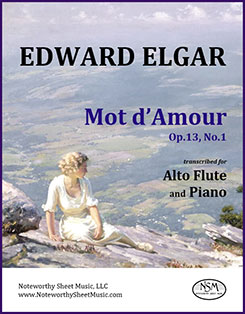
Elgar – Mot d’Amour – Alto Flute & Piano


Elgar Mot Op13 1 Afl Pf nsmMot d’Amour, Op.13, No.1, by Edward Elgar

Transcribed for Alto Flute and Piano by C. A. Vater

Piano Score and Part for Alto Flute, PDF $5.49

In 1888, Elgar composed Salut d’Amour, now one of his most-recognized pieces, as an engagement gift for his beloved fiancée. Later he wrote Mot d'Amour (Love's Word) for violin and piano as a companion piece to Salut d’Amour. Mot d'Amour, which was initially given the German title Liebesahnung, was published in 1889 by Osborn & Tuckwood in the edition 2 Pieces for Violin & Piano that included this piece and a second one, less well-suited to alto flute, called Bizarrerie. Mot d’Amour is similar to Salut d’Amour in being light, charming, and highly romantic. Although Mot d’Amour never attained the level of popularity achieved by the earlier work, it is considered by some to be the finer composition (https://www.elgar.org/3salut.htm). Both Salut d’Amour and Mot d'Amour sound especially rich and mellow when performed on alto flute, and both pieces are now available from Noteworthy Sheet Music as transcriptions for alto flute and piano, adapted from the composer’s violin and piano editions now in the public domain and available on imslp.org.  

Score, 4 pages; Alto Flute part, 1 page; Total, 8 pages.

 Preview 
$5.49

Instruments, alto flute, piano, duet, duets: alto flute and piano