Beach - 3 Compositions - Alto Flute & Piano
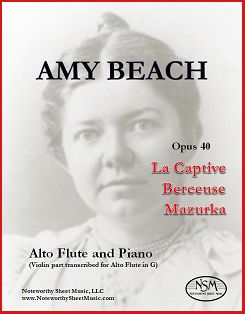
beach op40 nsm 245px3 Compositions, Op.40, by Amy Beach

Transcribed for Alto Flute and Piano by C.A.Vater

Piano Score and Alto Flute Part, PDF $10.50

Amy Marcy Cheney was born in Henniker, New Hampshire in 1867 and began composing music at the age of four.  Initially home-schooled as a pianist, she continued her music studies in Boston and made her professional debut as a pianist at age 16.   She later became a soloist with the Boston Symphony Orchestra.  At 18, she married the prominent Boston physician Dr. Henry Harris Aubrey Beach and began using "Mrs. H. H. A. Beach" as her professional name.  She continued to perform occasionally as a pianist, but for many years she focused her musical skills primarily on composing.   After her husband's death in 1910, Mrs. Beach resumed her performing career, beginning with a three year tour of Europe, while also continuing to write music.   Her works were received with great acclaim, and Amy Beach became one of America's leading composers and the first American woman composer to achieve widespread recognition in the United States and abroad.   During her lifetime, she wrote more than 150 numbered works, spanning a variety of genres that included piano pieces, chamber music, orchestral works, sacred choral music, and a great many songs.

Amy Beach's 3 Compositions for Violin and Piano, Op.40, were first published in 1898.   Written in the romantic style, the three pieces are (1) the beautiful but sombre La Captive, (2) a lovely, lyrical Berceuse, and (3) a lively but still tender Mazurka.  In addition to alto flute transcriptions of all three pieces, we include in our edition a version of the Mazurka transcribed for flute and piano (score and part), for those wishing to give this option a try as well.

Alto Flute part, 4 pages; Piano/Alto Flute Score, 10 pages; Alternate "Mazurka" Flute part, 2 pages; "Mazurka" Piano/Flute Score, 5 pages; Total, 29 pages.

Preview 
$10.50

flute, alto flute, piano, duet, duets: alto flute and piano, Women Composers
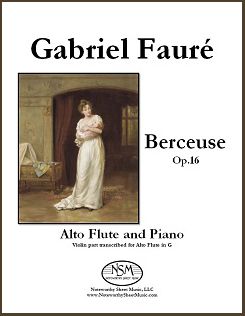
Fauré - Berceuse - Alto Flute & Piano

Berceuse, Op.16, by Gabriel Fauréfaure berceuse nsm

Transcribed for Alto Flute and Piano by C.A.Vater

Piano Score and Alto Flute Part, PDF $6.99

Gabriel Fauré composed his Berceuse (Op. 16) for violin (or cello) and piano in 1878-1879, and it was first published by J. Hamelle, Paris.   To this day, the Berceuse remains one of Fauré's most beloved and popular works.  The piece is simple but beautiful, short, with a quiet sweet melody that appeals to both performers and audiences alike.  It is no wonder that over the years the Berceuse has been transcribed for many other instruments; arrangements have been created for solo piano, viola, flute, alto saxophone, flute and harp, and string quartet, in addition to the composer's own arrangement for violin and orchestra.

Now, in response to an excellent suggestion we received from one of our customers, we add our own version of the Fauré Berceuse, a transcription for alto flute and piano.  Perhaps we are biased, but we think the alto flute is a wonderful instrument choice for this lullaby.   The piece is suitable for players of all levels.  

Alto Flute part, 2 pages; Piano Score, 5 pages; Total, 12 pages.

Preview
$6.99

alto flute, piano, duet, duets: alto flute and piano

Coste - Cavatine - Afl + Pf

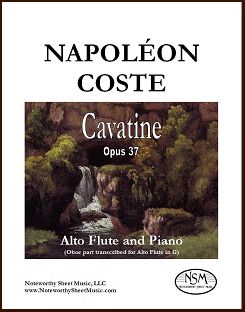
coste cavatine 245px nsmCavatine, Op.37, by Napoléon Coste

Transcribed for Alto Flute and Piano by C.A.Vater

Piano Score and Alto Flute Part, PDF $8.25

Napoléon Coste (1805-1883) was born in a small village in the Départment of the Doubs, France.  He began to play guitar at the age of 6, studying with his mother who was an accomplished guitar performer.   Napoléon himself began teaching and performing on guitar as a teenager.   At age 24 he moved to Paris, where he studied under Fernando Sor, the renowned Spanish classical guitarist and composer.   Coste quickly established himself as a virtuoso and is widely acknowledged as the dominant French guitarist of his era.

Coste became famous not only as a guitar soloist, but also as a major composer of some 60 works, most of which were written for guitar.  His Op.37 "Cavatine" is a short, single-movement piece composed for piano and oboe (or violin or flute).  The work is lovely, melodic but lively in places; it falls nicely within the range of the alto flute and sounds appealing and completely natural on that instrument.  The Noteworthy Sheet Music edition includes a score for piano and alto flute, in addition to the transcribed alto flute part.

Alto Flute part, 3 pages; Piano Score, 8 pages; Total, 16 pages.

Preview
$8.25

alto flute, piano, duet, duets: alto flute and piano

Kalliwoda - Concertino - Alto Flute

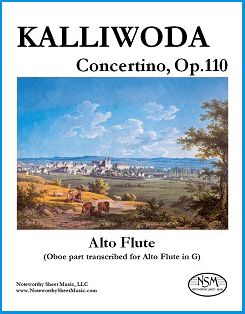
kalliwoda concertino 245px nsmConcertino, Op.110, by J. W. Kalliwoda

Transcribed for Alto Flute by C.A.Vater

Alto Flute Part ― PDF $6.99

Johann Wenzel Kalliwoda (1801‒1866) was a Bohemian violinist, orchestra conductor, and prolific composer who wrote numerous compositions, including operas, symphonies, various works for violin and orchestra, piano pieces, and chamber music works.  He was considered a significant composer in his day, especially for pieces written early in his career, and his music received the praise of Robert Schumann.  Kalliwoda was immensely popular and a favorite of American concert-going audiences in the first half of the 19th century.

His Concertino, Op.110, for oboe and orchestra was first published by Schott in 1841.  An arrangement of the work for oboe and piano is available on imslp.org, in addition to an orchestral score and parts for oboe, violins I and II, violas, cellos, and basses.  Like many of Kalliwoda's earlier compositions, the Concertino is highly melodic and energetic.  We created a transcription of the solo oboe part for alto flute that gives alto flutists an opportunity to experience first-hand the joy of playing this style of classical 19th century bravura work, for which the alto flute is well-suited.   Perhaps it should be pointed out that Theodore Boehm, who developed the modern alto flute in G during the mid-1850's, intended that the alto become a new instrument in its own right, utilized in a variety of musical roles and characterized by a unique quality of sound.  Indeed, we think Boehm likely would have approved of our creating new opportunities, such as this transcription of the Kalliwoda Concertino, to show off the alto flute's versatility and the alto flute performer's virtuosity.

We provide our alto flute part only; appropriate parts for piano or orchestral accompaniment may be obtained as free pdf downloads from public domain resources, such as imslp.org.

Alto Flute part, 7 pages; Total, 10 pages.

Preview
$6.99

alto flute, orchestra, duet, duets: alto flute and piano

Nielsen - Fantasy Pieces - Alto Flute & Piano

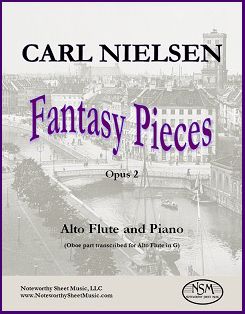
nielsen op2 245 px nsmFantasy Pieces, Op.2, by Carl Nielsen

Transcribed for Alto Flute by C.A.Vater

Piano Score and Alto Flute Part, PDF $9.99

The Fantasy Pieces for Oboe and Piano, Op.2 (Fantasistykker for obo og klavier) were composed in 1889, when Nielsen was 24.  They were written in the romantic idiom before his compositions became more experimental, chromatic, and dissonant.  Nielsen wrote the Fantasy Pieces for his good friend Olivo Kraüse, the Danish oboist and composer to whom the work is dedicated.  Nielsen and Krause were colleagues in the Royal Chapel Orchestra.   The Fantasy Pieces were premiered by Krause and the pianist Victor Bendix at a Royal Orchestra Soirée in Copenhagen in 1891.  Arrangements of the pieces for violin (with orchestra or piano), created by Hans Sitt, subsequently became quite popular.

Our transcription of the oboe part for alto flute is a simple transposition, as the entire oboe part falls nicely within the range of the alto flute.  Although the tonal characteristics of the alto flute and oboe are very different, the Fantasistykker sound so natural on alto flute that the listener might think that the two pieces were composed specifically for that instrument.

The first piece, Romance, is a beautiful andante that allows the alto flutist to exploit the rich, sensuous sonority of the instrument.  The contrasting second piece is a lively Humoresque in which the performer's lightheartedness and technical agility prevail.

Alto Flute part, 3 pages; Piano Score, 10 pages; Total, 18 pages.

Preview
$9.99

alto flute, piano, duet, duets: alto flute and piano