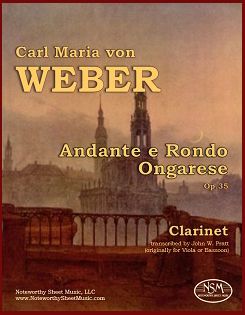
 Andante e Rondo Ongarese, Op.35, by Carl Maria von Weber
Transcribed for Clarinet (and Piano) by John W. Pratt
Bb Clarinet Part, PDF $6.99
Carl Maria von Weber (1786-1826) is widely credited with being a founder and leading composer of the Romantic school. He was prolific, making major and influential contributions to almost every kind of music, including 7 operas and 3 Singspiels, other vocal and choral music, orchestral and wind music, and piano music. Yet his chamber music consists of just 9 works (counting a set of 6 minor violin sonatas as one), and only the Grand Duo, the flute trio, and the clarinet quintet are substantial. The scarcity of Weber's chamber music makes a transcription of a concertante work, especially a fine one not often played like the Andante e Rondo Ongarese, particularly welcome. Weber’s Op.35 was first written in 1809 for viola (J79), but revised in 1813 for bassoon (J158) and apparently proved more popular in that form. Combining the viola's range and the bassoon's timbre points inexorably to the clarinet.
— excerpted from J.W.P.’s foreword to the edition
Clarinetists will find this work challenging and fun to play. We provide our clarinet transcription; a suitable piano part is readily available in the public domain as a free high quality pdf download of the score for bassoon and piano, which can be found at imslp.org: Piano Score
BbClarinet part, 5 pages; Total, 8 pages.
Preview
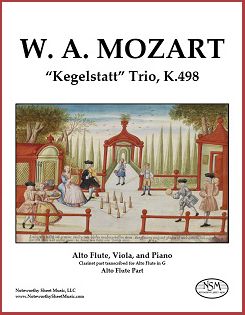 "Kegelstatt" Trio in E-flat major, K.498, by W. A. Mozart
Clarinet part transcribed for Alto Flute by John W. Pratt, with a Program Note by Peter H. Bloom
Alto Flute Part, PDF $7.99
As Editor-in-Chief of Noteworthy Sheet Music, LLC, I recently found myself in the unusual situation of having received transcriptions of the "Kegelstatt" Trio clarinet part for alto flute from two of NSM's most experienced and proficient arrangers, John W. Pratt and Peter H. Bloom. That both arrangers chose to create a "Kegelstatt" part for alto flute, and that their transcriptions were nearly identical, attests to the value of adapting this Mozart clarinet part and its natural fit for the alto flute. Our edition includes Mr. Pratt's alto flute part transcription along with a program note written by Mr. Bloom for his alto flute performances of the "Kegelstatt" Trio with Ensemble Aubade (Peter H. Bloom, flutes; Francis Grimes, viola; and Mary Jane Rupert, piano/harp). —cav, December, 2016
Our edition includes only the alto flute transcription of the clarinet part; the original piano score and viola part are in the public domain and may be downloaded free of charge from IMSLP.org as good quality PDFs.
Alto Flute part, 6 pages; Total, 10 pages.
Preview
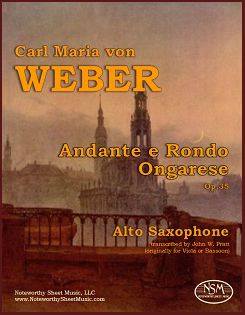 Andante e Rondo Ongarese, Op.35, by Carl Maria von Weber
Transcribed for Alto Saxophone (and Piano) by John W. Pratt
Alto Saxophone Part, PDF $6.99
In presenting our transcription of the Andante e Rondo Ongarese by Carl Maria von Weber for alto saxophone, we are keeping with a long-standing tradition of creating saxophone arrangements of 19th century recital pieces. This piece was first written in 1809 for viola, but was revised in 1813 for bassoon, in which form it became increasingly popular. NSM previously published our own version of Weber's Op.35 for clarinet, and after consultation with our saxophonist colleagues we decided to offer an alto saxophone version as well. In preparing his transcriptions of this fun, challenging piece, John Pratt worked from the public domain edition for piano and bassoon at imslp.org, where a free pdf download of the piano part is available. Our edition provides the transcribed solo part, which works perfectly with the pre-existing piano score.
Alto Saxophone part, 5 pages; Total, 8 pages.
Preview
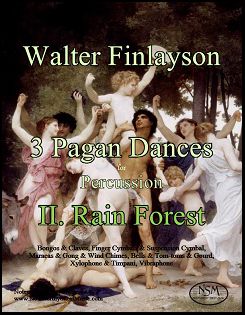 3 Pagan Dances, by Walter A. Finlayson
Contemporary Compositions for Percussion Ensemble
I. Goddess of the Earth: Score and Parts, PDF $8.99
II. Rain Forest: Score and Parts, PDF $6.99
III. Temple of the Sun: Score and Parts, PDF $13.99
Noteworthy Sheet Music's chief editorial consultant Peter H. Bloom received Walter Finlayson's previously-unpublished score for 3 Pagan Dances from the composer's daughter, and we were delighted for the opportunity to become acquainted with this rousing, intoxicating work. For our publications, we've opted to create separate editions for the three pieces, giving players the choice of acquiring only one or two of the 3 Pagan Dances at a time, depending on their level of interest and performance needs. In each case we have maintained the composer's allocation of instruments per player. Pagan Dance I. Goddess of the Earth is scored for (1) snare drum/suspension cymbal/gong, (2) tom-toms, (3) temple blocks/xylophone/cowbell, (4) bells, (5) chimes, and (6) timpani. Pagan Dance II. Rain Forest is scored for (1) bongos/claves, (2) finger cymbals/suspension cymbal, (3) maracas/gong/wind chimes, (4) bells/tom-toms/gourd, (5) xylophone/timpani, and (6) vibraphone. Pagan Dance III. Temple of the Sun is scored for (1) xylophone, (2) tom-toms, (3) temple blocks, (4) gong/suspension cymbal, (5) chimes/crash cymbal, and (6) timpani. Our editions of the 3 Pagan Dances include both scores and parts.
Click on the MP3 icons below to listen to audio samples from a 1964 performance of the work:
I. Goddess of the Earth audio 
II. Rain Forest
III. Temple of the Sun
We at NSM are pleased to aid in the re-discovery of some of Walter Finlayson's compositions; for additional biographical information about this remarkable composer, please visit the Our Composers page.
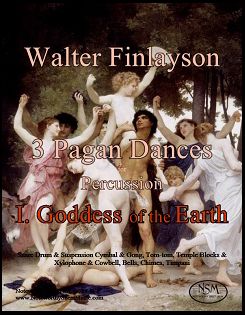 I. Goddess of the Earth: Score, 8 pages; Parts for (1) snare drum/suspension cymbal/gong, (2) tom-toms, (3) temple blocks/xylophone/cowbell, (4) bells, (5) chimes, and (6) timpani, 1 page each; Total, 16 pages
Preview I
II. Rain Forest: Score, 6 pages; Parts for (1) bongos/claves, (2) finger cymbals/suspension cymbal, (3) maracas/gong/wind chimes, (4) bells/tom-toms/gourd, (5) xylophone/timpani, and (6) vibraphone, 1 page each; Total, 14 pages.
Preview II
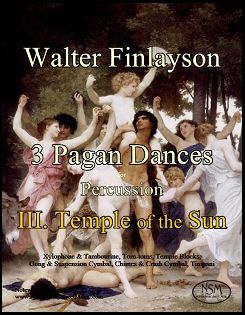 III. Temple of the Sun: Score, 13 pages; Parts for (1) xylophone, 2 pages, (2) tom-toms, 2 pages, (3) temple blocks, 2 pages, (4) gong/suspension cymbal, 1 page, (5) chimes/crash cymbal, 1 page, and (6) timpani, 2 pages; Total, 26 pages.
Preview III
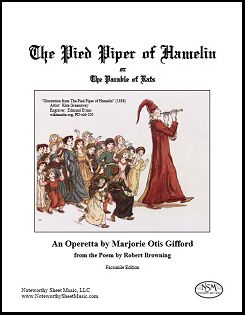 The Pied Piper of Hamelin, by Marjorie Otis Gifford
An Operetta, from the Poem by Robert Browning
Facsimile Edition by Noteworthy Sheet Music, LLC, PDF $24.99
Marjorie Otis Gifford (1909-2003) was a composer, choirmaster, and long-time music and piano teacher in CT and NY. At age 24, she put music to Robert Browning's classic poem The Pied Piper of Hamelin, creating a children's operetta for her students. In her preface to the operetta, Mrs. Gifford states that perhaps the best performance of The Pied Piper was at the Lenox School in NYC, where she was teaching in 1938; that production was directed by Antoinette Perry, who later became known as 'Tony' of the Tony Awards. Indeed, there are additional famous personalities and much fascinating history associated with the remarkable life of Marjorie Otis Gifford.
The Pied Piper of Hamelin operetta was brought to NSM's attention by Gale Finlayson, daughter of composer and music educator Walter Finlayson, and we created our facsimile edition of the operetta at Gale's request. Marjorie Otis Gifford and Walter Finlayson were great friends, and in her preface Mrs. Gifford credits Mr. Finlayson with putting her operetta down on paper. NSM has received permission to publish the operetta from both the executor of Mrs. Gifford's estate and from Deborah O'Connor, the artist who created the charming illustrations that grace the internal pages of the operetta. We hope that, in publishing our facsimile edition, we can contribute to sustaining the legacy of Marjorie Otis Gifford and enabling future generations of young music students to perform and enjoy her work.
Marjorie Otis Gifford's The Pied Piper of Hamelin operetta was performed by the Rutland Youth Theatre of Rutland, VT, on March 2, 2018; click the link to visit YouTube and watch clips of this performance videotaped and posted by Ms. Finlayson.
Score with music and lyrics for voices and piano accompaniment, 67 pages; text of the Robert Browning poem addendum, 7 pages; Total, 78 pages.
Preview
 Rondo in B minor, D.895, by Franz Schubert
Transcribed for Flute (and Piano) by J.W.Pratt and C.A.Vater
Flute Part, PDF $11.99
The Rondo in B minor, D.895 (alternatively known as Rondeau brillant) was written for violin and piano in 1826 by the great Austrian composer Franz Peter Schubert. Dedicated to the young violin virtuoso Josef Slawjk, the Rondo is demanding in both the solo and piano parts. The work consists of an Andante introduction and an Allegro rondo, and is quite long at 713 measures and typically some thirteen minutes or more in duration. Inexplicably, the piece is less familiar to players and audiences than many of Schubert’s other works. Brian Newbould, renowned composer, conductor, author, and Schubert expert, wrote of the Rondo in his treatise Schubert: The Music and the Man (University of California Press, Jan 1, 1997, p365): “Not surprisingly, perhaps, it is little known because it is seldom played. But it is also undervalued: it scintillates, dances and sings, with a blend of infectious joy, tireless energy, rhythmic zip and ‒ from time to time ‒ heart-melting turns of melody and harmony.”
These characteristics and the way the music realizes them are not only suitable to but often even suggestive of a wind instrument. Our transcription provides effective flute-friendly alternatives for the violin’s double-stops as well as for notes that fall below the flute’s range, so the piece can be played comfortably and beautifully on flute. The Rondo is virtuosic in places, showy and exciting, and overall great fun to play. The Noteworthy Sheet Music edition of our transcribed flute part does not include a re-notated copy of the score, since high-quality PDFs of the piano and violin score are freely available in the public domain and are sufficient to use along with our flute part, in lieu of violin. To download one such PDF of the score, please visit the Rondo’s page on IMSLP.
Flute part, 12 pages; Total 14 pages.
Preview
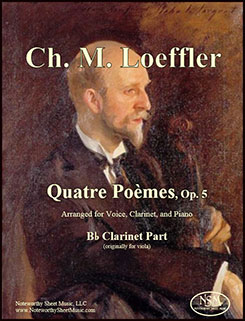 Quatre poèmes pour voix, alto et piano, by Charles Martin Loeffler
Viola part transcribed for Clarinet by C.A.Vater
Part for B-flat Clarinet; PDF $10.99
Noteworthy Sheet Music’s transcription of the viola part for Brahms’ Two Songs for Alto, Viola, and Piano, Op. 91 for clarinet quickly became one of our most popular editions, so we wanted to please our customers with another voice, clarinet, and piano option. We decided to create a clarinet version of the poems famously set to music by Charles Martin Loeffler (1861-1935). Quatre Poèmes pour Voix, Alto et Piano, Op. 5 was premiered by the Boston Symphony Orchestra with Loeffler himself on viola. In these four songs, Loeffler set to music one poem by Charles Baudelaire (“La cloche fêlée”) and three poems by Paul Verlaine (“Dansons la Gigue!”, “Le son du cor s’afflige vers les bois”, and “Sérénade”). Each of these songs has a unique character but Loeffler’s love of color variations and dense harmonies can be heard throughout the set.
We have taken care to adapt the viola part to the clarinet as conservatively as possible, and we think it works well. Obviously, there are places where we had to make modifications, and occasionally some difficult choices—for example where the viola has double stops, goes out of clarinet range, or uses harmonics or pizzicato. We encourage clarinetists who plan to perform this piece to listen to recordings of these songs with viola, and to consult the original
viola part and score, available as free PDF downloads from imslp.org. Our edition includes only the transcribed clarinet part.
B♭-Clarinet part, 10 pages; Total, 14 pages.
Preview
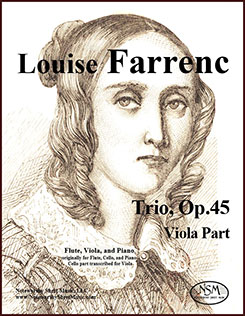 Trio, Op.45, by Louise Farrenc
Transcribed for Viola by C.A.Vater and J.W.Pratt (originally for cello)
Viola Part, PDF $9.99
The Farrenc Trio for Flute, Cello, and Piano, Op.45 is a big romantic piece, at times stirring, sweet, stormy, sad, dramatic, or lively, but always compelling throughout its entire four movements. As a flutist, I have enjoyed playing this piece many times, so I was intrigued and delighted to receive a request from flutist Peter H. Bloom that NSM prepare a transcription of the cello part for viola, so that his group Ensemble Aubade could perform a flute/viola/piano version. As Peter Bloom commented, the Trio is “not just a good piece to have been written by a woman in the 19th century; it’s a very good piece for anyone to have written anytime.” The Trio actually feels perfect for the viola, as most of the original cello part lies within viola range, and sections that do not can be modified for the viola tessitura without straying significantly from the composer’s musical intent. Our edition provides only the transcribed viola part; PDFs of the original score and flute part are freely available at imslp.org. —cav
Viola Part, 12 pages; Total, 16 pages.
Preview
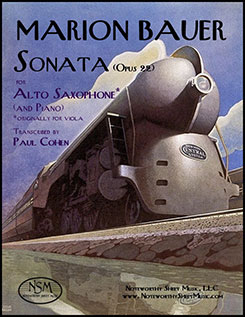 Sonata, Op.22, by Marion Bauer
Transcribed for Alto Saxophone (and piano) by Paul Cohen (originally for viola and piano)
Alto Saxophone Part, PDF $11.79
Paul Cohen is one of America's most sought-after saxophonists for orchestral and chamber concerts and solo recitals. In addition to being a renowned performer and recording artist, he is also a talented arranger, lecturer, and collector of rare and historical instruments. Dr. Cohen holds MM and DMA degrees from the Manhattan School of Music; he currently serves on the faculties of the Manhattan School of Music and Rutgers University. We at NSM were pleased for the opportunity to collaborate with him on this publication of his transcription of Marion Bauer’s Sonata for alto saxophone.
from Dr. Paul Cohen’s preface to the NSM edition © April 7, 2021:
“Bauer composed this sonata in 1932 or 1935. It originally was written for viola, and dedicated to the memory of her friend and colleague, Albert Stoessel who was a distinguished American violinist, conductor, author, composer, and educator in the 20th century. Bauer soon after created her own idiomatic transcription for clarinet and piano, and the sonata was published as a work for viola or clarinet in 1951. It is revealing to see the differences in the viola and clarinet versions. The piano part remains unchanged in both.
 There is a history of music for viola successfully adapted for saxophone by the composers. Fernande Decruck’s Sonata (1943) for saxophone and piano (or orchestra) was originally written for viola, as was Ross Lee Finney’s Sonata in A Minor from 1937 (viola and piano), adapted for saxophone in the early 1970s. Several works for alto saxophone and orchestra written for the American saxophonist Elise Hall were originally written for viola, including Florent Schmitt’s Legende (1918) and Choral Variee´ (1903) by Vincent D’Indy. Adolph Busch composed his Suite for violin and either viola or alto saxophone in 1926, while in 1923 Darius Milhaud replaced the viola with the saxophone in La Creation du Monde literally positioning the saxophone in the viola chair in the string section. My saxophone adaptation of Bauer’s Sonata combines elements of the clarinet and viola versions, creating a version appropriate for the alto saxophone. This includes changes in range, articulation, phrasing and dynamics to create an idiomatic (though challenging) version for the alto saxophone faithful to the musical intent of the composer.”
For additional information about Marion Bauer, please see the text excerpted from Peter H. Bloom’s preface to NSM’s 2014 publication of his transcription of the Sonata for alto flute.
We provide only the transcribed alto saxophone part in our edition; a pdf of the piano score is available from imslp.org.
Alto Saxophone Part, 11 pages; Total, 14 pages
Preview
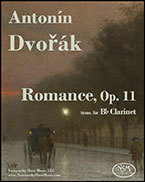 Romance, Op. 11 by Antonín Dvořák
Transcribed for B♭ Clarinet by C. A. Vater (originally for violin)
Part for B♭ Clarinet, PDF $6.97
Czech composer Antonín Dvořák based his Romance, Opus 11 on the slow movement of his String Quartet in F minor, composed in 1873, re-working that Andante con moto quasi allegretto to create two versions of the Romance, one for solo violin and orchestra (B.39) and another for solo violin and piano (B.38). The Romance is one of Dvořák’s most magnificent melodic works, teaming with romance, lyricism, and emotional intensity. Understandably, the piece became extremely popular and has been transcribed for several other instruments, including viola, cello, guitar, and flute. In creating an NSM edition of the work for clarinet (and piano), we have incorporated several changes in the solo part to account for sonic differences between the clarinet and the violin. In so doing, every effort has been made to maintain the spirit, character, and flow of Dvořák’s original composition. We provide here our transcribed B♭ clarinet part only; the score for violin and piano is readily available in the public domain as a free pdf download from imslp.org, and that piano part can be used in performance along with our clarinet part.
B♭ Clarinet part, 4 pages; Total, 6 pages.
Preview
