 Sing-Along Materials, arranged by John W. Pratt
Piano Scores and Lyrics, Free Downloads
In an ongoing project with John Pratt, we are uploading a variety of free materials for community sing-alongs. These include large-font lyrics sheets and piano scores with modifications or arrangements by Mr. Pratt. Just click on the title links or download buttons to access the pdfs, free of charge.
==========================
We Gather Together - Netherlands folk song optional piccolo part
Our friend John Pratt decided to liven up the traditional Thanksgiving hymn when he plays it at his extended family's annual feast, and we decided to make his version freely available to others similarly inclined. The first stanza is traditional, the second adds all the octaves John is able to play, and the third replaces the usual bass line with one which marches along step-wise, mostly in eighths, leading to a few nontraditional harmonies. For 2022 he added an optional piccolo part to accompany the piano and voice score.
He has also made a version without octaves for two players at one piano.
We Gather Together, 4-hand version without octaves
=======================================================
Large-font lyrics for Christmas carols and Thanksgiving songs [1] to [42]
One of the most common problems with song books for community sing-alongs, especially for seniors, is that the lyrics are too small to be seen easily. John Pratt has created large-font lyrics sheets with the words (public domain) for 42 popular songs for the holiday season. Open the pdf by clicking the link above and print as few or as many as you'd like.
Mr. Pratt has also created a booklet format for the large-font lyrics for holiday songs [1] to [42], called The NSM Carol Book, which is handy for group sing-alongs and is easily re-usable. The booklets should be printed double-sided on 8.5" x 11" paper (or 9" x 12", if available), stapled in the middle and folded to form a 5.5" x 8.5" booklet. Since printing directions will be different for every printer, we leave it to our visitors to know what settings to use on their own equipment to have all pages come out in order, right-side up, etc. With my Canon ImageCLASS MF4890 machine, for example, I would do the following: print using fit to page, landscape orientation, 2-sided, flipping on short edge; then staple along the mid-line and fold down the center along the staples so that the Contents are on the front page. Note that a long-arm stapler (reaching to 5.5") is required for manual stapling, but some institutions may have printer/copiers that can auto-staple along the mid-line.
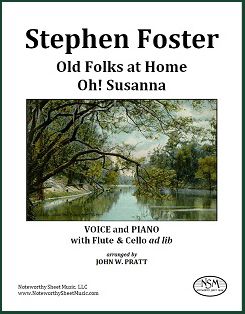 Old Folks at Home and Oh! Susanna, by Stephen Foster
Arranged with Flute and Cello ad lib by John W. Pratt
Flute Parts, Cello Parts, Voice Parts, and Piano Scores ― PDF $7.99
The following excerpts are taken from John W. Pratt's foreword to the edition:
When a Golden Oldie comes to mind, Doo-dah! Doo-dah!Comic, sad, or any kind, Oh! Doo-dah-day!Jeanie, Swanee, Kentucky, Joe, Doo-dah! Doo-dah!Beautiful, dreamy, fast, or slow, Oh! Doo-dah-day!I'll bet I know who wrote it, he wrote them night and day,Stephen Foster wrote it, he'll never go away.
Stephen Foster was born in Lawrenceville, Pa., on July 4, 1826...He wrote over 200 songs, including 135 parlor songs, 28 minstrel songs, and 21 hymns and Sunday school songs. A remarkable number are memorable, as the ditty above will attest to anyone with anything like my background. One wonders why. The harmonies and rhythms are basic, as are the forms and rhyme schemes (see above), the music is repetitious, and the vocal range rarely goes outside an octave (a great benefit for community singing). Yet the fit is so natural and the pacing so well judged that the songs are ideally effective and diabolically catchy. Foster is perhaps, though on a different plane, the Mozart of his field...
For a pianist playing several stanzas at a sing-along, Foster's songs do become a little dull. But their very simplicity, repetitiousness, and familiarity abet variation as, again on a different plane, chorales serve Bach chorale preludes. Like chorale preludes, the piano parts here always incorporate the melody, so they can be played solo or to accompany amateur singers. It struck me that they could be enhanced by optional flute parts. After writing them, I discovered that, according to his brother Morrison, Foster himself "delighted in playing accompaniments on the flute...As the song went on he would improvise...the most beautiful variations upon its musical theme." If Foster's improvisations were like the one his brother published, however, they just varied the melody itself in the manner of the period. My game is more ambitious, as you will easily see. I added optional cello parts, mostly for color, as in the Haydn trios but superficially more interesting for the cellist. (Again we are on a different plane, of course.)
"Oh! Susanna," one of the best-known American songs by anybody, is Foster's "Erlkönig." (Speak of different planes!) With its nonsensical lyrics and polka beat, it is clearly comical, and I treated it accordingly. It was written in Cincinnati, possibly for a social club, first performed at an ice cream saloon in Pittsburgh in 1847, and published in 1848. When no American song had sold over 5,000 copies, it sold over 100,000. It earned Foster only $100, but its popularity led to a publisher's offer, convincing him to become a professional songwriter, America's first.
"Old Folks at Home" established Foster as a truly American composer. It was written in 1851 for a blackface troupe whose leader paid Foster about $15 to be credited for it. When almost finished, Foster asked his brother for "a good name of two syllables for a Southern river." He rejected Yazoo and Pedee, but was delighted with Swanee, a shortening of Suwanee, a small river in Florida which his brother found in an atlas. Though about a slave's nostalgia for home, I find its theme universal and melancholy and I resisted the temptation to jazz it up. Please try, at least, a slowish tempo.
― John W. Pratt, May 27, 2013 ©
Flute parts, 2 pages; Cello parts, 2 pages; Voice parts, 2 pages; Scores, 7 pages; Total, 18 pages.
Preview
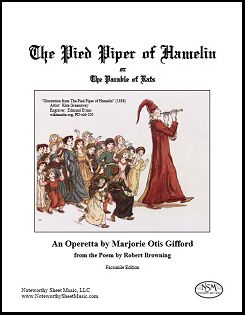 The Pied Piper of Hamelin, by Marjorie Otis Gifford
An Operetta, from the Poem by Robert Browning
Facsimile Edition by Noteworthy Sheet Music, LLC, PDF $24.99
Marjorie Otis Gifford (1909-2003) was a composer, choirmaster, and long-time music and piano teacher in CT and NY. At age 24, she put music to Robert Browning's classic poem The Pied Piper of Hamelin, creating a children's operetta for her students. In her preface to the operetta, Mrs. Gifford states that perhaps the best performance of The Pied Piper was at the Lenox School in NYC, where she was teaching in 1938; that production was directed by Antoinette Perry, who later became known as 'Tony' of the Tony Awards. Indeed, there are additional famous personalities and much fascinating history associated with the remarkable life of Marjorie Otis Gifford.
The Pied Piper of Hamelin operetta was brought to NSM's attention by Gale Finlayson, daughter of composer and music educator Walter Finlayson, and we created our facsimile edition of the operetta at Gale's request. Marjorie Otis Gifford and Walter Finlayson were great friends, and in her preface Mrs. Gifford credits Mr. Finlayson with putting her operetta down on paper. NSM has received permission to publish the operetta from both the executor of Mrs. Gifford's estate and from Deborah O'Connor, the artist who created the charming illustrations that grace the internal pages of the operetta. We hope that, in publishing our facsimile edition, we can contribute to sustaining the legacy of Marjorie Otis Gifford and enabling future generations of young music students to perform and enjoy her work.
Marjorie Otis Gifford's The Pied Piper of Hamelin operetta was performed by the Rutland Youth Theatre of Rutland, VT, on March 2, 2018; click the link to visit YouTube and watch clips of this performance videotaped and posted by Ms. Finlayson.
Score with music and lyrics for voices and piano accompaniment, 67 pages; text of the Robert Browning poem addendum, 7 pages; Total, 78 pages.
Preview
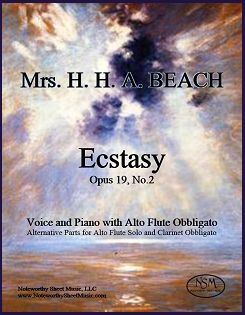 Ecstasy, Op.19 No.2, by Mrs. H. H. A. Beach
Two versions, for "Low voice (in Db)" or "High voice (in Eb)", with Alto Flute Obbligato (transcribed) and Piano.
Alternative parts for Alto Flute Solo and Bb Clarinet Obbligato.
Program Notes by Peter H. Bloom.
Piano Scores, Voice Parts, Alto Flute Obbligato Parts, and alternative Alto Flute Solo Parts and Clarinet Obbligato Parts; PDF $8.99
Noteworthy Sheet Music was thrilled to publish our edition of Amy Marcy Cheney Beach's song Ecstasy in 2017, in celebration of the 150th anniversary of the composer's birth. The idea to make Ecstasy available to a broader combination of players and singers came from flutist Peter H. Bloom, who proposed that the piece would be an excellent vehicle with which instructors might inform students (early and advanced alike) about interpretation of the highly romantic late 19th century idiom. To that end, we have packaged together in a single edition Mrs. H. H. A. Beach's two versions of Ecstasy, for "low voice (in Db)" and "high voice (in Eb)", with each version including transcriptions of the obbligato (originally for violin) for either alto flute in G or clarinet in Bb, and an alternative solo part in the form of an alto flute transcription of the voice line. Thus, multiple performance variations are possible, including high or low voice and piano with either alto flute or clarinet obbligato, or fully instrumental versions for alto flute and piano, or two alto flutes and piano, or alto flute, clarinet, and piano.
Scores, 8 pages (4 pages each version); Voice parts, 2 pages (1 page each version); Alto Flute Obbligatos, 2 pages (1 page each version); Clarinet Obbligatos, 2 pages (1 page each version); Alto Flute solo parts, 2 pages (1 page each version); Total, 20 pages.
Preview
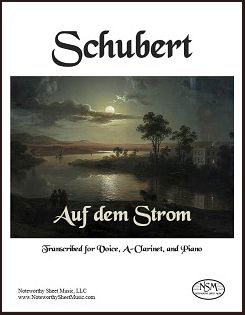 Auf dem Strom, Op.119, by Franz Schubert
Obbligato transcribed for A-Clarinet by C. A. Vater
Piano Score and Parts for Voice and A-Clarinet, PDF $9.50
The great Austrian composer Franz Peter Schubert (1797-1828) was a master at creating extremely beautiful, melodic, emotional lieder. His song Auf dem Strom (On the River) provided a musical setting for the text of the eponymous poem written by the German poet and music critic Ludwig Rellstab. The lyrics tell the story of a sad parting, of the yearning and loneliness that sets in as the narrator bids farewell to a loved one on shore, while his river journey carries him away towards the sea. The premier performance of Auf dem Strom took place in Schubert’s 1828 public concert, during which the obbligato part was played by Josef Lewy on horn, the instrument for which the obbligato was written and which undoubtedly can provide an appropriately mournful, sentimental character to the piece. However, an alternate obbligato version for cello was also published. Now, with all respect, we provide an A-clarinet version of the obbligato, in expectation that clarinetists will appreciate this addition to the voice/clarinet/piano repertoire. We believe that a well-played clarinet can aptly contribute a suitably complex, dolorous essence and tone that will adequately do justice to this highly romantic lied by Schubert. Schubert himself created one of his most wonderful and popular works, Der Hirt auf dem Felsen, for clarinet obbligato, and we hope he would welcome our adaptation of Auf dem Strom for A-clarinet.
Score, 19 pages; Voice part, 4 pages; A-Clarinet part, 4 pages; Total, 32 pages.
Preview
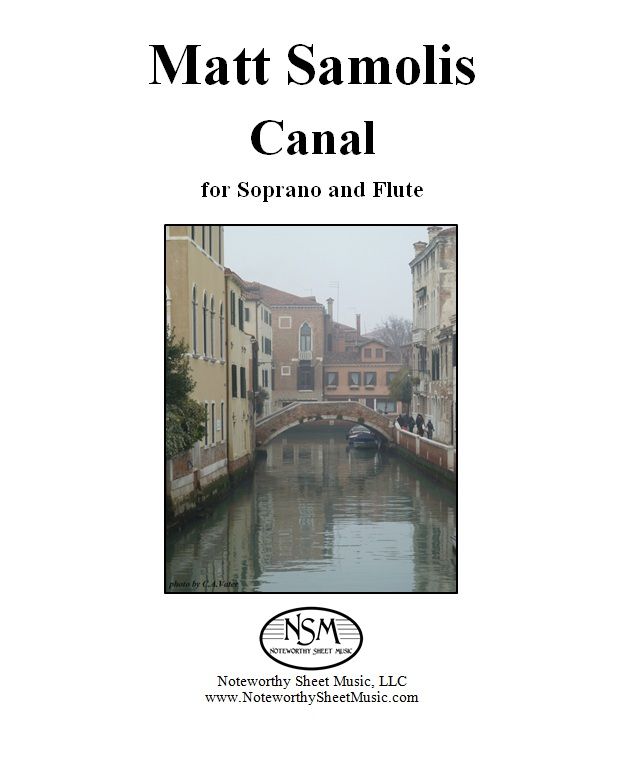 Canal, by Matt Samolis
Contemporary Composition for Soprano and Flute, PDF $13.95
Matt Samolis began studying flute, then later composition and tenor banjo. He has worked with ensembles at New England Conservatory, Brandeis University, and Tufts University, as well as Open Hand Theatre, Pilgrim Research Collaborative, and numerous other projects. Currently, his primary focus is composition, curating, and performing as a flutist with various local groups, as well as his drone alliance, The Metal & Glass Ensemble.
Canal is written in a free, self referential style, and uses the text of Roy Campbell's poem of the same name, written in 1920. Despite the somber text, the mood is idyllic and somewhat reminiscent of the contemporary musical language in use at that time. Each player also has a brief ad lib section, where they can interpret the material as they choose.
Click to listen to two snippets of an audio recording of Canal, performed by soprano Noell Dorsey and composer/flutist Matt Samolis:  Canal Owlseyes Canal Whiteflame
Score for Soprano and Flute, 5 pages; Total, 7 pages.
Preview
==============================================
US customers may purchase professionally-printed hard copies of Canalfrom Noteworthy Sheet Music for $20.93 plus a $5.95 shipping and handling fee. Please use the Contact Us form to let us know which print edition(s) you would like to purchase, along with your contact information and your USPO mailing address.
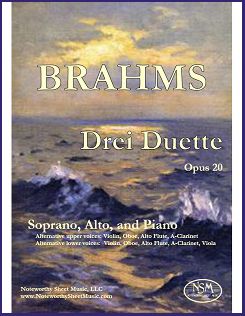 Drei Duette, Op.20, by Johannes Brahms
Transcribed for Mixed Voice, Instruments, and Piano by John W. Pratt
Score for Soprano, Alto, and Piano; Transcribed upper voice Parts for Violin/Oboe, Alto Flute, and A-Clarinet; and Transcribed lower voice Parts for Violin/Oboe, Alto Flute, A-Clarinet, and Viola; PDF $12.99
Composed in 1858–1860, the Drei Duette, Op. 20, for soprano and alto are the earliest of Johannes Brahms' duets and quartets for solo voices and piano. The three songs are titled Weg der Liebe (1. Teil), Weg der Liebe (2.Teil), and Die Meere. Except for brief canonic passages in No. 1, the voices have the same words, sung simultaneously, mostly in parallel thirds and sixths. The accompaniments are straightforward, without Brahmsian ensemble challenges but not without harmonic interest. Many have found the songs Mendelssohnian. The words come from the collection Stimmen der Völker of Johann Gottfried Herder (1744–1803). The first two are translations by Herder of two parts of a Northern English folk poem Love will find out the Way. The third is Italian in origin.
The vocal parts lie well for many instruments, opening the possibility of mixed voice and instrument, as well as fully-instrumental, performances. If one voice is replaced by an instrument, no words will be lost and the result will be a song with wonderful instrumental obbligato and piano accompaniment. If two instruments are used, the result is a beautiful "song without words." We include in our edition transcriptions of both voices for oboe/violin, alto flute in G, and clarinet in A, and of the lower voice for viola as well. Our transcriptions provide slurs to suggest a vocal style to instrumental players and to facilitate coordination of the instrumental parts with those of the voices. We also provide a re-notated piano/vocal score, in which repeat signs are used in the second and third songs to save page turns, rather than writing out the multiple stanzas as in the original. For those needing only the piano/vocal score, the Breitkopf & Härtel edition is in the public domain and freely available on imslp.org.
Piano/Vocal Score, 10 pages; Instrumental Parts, 3 pages each; Total, 42 pages.
Preview
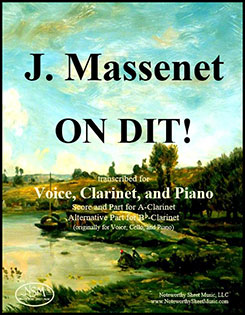 On Dit!, by Jules Massenet
Transcribed for Clarinet, Voice and Piano by C. A. Vater
Score for Clarinet, Voice and Piano; Alternative Parts for A-Clarinet and B-flat-Clarinet, PDF $8.99
Massenet’s composition On dit! is a musical setting of the eponymous poem by Jean Roux in which the poet ponders how the word “love” is commonly and inevitably associated with the sweetness and delights of spring. In addition to the vocal line and piano accompaniment, Massenet provided On dit! with a prominent part for cello. The cello line can be readily adapted for clarinet, creating a lovely and suitable new version of the piece for clarinet, voice, and piano. Our Noteworthy Sheet Music edition includes a score in concert pitch, as well as individual parts for either A-clarinet or B-flat-clarinet transcribed from the original cello part. Clarinetists in possession of both A and B-flat instruments may develop a personal preference for playing this piece on one instrument over the other, based on tone quality, complementarity with a particular singer’s sound, etc.
Score, 5 pages; A-Clarinet Part, 2 pages; B-flat-Clarinet Part, 2 pages; Total, 16 pages.
Preview
 Waldesgruss and Frühlingsblumen, Op.26, by C. Reinecke
Facsimile Edition plus Transcriptions for Flute & Alto Flute by C.A.Vater
Score for Violin, Voice, & Piano, Violin Part, Flute & Alto Flute Parts, PDF $9.98
Carl Reinecke (1824-1910) was a renowned German pianist, composer, conductor, and teacher of composition. He composed numerous works, and for over 35 years was a leader of the music scene in Leipzig. Reinecke's Op.26 includes two songs for voice with accompaniment of violin and piano: No.1, Waldesgruss (The Forest's Greeting); and No.2, Frühlingsblumen (Spring Flowers). The vocal range of Reinecke's Op.26 lieder extends from C4 to A5, and thus is well-suited for either soprano or mezzo-soprano.
Our edition contains an "enhanced" facsimile of the original score and violin part, plus new transcriptions of the violin part for either alto flute or flute. Thus, the two songs may be performed utilizing the accompaniment of violin, alto flute, or flute, along with the voice and piano. Alternatively, these pieces work very well as an instrumental arrangement with the voice part played on flute, accompanied by alto flute and piano.
Score, 6 pages; Violin, Alto Flute, and Flute parts, 2 pages each; Total, 18 pages.
Preview
 In die Ferne, Op.98, No.1, by J. W. Kalliwoda
Facsimile Edition plus Transcription of Violin part for Flute by C.A.Vater
Score for Violin, Voice, & Piano, Violin Part, Flute Part, PDF $5.99
Johann Wenzel Kalliwoda (1801‒1866) was a Bohemian violinist, conductor, and composer who spent much of his career in Donaueschingen, where he served as the conductor of the court orchestra for Prince Karl Egon II of Fürstenberg. Kalliwoda composed numerous works, including operas, symphonies, pieces for piano, violin and orchestra, and chamber music.
Kalliwoda's song In die Ferne (Far Away) was published in a nineteenth century collection of lieder, along with several songs by Hauptmann and Reinecke. The vocal range of In die Ferne extends from E4 to G#5, and thus is well-suited for either soprano or mezzo-soprano. Our edition contains "enhanced" facsimiles of the original score (violin, voice, and piano) and violin part, plus a transcription of the violin part for flute created using a modern music notation program. Therefore, In die Ferne may be performed using the accompaniment of either violin or flute, along with the voice and piano.
Score, 6 pages; Violin and Flute parts, 1 page each; Total, 12 pages.
Preview
===============
U.S. customers may purchase professionally-printed hard copies of In die Fernefor $10.18 plus a $5.95 shipping and handling fee. Please use the Contact Us form to let us know which print edition(s) you would like to purchase, along with your contact information and your USPO mailing address.
