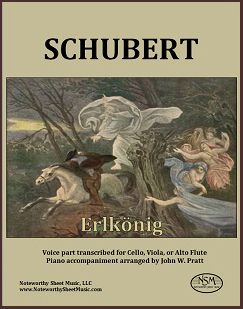
 Erlkönig, by Franz Schubert
Arranged for Cello (or Viola or Alto Flute) and Piano by John W. Pratt
Piano Score and Parts for Cello/Voice, Viola, and Alto Flute; PDF $11.99
Franz Schubert (1797-1828), inspired by reading Goethe's poem, wrote his song "Erlkönig" in a few hours in 1815. The song was an immediate hit, and continues to be popular to the present day. John Pratt has created a trio arrangement for flute, cello, and piano (click for more information), and also the duo version offered here with Schubert's solo voice part transposed for cello (or viola or alto flute), and with a less arduous alternative to Schubert's piano accompaniment.
Excerpted from Mr. Pratt's © preface:
"In the duo arrangement, Schubert's solo part is adopted without change. Thus the piano must provide the entire accompaniment, but rocking triplets and other pianistically felicitous passagework replace Schubert's unremitting repetition. The range of sonorities is also wider than Schubert's, though more restrained than that of the trio arrangement, where the flute enlarges the musical terrain. This accompaniment is offered as a less punishing alternative to Schubert's, to be played with a singer or any solo instrument. Solo parts are provided for voice or cello, viola, and alto flute."
Piano score, 6 pages; Cello, Viola, and Alto Flute parts, 2 pages each; Total, 22 pages.
Preview
 From the Drawer, by Peter H. Bloom
Contemporary Composition for Tenor or Soprano, with Flute (doubling Piccolo), Clarinet in B-flat, Bassoon, and Horn in F
Score and Parts, PDF $13.99
Peter H. Bloom is a Boston-based flutist, whose original compositions and arrangements are published by Noteworthy Sheet Music. From the Drawer was written for Tenor or Soprano, with Flute (doubling Piccolo), Clarinet, Bassoon, and Horn, and provides a musical setting for the intensely emotional poem by Constantine Cavafy.
Here are Peter Bloom's comments about From the Drawer from the composer's preface (Copyright © 2015) to the edition:
"Constantine Cavafy’s 1923 poem, From the Drawer, captures the acerbic condition of longing, the impossibly private nature of affection, and the occultation of time. Its poignancy is universal; transcending gender, age, era, place, and even translation. Rather than rely on one particular translation of Cavafy’s text, I’ve drawn on a number of versions to arrive at a paraphrase that both informs and is shaped by the musical score.
The musical setting is a sonic image of the intensely emotional response to a flood of memory that informs the poet’s narrative: now pensive, now anxious, now wistful, now joyous, now fraught, now resigned, and ever mercurial." P. H. Bloom, September 19, 2015
Our sheet music edition of From the Drawer was featured on the New Products page of the Summer 2016 edition of "The Flutist Quarterly", journal of The National Flute Association.
Score, 14 pages; Tenor or Soprano part, 2 pages; Flute part, 4 pages; Clarinet part, 3 pages; Bassoon part, 3 pages; Horn part, 3 pages; Total, 29 pages.
=========================================================
We also offer a professionally-printed hard copy edition of From the Drawer for $23.78 plus a $5.95 shipping and handling fee. Due to prohibitively high international shipping rates, we ship print editions only to addresses in the USA. Please use the Contact Us form to let us know which hard copy publication(s) you would like to purchase, along with your email contact information and USPS mailing address. We will then send you a PayPal invoice for the sale and, once we receive notice from PayPal that you have paid for the item(s), we will ship your music to the address provided.
=========================================================
 From the Drawer, for Voice and Saxophones, by Peter H. Bloom
Contemporary Composition for Tenor or Soprano, with Saxophone Quartet
Score and Parts, PDF $13.99
Boston-based flutist Peter H. Bloom created two versions of his composition From the Drawer, the edition listed here for Tenor or Soprano with Saxophone Quartet (soprano saxophone, alto saxophone, tenor saxophone, and baritone saxophone) and a second edition for Tenor or Soprano with Flute (doubling Piccolo), Clarinet, Bassoon, and Horn; both editions have been published by Noteworthy Sheet Music. The score provides a musical setting for the intensely emotional poem by Constantine Cavafy. The composer suggests that the vocalist (depending on his or her performance style/background/aesthetic judgment) should free to employ amplification at his/her discretion.
Here are Mr. Bloom's comments about From the Drawer, taken from his preface (Copyright © 2015) to the edition:
"Constantine Cavafy’s 1923 poem, From the Drawer, captures the acerbic condition of longing, the impossibly private nature of affection, and the occultation of time. Its poignancy is universal; transcending gender, age, era, place, and even translation. Rather than rely on one particular translation of Cavafy’s text, I’ve drawn on a number of versions to arrive at a paraphrase that both informs and is shaped by the musical score.
The musical setting is a sonic image of the intensely emotional response to a flood of memory that informs the poet’s narrative: now pensive, now anxious, now wistful, now joyous, now fraught, now resigned, and ever mercurial." P. H. Bloom, September 19, 2015
Score, 14 pages; Tenor or Soprano part, 2 pages; Soprano Saxophone part, 4 pages; Alto Saxophone part, 3 pages; Tenor Saxophone part, 3 pages; Baritone Saxophone part, 3 pages; Total, 29 pages.
Preview
=========================================================
We also offer a professionally-printed hard copy edition of From the Drawer for $23.78 plus a $5.95 shipping and handling fee. Due to prohibitively high international shipping rates, we ship print editions only to addresses in the USA. Please use the Contact Us form to let us know which hard copy publication(s) you would like to purchase, along with your email contact information and USPS mailing address. We will then send you a PayPal invoice for the sale and, once we receive notice from PayPal that you have paid for the item(s), we will ship your music to the address provided.
=========================================================
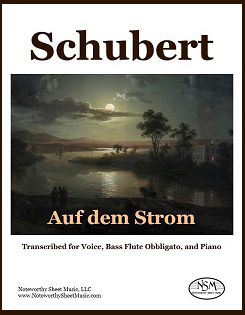 Auf dem Strom, Op.119, by Franz Schubert
Obbligato transcribed for Bass Flute by C. A. Vater
Piano Score and Parts for Voice and Bass Flute, PDF $9.50
The great Austrian composer Franz Peter Schubert (1797-1828) was a master at creating extremely beautiful, melodic, emotional lieder. His song Auf dem Strom (On the River) provided a musical setting for the text of the eponymous poem written by the German poet and music critic Ludwig Rellstab. The lyrics tell the story of a sad parting, of the yearning and loneliness that sets in as the narrator bids farewell to a loved one on shore, while his river journey carries him away towards the sea. The premier performance of Auf dem Strom took place in Schubert's 1828 public concert, during which the obbligato part was played by Josef Lewy on horn, the instrument for which the obbligato was written and which undoubtedly can provide an appropriately mournful, sentimental character to the piece. However, an alternate obbligato version for cello was also published. Now, with all respect, and at the suggestion of our flutist colleague Peter H. Bloom, we offer a bass flute version of the obbligato. Most of the transposed horn part falls nicely within the sweet range of the bass flute, and very few adaptations were required. Though clearly having different sonic qualities than a horn, the bass flute lends a forlorn, haunting, earthy tone that can well do justice to this Schubert song. After giving the bass flute obbligato a try, Mr. Bloom commented: "Fabulous! // The tone-color of the bass flute for this number is gorgeous."
Piano score, 19 pages; Bass Flute part, 4 pages; Total, 32 pages.
Preview
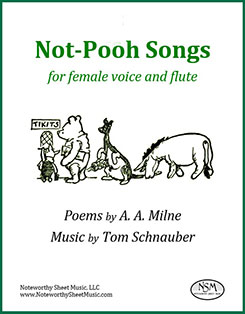 Not-Pooh Songs, by Tom Schnauber
For Female Voice and Flute or Female Voice and Oboe, 2 editions
Score for Female Voice and Flute, PDF $18.46
Score for Female Voice and Oboe, PDF $18.46
Tom Schnauber’s Not-Pooh Songs are absolutely delightful. The composer has set to music six children’s poems by A. A. Milne, four from When We Were Very Very Young (“The Alchemist”, “The Mirror”, “The Four Friends”, and “If I Were King”) and two from Now We Are Six ("The Charcoal Burner" and "The Engineer"). The work is offered by Noteworthy Sheet Music, LLC in two publications, one for female voice and flute, the other for female voice and oboe. The oboe line is sufficiently different from the flute line in terms of register to warrant it being published as a separate edition (i.e., the flute version makes use of that instrument’s wider range by putting some material in higher octaves). Also, the flute edition includes an alternate variation of “The Mirror” for voice and alto flute, whereas the oboe edition includes an alternate variation of “The Mirror” for voice and English horn.
It’s clear from hearing this music that Schnauber gets a real kick out of Milne’s poetry. The flute/oboe comments, echoes, etc. go with or against the voice line very effectively and entertainingly. These songs will have broad appeal to both players and audiences, and there’s a lot that a pair of performers could do with them. The music isn’t easy, but provides just the sort of challenges that the adventuresome player loves; in places, for example, the flute jumps from C7 to C4, plays multiphonics, and executes finger snaps. But, as the composer has pointed out, just because the music is somewhat demanding doesn’t mean that it should be presented seriously in performance; on the contrary, players should have fun with these pieces and convey the intended joy and playfulness of the work.
Note that both performers are to play from the score, so flutists and oboists may want to print their copy of the score single-sided to avoid a few difficult page turns.
To listen to a recording of Not-Pooh Songsperformed by Mitsi Westra, voice, and Pamela French, oboe, visit Tom Schnauber’s SoundCloud page at https://soundcloud.com/user-557772917/sets/not-pooh-songs.
► Schnauber - Not-Pooh Songs - Voice and Flute - PDF
Preview: Not-Pooh Songs for Voice and Flute, p1
Score for female voice and flute, 22 pages; Lyrics, 2 pages; Total, 28 pages.
► Schnauber - Not-Pooh Songs - Voice and Oboe - PDF
Preview: Not-Pooh Songs for Voice and Oboe, p7
Score for female voice and oboe, 22 pages; Lyrics, 2 pages; Total 28 pages
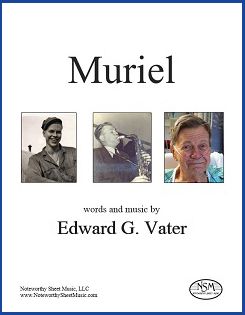 Muriel, by Edward G. Vater
Contemporary Ballad for Voice with Piano or Guitar Accompaniment
Edward G. Vater (1923-2018), my dad, was quite a remarkable man. A lifelong-resident of New Britain, CT, he was an educator by profession, and served many years as a school teacher and later as a college administrator. But he had numerous, diverse interests and took on many challenges over the years, including raising three children with his loving wife Anne (Mickey) Siton Vater, building a house, studying the Russian language, teaching English to Russian immigrants, working as a tool and die maker summers to support his young family, and serving his community in various roles such as Democratic Town Committee member, Justice of the Peace, and Chairman of the Public Works Department, to name a few. Displaying a life-long love of music, he was heavily involved in school music programs as a child, and loved to sing and play saxophone and clarinet. He played alto saxophone in dance bands during his stint in the U.S. Army Aircorps in England during WWII and stateside after returning home, often in groups with his two brothers, Al and Bob. He sang and played his horn most days, still infusing his music with tenderness and passion, until a couple weeks before his death in April, 2018.
At age 93 and dealing with metastatic melanoma but still independent, Ed moved into an apartment in Arbor Rose, an independent-assisted living facility. Upon hearing him sing his song Muriel, Denise Lebrocquy, one of the administrators there, arranged to take Ed to a professional music studio* to make a recording of him singing the tune, for which he had written the music and lyrics. This was a beautiful and uplifting experience for him, and one for which I too am very grateful. The audio file may be heard by clicking the mp3 link below. John Pratt, Jerry Gleason, and I entered the melody, chords, and lyrics for Muriel into a music notation software program for publication of the lead sheet on NSM, so we can share my dad’s moving love-song with our website visitors and pay tribute to a wonderful man and a life well-lived.
―Carol A. Vater, December 21, 2016
―revised 4/22/18
Ed Vater passed away on April 18, 2018; he would have turned 95 that June.
*Matt Berky, Massive Productions, LLC, Rocky Hill, CT http://massiveproductions.com/
Ed Vater wished to give thanks and dedicate his song Muriel to the Jerome Home/Arbor Rose health complex at 975 Corbin Avenue, New Britain, CT, and to health care providers everywhere.
We're making Muriel (Copyright © 2016 by Edward G. Vater) available free of charge, with the understanding that the song writer will be publicly credited upon any performance or other use of his song, and with the suggestion that donations be made to the Melanoma Research Alliance in support of finding a cure. Click to download a PDF of the NSM edition of the Muriel lead sheet or to listen to the Muriel audio recording.
A video of Ed Vater being interviewed and singing Muriel aired in the Hartford area on NBC on January 1, 2017; here's a link to the full news story, and another to just the music video.
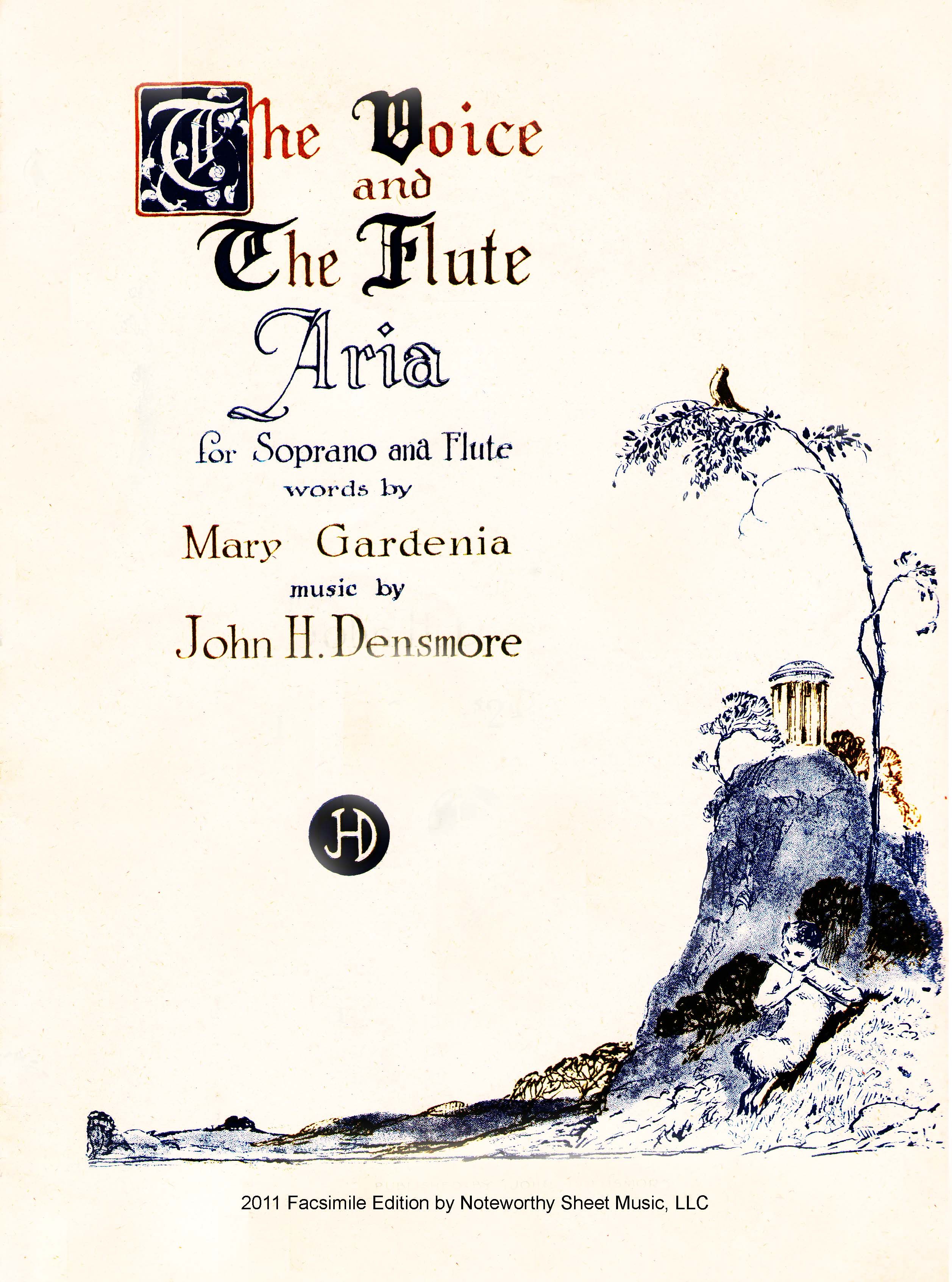 The Voice and The Flute, by John H. Densmore
Aria for Soprano and Flute
Facsimile Edition by Noteworthy Sheet Music
Piano Score and Part, $8.99
The Voice and The Flute is a work composed by John H. Densmore for soprano, flute, and piano, with lyrics written by Mary Gardenia. Densmore was a native of Somerville, Massachusetts; he graduated from Harvard '04 and is perhaps best known for having composed the Harvard fight song "Veritas". Our edition of Densmore's Aria for Soprano and Flute is a facsimile reproduction of the original 1922 edition published by the composer, and contains both the piano score and the part for the voice and the flute.
Piano, Flute, & Voice score, 12 pages; Flute & Voice part, 6 pages; Total, 21 pages.
Preview
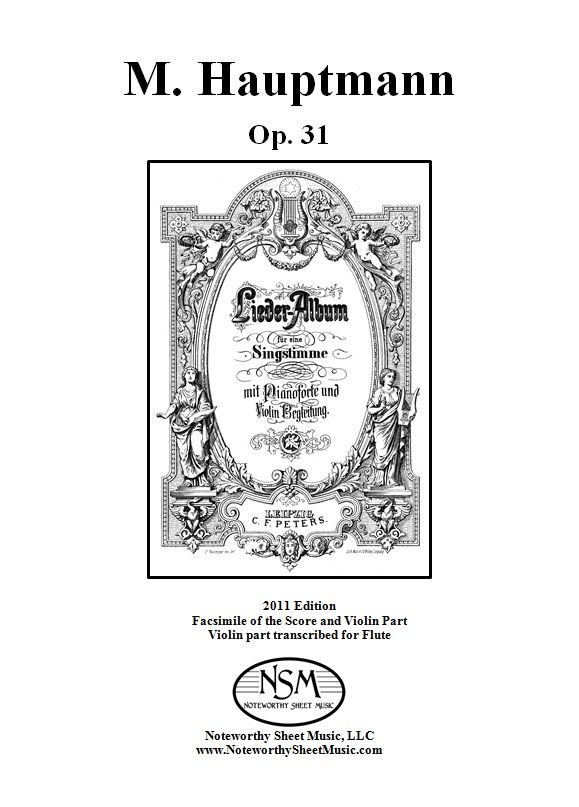 Meerfahrt, Nachtgesang, and Der Fischer, Op.31, by M. Hauptmann
Facsimile Edition plus a Transcription of the violin part for Flute by C.A.Vater
Score for Violin, Voice, & Piano, Violin Part, and Flute Part, PDF $18.75
Moritz Hauptmann (1792-1868) was a renowned music theorist, pedagogue, violinist, and composer. In 1842, at Mendelssohn's recommendation, he was appointed cantor at the Thomasschule and professor of composition at the newly founded Leipzig Conservatory. Hauptmann published a major scholarly work on music theory in 1853, "Die Natur der Harmonik und Metrik" (The Nature of Harmony and Meter), as well as some 60 compositions.
Hauptmann's Op.31 comprises three lovely songs scored for voice with accompaniment of violin and piano: No.1, Meerfahrt (Sea Voyage); No.2, Nachtgesang (Night Song); and No.3, Der Fischer (The Fisherman). The vocal range extends from B3 to G5, and thus is well-suited for mezzo-soprano. These pieces were published by C. F. Peters as part of a larger volume, now in the public domain, entitled "Lieder-Album für eine Singstimme mit Pianoforte und Violin Begleitung". Our edition contains an "enhanced" facsimile of the original, plus a new transcription of the violin part for flute created using a modern music notation program. The three songs may be performed with comparable gratification utilizing the accompaniment of either violin or flute, along with the voice and piano.
Score, 15 pages; Violin part, 5 pages; Flute part, 5 pages; Total, 29 pages.
Preview
 Two Songs, Op.91, by Johannes Brahms
Transcribed for Clarinet by John W. Pratt (part originally for viola)
Clarinet Part, PDF $6.99
The two chamber music songs of Brahms' Zwei Gesänge, Op.91 were composed specifically for his dear friends, the violinist/violist Joseph Joachim and the mezzo-soprano Amalie Schneeweiss, who were married in 1863. The songs (for alto, viola, and piano) were written over 20 years apart, but Brahms published them together as Op.91 in 1884.
"Gestillte Sehnsucht", which appears first in the Op.91 pairing, was actually written second, in 1884. The song sets the text of the poem by Friedrich Rückert (1788-1866). "Gestillte Sehnsucht" is a nature poem, filled with images of forests at sunset, gentle breezes, and twittering birds. Rückert is famous not only for his exquisite poems themselves but also for the great inspiration his work provided to numerous prominent composers, in addition to Brahms. "Geistliches Wiegenlied" (Sacred Cradle Song) was first composed in 1863-1864, and later revised. The viola opens with the melody of the medieval Christmas carol "Joseph, lieber Joseph mein." The singer has her own variation of the melody, and enters after the first stanza of the viola's carol. The song is a beautiful cradle-rocking lullaby, in 6/8 time.
It is said that the viola was Brahms' favorite stringed instrument, and the composer gave the viola a major role in both of these songs, allowing it to open both pieces before the singer enters. Clarinetists have long coveted these viola parts, and various performances have provided clear evidence that a successful outcome can be achieved with the substitution of a clarinet for the viola in Op.91. So when a clarinetist friend of ours asked us to create a transcription for him, we gladly obliged. Our edition of the clarinet part adapts the first song, "Gestillte Sehnsucht", for clarinet in A, and the second, "Geistliches Wiegenlied", for clarinet in Bb. The original piano score and voice part are in the public domain, readily available as free PDF downloads from IMSLP.org.
Clarinet part, 4 pages; Total, 8 pages.
Preview
 The Wreck of the Hesperus, by J. L. Hatton & H. W. Longfellow
Arranged for theatre or salon orchestra by Peter H. Bloom
Tenor, Flute, Clarinet, Violin, Viola, & Double Bass Parts, and Mini-Score ― PDF $19.98
The "dramatic scena" was an especially popular entertainment at its zenith in the mid-nineteenth century throughout the English speaking world. John Liptrot Hatton's setting of Longfellow's Wreck of the Hesperus is the very model of the dramatic scena at its finest, and a magnificent showcase for an heroic tenor. Longfellow's ballad recounts a chilling tale loosely based on conflated reports of two New England shipwrecks that occurred during a single devastating blizzard in 1839. This arrangement of Wreck of the Hesperus for theatre or salon orchestra was made for the now retired D.C. Hall's New Concert and Quadrille Band of Boston, and their extraordinary tenor Kevin McDermott. It can be heard on the Hall's Band's CD recording "Grand Concert," winner of the Noah Greenberg Award of the American Musicological Society. (excerpted from Peter H. Bloom's © foreword)
Click the mp3 icon to listen to an audio clip of Wreck of the Hesperus from the Hall's Band CD recording Grand Concert!. 
The D.C. Hall's Grand Concert! CD is available from NSM - click to access the page.
Tenor part, 4 pages; Flute part, 2 pages; Bb Clarinet part, 2 pages; Violin part, 2 pages; Viola part, 2 pages; Double bass part, 2 pages; Mini-Score, 8 pages; Total, 26 pages.
Preview
===========================================
We also offer a professionally-printed hard copy edition of The Wreck of the Hesperus for $29.97 plus a $5.95 shipping and handling fee to addresses in the USA. Please use the Contact Us form to let us know which hard copy publication(s) you would like to purchase, along with your email contact information and USPS mailing address. We will then send you a PayPal invoice for the sale and, once we receive notice from PayPal that you have paid for the item(s), we will ship your music to the address provided.
