
Mozart - Sinfonia Concertante - Fl/Cl/Pf
 Sinfonia Concertante, K.364, by Wolfgang Amadeus Mozart
(originally for Violin, Viola, and Orchestra)
Piano Score, Flute & Clarinet Parts, PDF $17.99
Excerpted from the Foreword by J. W. Pratt: "The idea that every piece, especially a major one, can be satisfactorily transcribed for whatever instruments one would like is one I firmly reject. However, a trio arrangement of this Sinfonia Concertante for flute, clarinet, and piano can, I believe, capture and present in a new light many of the wonders of this great work, even the wonders of its sonorities. .... In the arrangement here, the flute and clarinet almost always play either a solo part or an orchestral part with only octave changes. .... For the piano, on the other hand, straightforward orchestral reduction is often ineffective and unsatisfying, and that would certainly be true here, even with the flute and clarinet taking some wind parts. I have attempted instead to find natural piano "orchestrations" as alternatives to Mozart's orchestral layouts, especially where the full orchestra is playing. .... Such effects, often heightened on returns, are better suited to the piano's capabilities and its role as a member of a trio than a straightforward reduction would be. .... The music available for flute, clarinet, and piano includes surprisingly few major works. The purpose of our arrangement is to add a significant piece to this repertoire and to enable players and listeners to enjoy Mozart's magnificent Sinfonia Concertante in a new way."
Score, 41 pages; Flute part, 18 pages; Clarinet part, 17 pages; Total, 82 pages.
PreviewNelson - Play of Light - Flute & Harp
 Play of Light, by Richard Nelson
Contemporary Composition for Flute (doubling piccolo & bass flute) and Harp
Score and Flute Part, PDF $15.25
Play of Light, for flute and harp, was written for the duo "2" (Peter H. Bloom and Mary Jane Rupert). The piece is built around spaciousness, transparency, multi-hued shadings and playful chases. The incorporation of bass flute and piccolo further enhances the inherently rich color possibilities of the flute/harp combination—the three flute instruments in succession form a sort of "super-flute" in the work's final section.
Drawing on his jazz and improvisation background, composer Richard Nelson in this composition leads the players into a substantial section that they complete through improvisation. While they follow signposts on intensity, energy and pitch content that he provides, this practice nonetheless creates an element of intrigue and unpredictability that the composer values highly. It also assures that each performance of the piece will have a strongly individual profile.
The Duo "2" artists have released a studio recording of Play of Light, available free of charge; please click the link to listen to the audio file on the composer's SoundCloud site.
Peter H. Bloom gave a lecture on “Effective Writing for Flutes and the Contemporary Flutist” at the 2018 Snow Pond Composers Workshop. In his presentation, Mr. Bloom discussed various topics using four contemporary works published by Noteworthy Sheet Music, including Play of Light, as examples. We later published a free text version of this excellent presentation on our website, in the Reviews and Articles section, including some of the audio clips and supplemental written materials that Mr. Bloom used as demonstrations.
Score, 23 pages; Flute part, 9 pages; Total, 36 pages.
Preview==========================================================
We also offer a print version of Play of Light by Richard Nelson, for those who prefer to purchase the work as a professionally-printed hard copy. Due to prohibitively high international shipping rates, we ship print editions only to addresses in the USA. The cost of the hard copy edition of Play of Light is $25.93, plus a $5.95 shipping and handling fee. Please use the Contact Us form to let us know which print publication(s) you would like to purchase, along with your email contact information and USPS mailing address. We will then send you a PayPal invoice for the sale and, once we receive notice from PayPal that you have paid for the item(s), we will ship your music to the address provided for delivery in 7-10 business days.
Saint-Saëns - Fantaisie - Flute
 Fantaisie, Op.124, by Camille Saint-Saëns
Transcribed for Flute (originally for violin) by Peter H. Bloom
Flute Part, PDF $8.98
The following excerpt is taken from Peter H. Bloom's foreword to the edition:
"We flutists are always on the lookout for great repertoire to perform with harp, and the Fantaisie is a perfect gem to purloin from the violinists' repertoire. The expressively romantic melodies, lush impressionistic sonorities, athletic intervals, diversity of articulation, variety of dynamics, and evocative exoticism are ideal for the flute. The few problems of range are easily modified, customized, accommodated. As a duo, the work features both instruments in equally prominent and demanding roles. It's no surprise, then, that a number of flute transcriptions have been generated over the years. My goal, in this current work, is to provide fellow flutists with a significantly fresh approach to the Fantaisie.
Although a simplified adaptation of the Fantaisie is fairly straightforward, an arrangement that preserves the thrilling virtuosic intensity and rhetorical thrust of the work is another matter. An accurate presentation of Saint-Saëns's aural palette is essential to an authentic performance of the Fantaisie, and methods of achieving dynamic balance and tonal color often differ between flute and violin. The rhetorical nuances of articulation between the two instruments also require different approaches to achieve equivalent interpretations. The treatment of the violin pizzicato at measure 178, the elimination of articulation marks at measure 11, the inversions of double-stops/tremolos at measure 43-44 and 77-86, and the octave transposition from measure 184-194 exemplify these accommodations.
Violin double-stops present a conundrum. Technically impossible on the flute, double-stops are often reduced to a single line. The lower part is simply excised. But discarding the sonic complexity and virtuosic gesture of Saint-Saëns's parallel voicing dilutes the music and belies the composer's dramatic intentions. I've suggested double-stops be executed, on the flute, as tremolos. They're somewhat challenging but not impossible. Consider that the tremolo, as a virtuoso flute technique, was perhaps more popular during the composer's lifetime than in the late 20th and early 21st centuries.
Changes to the original violin part are made, here, with the intention of conserving the composer's ingenious creation. After a decade of study, experimentation, adjustment, and performance of this work, I've settled on a transcription for flute that conveys, with integrity, the musical spirit of the original orchestration."
P. H. Bloom, May 11, 2013 ©
 Click the icon to listen to a portion of the Saint-Saëns's Fantaisie performed by the duo "2", Peter H. Bloom on flute and Mary Jane Rupert on harp. Or watch part of a performance video on YouTube.
Fantaisie, Op.124 was written originally for violin and harp. We provide the Fantaisie flute part transcribed by P. H. Bloom; the harp part is available as a free PDF download from online libraries of public domain music, such as imslp.org.
Flute part, 7 pages; Total, 12 pages.
Preview
========================================================
We also offer a professionally-printed hard copy edition of Fantaisie, Op.124 by Saint-Saëns, transcribed for Flute for $14.99 plus a $5.95 shipping and handling fee to addresses in the USA. Use the Contact Us form to let us know which hard copy publication(s) you would like to purchase, along with your email contact information and USPS mailing address. We will then send you a PayPal invoice for the sale and, once we receive notice from PayPal that you have paid for the item(s), we will ship your music to the address provided.
Schnauber - A Little Grand Wedding March Waltz - Piccolo and Trombone
 A Little Grand Wedding March Waltz, by Tom Schnauber
Score for Piccolo and Trombone, PDF $4.99
This piece was written for the wedding of two good friends of mine from graduate school. One was a trombonist and the other a piccolo specialist. It was conceived in the lovely tradition of Hausmusik: short, simple, fun, and meant for two people to play with each other or for friends. Also, though the score indicates trombone and piccolo, it should be equally satisfying with a cello or bassoon on the lower part and a standard flute on the upper. Or even contrabassoon and piccolo . . . whatever you have available. —Tom Schnauber
Score, 3 pages; Total, 4 pages
PreviewSchubert - Erlking - Flute, Cello & Piano
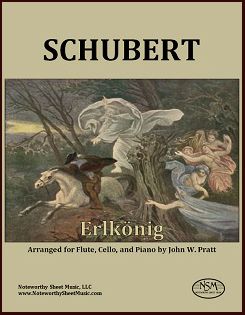 Erlkönig, Franz Schubert
Arranged for Flute, Cello, and Piano by John W. Pratt
Piano Score and Parts for Flute and Cello; PDF $11.99
Franz Schubert (1797-1828), inspired by reading Goethe's poem, wrote his song "Erlkönig" in a few hours in 1815. The song was an immediate hit, and continues to be popular to the present day. Numerous transcriptions have been prepared, but surprisingly none that we found for flute, cello, and piano. John Pratt has created such a trio arrangement, listed here, and also a duet version of the piece with Schubert's solo part adopted without change but with a less punishing alternative to Schubert's piano accompaniment.
Excerpted from Mr. Pratt's © preface:
"In the trio arrangement, the flute provides a natural voice for the child and for the mysterious Erlking, whose words are in the child's head. The cello makes a natural father. The narration is mostly given to the cello also, but the flute takes over when the child is mentioned in bars MM 24-30, and joins the cello when the ride is ending in anguish and distress (MM 139-145). The piano is treated as a member of a trio rather than an accompaniment to a voice singing words. The presence of the cello helps free the piano from the constant pounding and allows it to employ a wider range of expressive sonorities than Schubert's, befitting the absence of words. One might view the result as a kind of tone poem."
Preview