
Bach - Prelude & Fugue - String Quintet
 Prelude and Fugue, WTC Book I, No.22, by J. S. Bach
Transcribed for String Quintet by John W. Pratt, PDF $16.00
Though written for keyboard, this Prelude and Fugue from Book I of Bach's Well-Tempered Clavier is wonderfully adaptable to an instrumental quintet. The Prelude, with its serene harmonic pacing, reveals an almost Schubertian sublime beauty, and the magical counterpoint of the five-part fugue emerges crystal-clear. The challenge for the players, as well as the pleasure, lies in ensemble achievements, not technical difficulties in individual parts.
Score, 6 pages; Parts, 2 pages each, for Violin I, Violin 2, Viola 1, Viola 2, and Cello
with an alternate part for Cello in place of Viola 2; Total, 20 pages.
PreviewBach - Prelude & Fugue - Wind Quintet
 Prelude and Fugue, WTC Book I, No.22, by J.S.Bach
Transcribed for Woodwind Quintet by John W. Pratt, PDF $16.00
Score, 6 pages; Parts, 2 pages each for Flute, Oboe (plus alternate Alto Flute), Clarinet, Horn, and Bassoon; Total, 20 pages.
PreviewBloom - From the Drawer - Tenor or Soprano and Saxophone Quartet
 From the Drawer, for Voice and Saxophones, by Peter H. Bloom
Contemporary Composition for Tenor or Soprano, with Saxophone Quartet
Score and Parts, PDF $13.99
Boston-based flutist Peter H. Bloom created two versions of his composition From the Drawer, the edition listed here for Tenor or Soprano with Saxophone Quartet (soprano saxophone, alto saxophone, tenor saxophone, and baritone saxophone) and a second edition for Tenor or Soprano with Flute (doubling Piccolo), Clarinet, Bassoon, and Horn; both editions have been published by Noteworthy Sheet Music. The score provides a musical setting for the intensely emotional poem by Constantine Cavafy. The composer suggests that the vocalist (depending on his or her performance style/background/aesthetic judgment) should free to employ amplification at his/her discretion.
Here are Mr. Bloom's comments about From the Drawer, taken from his preface (Copyright © 2015) to the edition:
"Constantine Cavafy’s 1923 poem, From the Drawer, captures the acerbic condition of longing, the impossibly private nature of affection, and the occultation of time. Its poignancy is universal; transcending gender, age, era, place, and even translation. Rather than rely on one particular translation of Cavafy’s text, I’ve drawn on a number of versions to arrive at a paraphrase that both informs and is shaped by the musical score.
The musical setting is a sonic image of the intensely emotional response to a flood of memory that informs the poet’s narrative: now pensive, now anxious, now wistful, now joyous, now fraught, now resigned, and ever mercurial." P. H. Bloom, September 19, 2015
Score, 14 pages; Tenor or Soprano part, 2 pages; Soprano Saxophone part, 4 pages; Alto Saxophone part, 3 pages; Tenor Saxophone part, 3 pages; Baritone Saxophone part, 3 pages; Total, 29 pages.
Preview=========================================================
We also offer a professionally-printed hard copy edition of From the Drawer for $23.78 plus a $5.95 shipping and handling fee. Due to prohibitively high international shipping rates, we ship print editions only to addresses in the USA. Please use the Contact Us form to let us know which hard copy publication(s) you would like to purchase, along with your email contact information and USPS mailing address. We will then send you a PayPal invoice for the sale and, once we receive notice from PayPal that you have paid for the item(s), we will ship your music to the address provided.
=========================================================
Bloom - From the Drawer - Tenor or Soprano, Flute, Clarinet, Bassoon, Horn
 From the Drawer, by Peter H. Bloom
Contemporary Composition for Tenor or Soprano, with Flute (doubling Piccolo), Clarinet in B-flat, Bassoon, and Horn in F
Score and Parts, PDF $13.99
Peter H. Bloom is a Boston-based flutist, whose original compositions and arrangements are published by Noteworthy Sheet Music. From the Drawer was written for Tenor or Soprano, with Flute (doubling Piccolo), Clarinet, Bassoon, and Horn, and provides a musical setting for the intensely emotional poem by Constantine Cavafy.
The musical setting is a sonic image of the intensely emotional response to a flood of memory that informs the poet’s narrative: now pensive, now anxious, now wistful, now joyous, now fraught, now resigned, and ever mercurial." P. H. Bloom, September 19, 2015
Our sheet music edition of From the Drawer was featured on the New Products page of the Summer 2016 edition of "The Flutist Quarterly", journal of The National Flute Association.
Score, 14 pages; Tenor or Soprano part, 2 pages; Flute part, 4 pages; Clarinet part, 3 pages; Bassoon part, 3 pages; Horn part, 3 pages; Total, 29 pages.
=========================================================
We also offer a professionally-printed hard copy edition of From the Drawer for $23.78 plus a $5.95 shipping and handling fee. Due to prohibitively high international shipping rates, we ship print editions only to addresses in the USA. Please use the Contact Us form to let us know which hard copy publication(s) you would like to purchase, along with your email contact information and USPS mailing address. We will then send you a PayPal invoice for the sale and, once we receive notice from PayPal that you have paid for the item(s), we will ship your music to the address provided.
=========================================================
Brahms - Variationen über ein Thema von Joseph Haydn - arr. for Piano, Flute, Oboe, Bb Clarinet, and Bassoon
 Variationen über ein Thema von Joseph Haydn by Johannes Brahms
Arranged for Piano, Flute, Oboe, Bb Clarinet, and Bassoon by John W. Pratt (originally for two pianos or orchestra)
Piano Score and Parts for Flute, Oboe, Bb Clarinet and Bassoon, PDF $26.99
Johannes Brahms completed composition of his Variations on a Theme by Joseph Haydn in 1873. He wrote two versions of the work, one for two pianos, the other for orchestra. The two-piano version, written first, is not a piano reduction of the orchestral version, nor is the latter an orchestration of the former. When Brahms planned an orchestral work, he often wrote piano sketches first, but this is the only one he published separately, with its own opus number. Clearly he valued it as an independent piece, perhaps because (as the performance on YouTube by Lupu and Perahia shows) much of it has a lightness, charm, and wit unachievable by a full orchestra. The purpose of this arrangement, like our arrangement of Brahms's Opus 23 for the same instrumentation, is to create a chamber music version of some wonderful music combining much of the lightness of the piano version with a WW4’s contrasting and beautiful sonorities. Much of the piano part is drawn directly from Brahms’s piano parts. The wind parts, of course, draw mostly on the orchestral version, but with nowhere near as much doubling. —adapted from JWP’s © foreword to the edition)
Score, 44 pages; Parts, 9 pages each; Total, 86 pages.
PreviewBrahms – Variationen über ein Thema von Robert Schumann – Pf, Fl, Ob, Cl, Bn
 Variationen über ein Thema von Robert Schumann, Op.23, by Johannes Brahms
Arranged for Piano, Flute, Oboe, Clarinet, and Bassoon by John W. Pratt
Piano Score and Wind Parts, PDF $16.99
- adapted from John W. Pratt’s foreword to the edition: Brahms’s Variations on a Theme by Robert Schumann, Op.23, were written in tribute to his friend, for piano four hands. Yet how often have you heard this exquisite masterpiece, in any form? Arranging it as a quintet for piano and winds allows realization of its implicit orchestral effects and incorporation of contrasting and beautiful woodwind sonorities while preserving its many special piano sonorities and its personal, chamber music qualities and will, hopefully, encourage performance. The variations range from delicately decorative (Var. I) to spectral (IV) to warmly Brahmsian (many) to bravura (IX) and even perhaps witty (V and VII). The final variation (X) is an amazing valedictory, a funeral march which becomes combined with the theme and is suffused throughout with sadness, solemnity, resignation, and reaffirmation, by turns and even simultaneously. Especially apt contributions by the woodwinds in this arrangement include, to mention just two, the appreciative chuckles accompanying the rollicking theme of Var. V and the chorale effect at the end of Var. X. At the same time, the arrangement allows the piano to fulfill its usual roles in chamber ensembles and to contribute some special colorings of its own, including the multi-octave filigree of Var. I, the layout of the accompaniments in the first part of Var. III and last part of Var. V, the bass rumbles of Var. IV and Var. X, and the two-hand octaves in Var. VI and Var. IX.
Listen to a computer-generated audio clip of the Theme; of course, real live instruments will sound even better:
The Preview below is a page of the score from Var. VI. Note that the score is presented in concert pitch.
Score, 28 pages; Flute, Oboe, B-flat Clarinet, and Bassoon parts, 4 pages each; Total, 48 pages.
PreviewFigueiredo - Na Rua Dos Meus Ciúmes - WW5
 Na Rua dos Meus Ciúmes, Traditional Fado
Arranged for Woodwind Quintet by Antonio F. Figueiredo
Parts and Score, PDF $10.00
Na Rua Dos Meus Ciúmes is a traditional Portugese fado, still highly popular among recording artists today. This passionate love song tells the story of the intense jealousy experienced by a girl upon seeing her lover pass by with another woman on the street near her home. Though her pain is palpable, the girl is proud and determined to endure her suffering resolutely and without tears.
Antonio Figueiredo was born in the Azores, Portugal, and now resides in Massachusetts. He grew up listening to (and falling in love with) fado music, with all its romance and passion, and its timeless themes of love, loss, jealousy, poverty, and the sea. Figueiredo is a bassoonist who plays regularly in various orchestras and chamber music groups in the Boston area. He enjoys arranging folk tunes for woodwind quintet, and he created this delightful and engaging arrangement of Na Rua Dos Meus Ciúmes for one of his own groups. The piece is scored for flute, oboe, clarinet in B-flat, horn in F, and bassoon.
"This brief piece is a charming addition to the quintet repertory." Read John Ranck's full review of Figueiredo's arrangement of Na Rua Dos Meus Ciúmes.
Score, 5 pages; Parts, 1 page each; Total, 12 pages.
PreviewLane - Danzas Mecánicas - Wind Quintet
 Danzas Mecánicas, by Peter Van Zandt Lane
Contemporary Composition for Wind Quintet, PDF $30.00
Peter Van Zandt Lane is a Boston-based composer and bassoonist. His compositions have been performed across the United States, as well as in Europe and South America, by acclaimed musicians and ensembles such as The Cleveland Orchestra, SIGNAL, International Contemporary Ensemble, Dinosaur Annex, New York Virtuoso Singers, Triton Brass, Xanthos Ensemble, East Coast Composers Ensemble, EAR Duo, Quux Collective, and NotaRiotous. He has written for chamber ensemble, wind ensemble, orchestra, and choir, and often employs the use of electronics in his works.
Lane's Danzas Mecánicas - for woodwind quintet (2011) is an exciting 3-movement, 10-minute piece of fairly high difficulty scored for flute, oboe, clarinet, horn, and bassoon. A recording of the piece performed by the Solar Winds Quintet at Slosberg Hall, Brandeis University, in October, 2013 can be heard on YouTube.
Score, 26 pages; Parts, 49 pages; Total, 78 pages.
PreviewMozart - Quintet, K.515, arr. Flute Quintet
 Quintet, K.515, by Wolfgang Amadeus Mozart
Arranged for Flute Quintet by John W. Pratt (originally for strings)
Score and Parts for Flute 1, Flute 2, Alto Flute 1, Alto Flute 2, and Bass Flute, PDF $26.50
Wolfgang Amadeus Mozart wrote six quintets for 2 violins, 2 violas, and cello. Two of these, K.515 in C major and K.516 in G minor, are generally regarded as high points in Mozart’s, and indeed all, chamber music. Performances of K.515 are infrequent, far less than such great music deserves, since there is not enough repertoire to support permanent string quintets and string quartets have an abundance of great music to play without needing to find an additional violist. Adaptation to flute quintet is thus particularly apropos, as its textural possibilities apply also to a flute quintet, and its musical and emotional content are well worth viewing through the prism of five flutes. Our edition includes a score as well as parts for two concert flutes, two alto flutes, and bass flute. (adapted from jwp’s foreword to the edition)
Score, 37 pages; Flute 1, 16 pages of music; Flute 2, 14 pages of music; Alto Flute 1, 16 pages of music; Alto Flute 2, 14 pages of music; and Bass Flute, 14 pages of music; Total, 124 pages.
PreviewMozart - Quintet, K.516 - arr. Flute Quintet
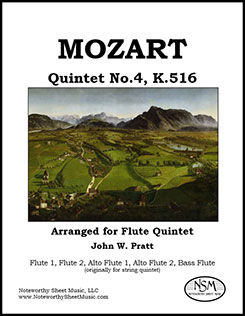 Quintet, K.516 by Wolfgang Amadeus Mozart
Arranged for Flute Quintet by John W. Pratt (originally for strings)
Score and Parts for Flute 1, Flute 2, Alto Flute 1, Alto Flute 2, and Bass Flute, PDF $23.50
Wolfgang Amadeus Mozart (1756-1791) wrote six quintets for 2 violins, 2 violas, and cello. Two of these, K.515 in C major and K.516 in G minor, are generally regarded as high points in Mozart’s, and indeed all, chamber music. Adaptation of K.516 to flute quintet is apropos, as its textural possibilities apply also to a flute quintet, and its musical and emotional content are well worth viewing through the prism of five flutes. In John Pratt’s arrangement, the work has been transposed up a step to better adapt to a flute ensemble. Our edition includes a score as well as parts for two concert flutes, two alto flutes, and bass flute.
Score, 30 pages; Flute 1, 14 pages; Flute 2, 13 pages; Alto Flute 1, 14 pages; Alto Flute 2, 13 pages; and Bass Flute, 11 pages of music; Total, 106 pages.
Preview