
Bach - Prelude & Fugue - String Quintet
 Prelude and Fugue, WTC Book I, No.22, by J. S. Bach
Transcribed for String Quintet by John W. Pratt, PDF $16.00
Though written for keyboard, this Prelude and Fugue from Book I of Bach's Well-Tempered Clavier is wonderfully adaptable to an instrumental quintet. The Prelude, with its serene harmonic pacing, reveals an almost Schubertian sublime beauty, and the magical counterpoint of the five-part fugue emerges crystal-clear. The challenge for the players, as well as the pleasure, lies in ensemble achievements, not technical difficulties in individual parts.
Score, 6 pages; Parts, 2 pages each, for Violin I, Violin 2, Viola 1, Viola 2, and Cello
with an alternate part for Cello in place of Viola 2; Total, 20 pages.
PreviewBloom - Ablaze She Came in the Dream - Flute, Viola, and Guitar
 Ablaze She Came in the Dream, by Peter H. Bloom
Contemporary Composition for Flute, Viola, and Guitar (or Electric Guitar)
Flute, Viola, & Guitar Parts and Score, PDF $22.97
Flutist Peter H. Bloom is no stranger to Noteworthy Sheet Music or to our customers, as he has contributed several popular arrangements and transcriptions to our catalog and he also serves as an editorial consultant for NSM.
Now we are very pleased to offer this newly published (2014) and highly intriguing original composition by Mr. Bloom entitled Ablaze She Came in the Dream. The piece comprises eleven brief episodes written for the unusual trio combination of flute, viola, and guitar (or electric guitar). Ablaze is intended to serve as an interpretive vehicle for the performers and thus should be executed freely and expressively. The work is suitable for advanced players.
Click to access a recording of the premier performance of Ablaze which took place on November 21, 2014 in Boston, MA, as part of the Church of the Advent Library Concert Series. The performance features Peter H. Bloom on flute, Frank Grimes on viola, and Anastasiya Dumma on electric guitar.
Score, 23 pages; Flute Part, 11 pages; Guitar Part, 12 pages; Viola Part, 12 pages; Total, 66 pages.
Preview====================================
We also offer a professionally-printed hard copy edition of Ablaze She Came in the Dream for $45.88 plus a $5.95 shipping and handling fee. Due to prohibitively high international shipping rates, we ship print editions only to addresses in the USA. Please use the Contact Us form to let us know which hard copy publication(s) you would like to purchase, along with your email contact information and USPS mailing address. We will then send you a PayPal invoice for the sale and, once we receive notice from PayPal that you have paid for the item(s), we will ship your music to the address provided for delivery in 7-10 business days.
Brahms - Drei Duette - 2 Voices and/or Instruments and Piano
 Drei Duette, Op.20, by Johannes Brahms
Transcribed for Mixed Voice, Instruments, and Piano by John W. Pratt
Score for Soprano, Alto, and Piano; Transcribed upper voice Parts for Violin/Oboe, Alto Flute, and A-Clarinet; and Transcribed lower voice Parts for Violin/Oboe, Alto Flute, A-Clarinet, and Viola; PDF $12.99
Composed in 1858–1860, the Drei Duette, Op. 20, for soprano and alto are the earliest of Johannes Brahms' duets and quartets for solo voices and piano. The three songs are titled Weg der Liebe (1. Teil), Weg der Liebe (2.Teil), and Die Meere. Except for brief canonic passages in No. 1, the voices have the same words, sung simultaneously, mostly in parallel thirds and sixths. The accompaniments are straightforward, without Brahmsian ensemble challenges but not without harmonic interest. Many have found the songs Mendelssohnian. The words come from the collection Stimmen der Völker of Johann Gottfried Herder (1744–1803). The first two are translations by Herder of two parts of a Northern English folk poem Love will find out the Way. The third is Italian in origin.
The vocal parts lie well for many instruments, opening the possibility of mixed voice and instrument, as well as fully-instrumental, performances. If one voice is replaced by an instrument, no words will be lost and the result will be a song with wonderful instrumental obbligato and piano accompaniment. If two instruments are used, the result is a beautiful "song without words." We include in our edition transcriptions of both voices for oboe/violin, alto flute in G, and clarinet in A, and of the lower voice for viola as well. Our transcriptions provide slurs to suggest a vocal style to instrumental players and to facilitate coordination of the instrumental parts with those of the voices. We also provide a re-notated piano/vocal score, in which repeat signs are used in the second and third songs to save page turns, rather than writing out the multiple stanzas as in the original. For those needing only the piano/vocal score, the Breitkopf & Härtel edition is in the public domain and freely available on imslp.org.
Piano/Vocal Score, 10 pages; Instrumental Parts, 3 pages each; Total, 42 pages.
PreviewFarrenc – Trio, Op.45 – Viola
 Trio, Op.45, by Louise Farrenc
Transcribed for Viola by C.A.Vater and J.W.Pratt (originally for cello)
Viola Part, PDF $9.99
The Farrenc Trio for Flute, Cello, and Piano, Op.45 is a big romantic piece, at times stirring, sweet, stormy, sad, dramatic, or lively, but always compelling throughout its entire four movements. As a flutist, I have enjoyed playing this piece many times, so I was intrigued and delighted to receive a request from flutist Peter H. Bloom that NSM prepare a transcription of the cello part for viola, so that his group Ensemble Aubade could perform a flute/viola/piano version. As Peter Bloom commented, the Trio is “not just a good piece to have been written by a woman in the 19th century; it’s a very good piece for anyone to have written anytime.” The Trio actually feels perfect for the viola, as most of the original cello part lies within viola range, and sections that do not can be modified for the viola tessitura without straying significantly from the composer’s musical intent. Our edition provides only the transcribed viola part; PDFs of the original score and flute part are freely available at imslp.org. —cav
Viola Part, 12 pages; Total, 16 pages.
PreviewHatton - Wreck of the Hesperus - Theatre Orchestra
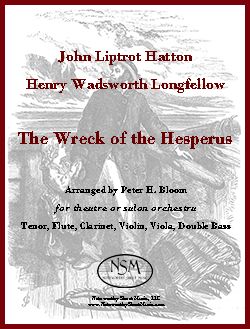 The Wreck of the Hesperus, by J. L. Hatton & H. W. Longfellow
Arranged for theatre or salon orchestra by Peter H. Bloom
Tenor, Flute, Clarinet, Violin, Viola, & Double Bass Parts, and Mini-Score ― PDF $19.98
The "dramatic scena" was an especially popular entertainment at its zenith in the mid-nineteenth century throughout the English speaking world. John Liptrot Hatton's setting of Longfellow's Wreck of the Hesperus is the very model of the dramatic scena at its finest, and a magnificent showcase for an heroic tenor. Longfellow's ballad recounts a chilling tale loosely based on conflated reports of two New England shipwrecks that occurred during a single devastating blizzard in 1839. This arrangement of Wreck of the Hesperus for theatre or salon orchestra was made for the now retired D.C. Hall's New Concert and Quadrille Band of Boston, and their extraordinary tenor Kevin McDermott. It can be heard on the Hall's Band's CD recording "Grand Concert," winner of the Noah Greenberg Award of the American Musicological Society. (excerpted from Peter H. Bloom's © foreword)
Click the mp3 icon to listen to an audio clip of Wreck of the Hesperus from the Hall's Band CD recording Grand Concert!. 
The D.C. Hall's Grand Concert! CD is available from NSM - click to access the page.
Tenor part, 4 pages; Flute part, 2 pages; Bb Clarinet part, 2 pages; Violin part, 2 pages; Viola part, 2 pages; Double bass part, 2 pages; Mini-Score, 8 pages; Total, 26 pages.
Preview===========================================
We also offer a professionally-printed hard copy edition of The Wreck of the Hesperus for $29.97 plus a $5.95 shipping and handling fee to addresses in the USA. Please use the Contact Us form to let us know which hard copy publication(s) you would like to purchase, along with your email contact information and USPS mailing address. We will then send you a PayPal invoice for the sale and, once we receive notice from PayPal that you have paid for the item(s), we will ship your music to the address provided.
Schade - Nocturne – Flute & Cello acc. by either Piano or Quartet – or, arr. for Flute Alone
 Nocturne, by William Schade
Schade’s original publication, re-notated and edited by NSM, plus an arrangement of the Nocturne for Unaccompanied Flute created by Peter H. Bloom
William Schade is primarily known today as the composer of fine pedagogical works for flute including sets of beautifully crafted caprices, impromptus, etudes, and progressive duets, but his career as a prolific and versatile performing artist should be celebrated as well. Noteworthy Sheet Music’s chief editorial consultant Peter H. Bloom happened upon the published score and parts for Schade’s Nocturne while exploring music collected by flutist, conductor, arranger Elmer Reade. Mr. Bloom was duly impressed with the beauty and expressiveness of the Nocturne; he created an arrangement of the piece for flute alone, and later suggested that NSM add the accompanied and unaccompanied versions of the work to our catalog. NSM now offers both original versions of William Schade’s Nocturne, those for Flute and Cello accompanied by either Piano or Quartet (Violin-1, Violin-2, Viola, Bass), plus the Bloom arrangement for flute alone. All editions have been re-notated and edited by NSM and include a foreword/preface written by Peter H. Bloom.
► Schade - Nocturne - for Flute and Cello with Piano Accompaniment
Schade provided a complete score for his version of the Nocturne for Flute and Cello with Piano Accompaniment. Since the published copy we came across wasn’t in great shape, we re-notated the score and parts using a modern music notation program. Note that we used a slightly modified and cleaned-up image of Schade’s lovely original publication cover on the inner covers for the flute and cello parts.
Piano Score, 7 pages; Flute part, 2 pages; Cello part, 2 pages; Total, 18 pages.
Preview, Flute & Cello, acc. by Piano
 ► Schade - Nocturne - for Flute and Cello with Quartet Accompaniment
Score, 13 pages; Parts for Flute, Cello, Violin-1, Violin-2, and Viola, 2 pages each; Bass part, 1 page; Total, 24 pages.
Preview, Flute & Cello, acc. by Quartet ► Schade - Nocturne – arranged for Unaccompanied Flute by Peter H. Bloom
As mentioned above, flutist Peter H. Bloom, having been moved by the uncomplicated eloquence of the Nocturne, adapted the work for flute alone—the flute in his arrangement is unaccompanied, yet evokes the entire original ensemble. The composer’s harmonies and counterpoint are elicited and unveiled by the soloist through judicious use of auditory illusion and “sleight-of-ear.” Mr. Bloom has performed his arrangement of the Schade Nocturne for solo flute in lecture/recitals for the New York Flute Club in 2008 and for the National Flute Association Annual Convention in 2026.
Flute part, 3 pages; Total,6 pages.
Preview, Unaccompanied Flute
Schubert – Erlking – Duo (Vo, Vc, Va, or Afl with Pf)
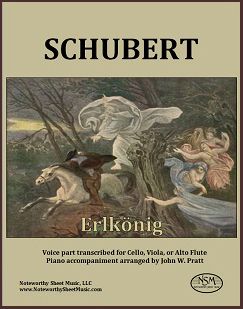 Erlkönig, by Franz Schubert
Arranged for Cello (or Viola or Alto Flute) and Piano by John W. Pratt
Piano Score and Parts for Cello/Voice, Viola, and Alto Flute; PDF $11.99
Franz Schubert (1797-1828), inspired by reading Goethe's poem, wrote his song "Erlkönig" in a few hours in 1815. The song was an immediate hit, and continues to be popular to the present day. John Pratt has created a trio arrangement for flute, cello, and piano (click for more information), and also the duo version offered here with Schubert's solo voice part transposed for cello (or viola or alto flute), and with a less arduous alternative to Schubert's piano accompaniment.
Excerpted from Mr. Pratt's © preface:
"In the duo arrangement, Schubert's solo part is adopted without change. Thus the piano must provide the entire accompaniment, but rocking triplets and other pianistically felicitous passagework replace Schubert's unremitting repetition. The range of sonorities is also wider than Schubert's, though more restrained than that of the trio arrangement, where the flute enlarges the musical terrain. This accompaniment is offered as a less punishing alternative to Schubert's, to be played with a singer or any solo instrument. Solo parts are provided for voice or cello, viola, and alto flute."
Piano score, 6 pages; Cello, Viola, and Alto Flute parts, 2 pages each; Total, 22 pages.
Preview